Audit Checklist Best Practices
Best practices for audit checklists, including scope, evidence, findings, actions, closure review, failure modes and sample wording.
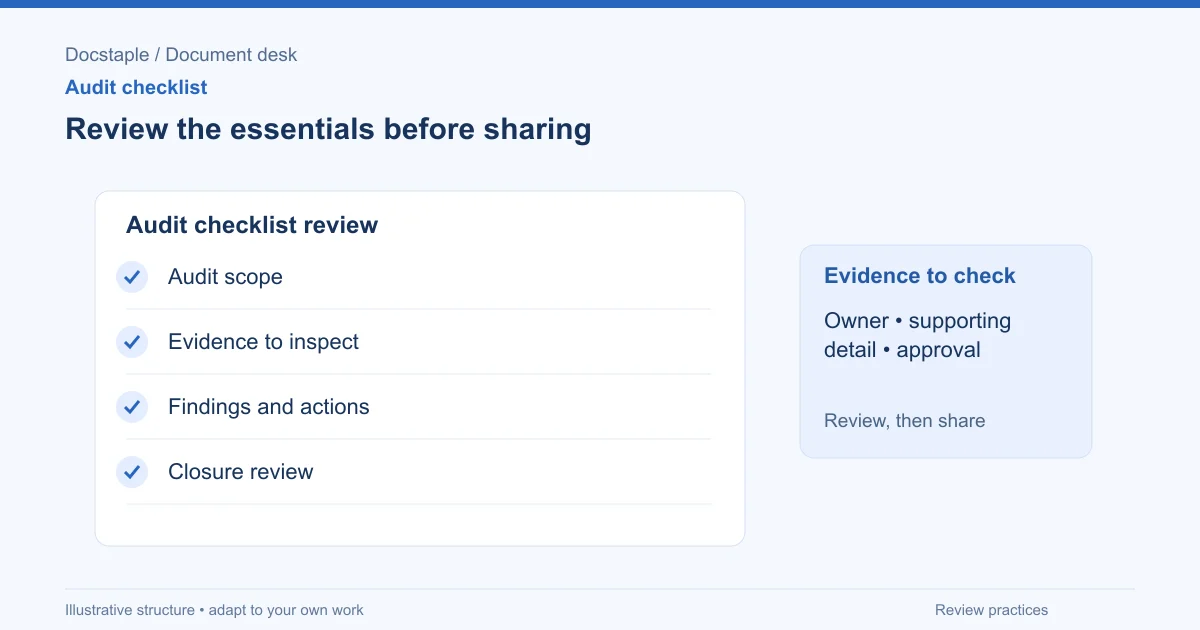
Audit checklist best practices are mostly about discipline. The checklist should focus the review, not replace thinking. It should help the reviewer inspect evidence consistently, record findings fairly and drive corrective actions to closure. When a checklist becomes a string of vague yes/no questions, it may create the appearance of control while hiding weak evidence.
Consider a consulting quality audit. A firm reviews several completed strategy engagements and wants to know whether final recommendations were supported by client-approved scope, interview evidence, analysis records and decision logs. A poor checklist asks, "Was documentation complete?" A stronger checklist asks which document, against which requirement, with what evidence and what action is needed if the answer is no.
Best practice 1: Scope before questions
Do not write checklist questions until the audit scope is defined. Scope sets the boundary for every answer. It prevents the reviewer from inspecting unrelated records and prevents the audited team from arguing later that the review covered something it did not.
A strong scope includes:
- Audit objective
- Process, project or location
- Time period
- Records or activities included
- Exclusions
- Reviewer
- Criteria sources
Draft language:
This audit reviews the strategy engagement closeout process for projects completed between 1 July and 30 September 2026. It covers statements of work, interview records, analysis workbooks, decision logs and final recommendation reports. It excludes billing and personnel performance review.
Failure mode: the checklist starts with "Are records complete?" and no one knows whether the reviewer should inspect drafts, final records, emails, chat threads or all of them. The result may be inconsistent across reviewers.
The EPA describes technical audits as systematic and objective examinations against planning documents and project goals (EPA quality management tools for projects). "Systematic" begins with a clear boundary.
Best practice 2: Tie every item to criteria
Criteria are the standards used to judge evidence. In a consulting audit, they may come from a client contract, internal quality procedure, information security policy or approved project plan. In a construction audit, they may come from drawings, specifications, permit conditions, inspection test plans or safety procedures.
Each checklist item should be traceable:
Requirement: QP-04 section 5 requires material scope changes to be recorded in the decision log before final report issue. Evidence: decision log and final report change history.
Without criteria, the reviewer may be right but unable to prove the basis. Worse, two reviewers may apply different expectations.
Failure mode: the checklist includes "Good client communication maintained" as a pass/fail item. That may be useful as a discussion prompt, but it is not an audit criterion unless the required communication standard is defined.
Your checklist should show humility about its own authority: identify what the review is against and avoid implying certification beyond the evidence.
Best practice 3: Ask for evidence, not confidence
Audits depend on evidence. A reviewer may interview people, inspect records or observe work, but the checklist should say what evidence is expected.
Better item:
Does the engagement file contain the approved interview guide, interview schedule and interview notes for the sampled participants?
Weaker item:
Were interviews done properly?
Include a field for evidence limits. Sometimes a record is unavailable, a system log has rolled off, or a sample cannot be inspected because it contains restricted information. The checklist should not force the reviewer to pretend.
Draft evidence note:
Evidence inspected: interview guide v1.2, interview schedule, notes for participants A, C, F and H. Limitation: participant D notes were unavailable because the file is locked pending privacy review.
Failure mode: the checklist allows a pass based only on verbal assurance. Interviews can support an audit, but they should be recorded as the source and weighed against available records.
EPA quality program materials describe QA project plans as documents that identify quality activities needed to satisfy performance and acceptance criteria (EPA quality program FAQs). A checklist should similarly make evidence and acceptance visible.
Best practice 4: Classify findings carefully
Not every issue is the same. A missing required approval is different from an improvement suggestion. If the checklist treats both as "fail," the team may waste energy. If it treats both as "notes," serious issues may be ignored.
Useful categories:
- Conforming
- Nonconforming
- Observation
- Improvement opportunity
- Not applicable
- Not inspected
Draft finding:
Nonconformity: SOW section 4 requires written client approval for added workstreams. The audit found written approval for the margin workstream but no approval for the pricing sensitivity appendix. Effect: the final report may include work outside approved scope.
Draft improvement opportunity:
Improvement opportunity: The decision log is complete, but entries use inconsistent names for the same client sponsor. Standardizing names would make later review easier.
Failure mode: the checklist records "documentation issue" for both examples. That hides severity and makes action planning muddy.
Best practice 5: Make actions verifiable
Corrective actions should be specific, owned and verifiable. A checklist that says "team to improve process" does not give anyone a closure path.
Strong action fields:
- Finding reference
- Required action
- Owner
- Due date
- Verification evidence
- Closure reviewer
- Closure date
Add an escalation field when a missed action could affect a client deadline, regulated submission or safety-critical handoff. The checklist should show who must decide if the due date slips.
Draft action:
Action A-04: Engagement lead to obtain written client approval for the pricing sensitivity appendix or remove the appendix before final issue. Owner: [name]. Due: [date]. Verification evidence: approval email in decision log or revised final report without appendix. Closure reviewer: quality lead.
Failure mode: the action is "discuss with team." Discussion may be one step, but it is not correction unless the finding only required discussion.
EPA Region 1's QAPP guidance asks organizations to identify who is responsible for corrective actions and how they will be tracked to completion (EPA Region 1 QAPP guidance). That principle applies to ordinary business audits too.
Best practice 6: Close with limitations and approval
The closure section should record what the audit can and cannot support. If the reviewer only sampled five files, say so. If a system outage prevented log review, say so. If a finding remains open, do not bury it.
Closure review criteria:
- Scope was followed.
- Evidence limitations are recorded.
- Findings are classified and supported.
- Actions have owners and due dates.
- Verification evidence is defined.
- Open risks are accepted or escalated.
- Final approval is recorded.
Draft closure language:
The reviewer confirms the checklist was completed for the stated scope. Findings F-01 and F-03 are closed with evidence attached. Finding F-02 remains open and prevents final report issue until approval evidence is added or the appendix is removed. Limitations: chat records were not reviewed because they are outside the approved audit scope.
For a reusable Word structure, the consulting audit checklist template includes editable sections for scope, criteria, evidence, findings, actions, verification and approval. Treat it as a starting point and adapt the criteria to the audit you are actually performing.
Best practice is not a longer checklist. It is a checklist that makes the review fair, evidence-based and closable.
Last updated: September 26, 2026
Frequently Asked Questions
Related Articles
Audit Checklist Checklist: Review Your Audit Form Before You Use It
A practical audit checklist checklist with decision gates for scope, evidence, findings, actions and closure review.
Audit Checklist Examples: Scope, Evidence, Findings and Closure
Audit checklist examples for consulting work, covering audit scope, evidence to inspect, findings and actions, closure review and practical draft wording.
Business Continuity Plan Best Practices for Consulting Teams
Business continuity plan best practices for consulting teams, including critical services, recovery priorities, communications, exercises and review criteria.
Business Continuity Plan Checklist for Consulting Teams
A practical business continuity plan checklist for consulting work, covering critical services, recovery priorities, communications, exercises and review criteria.
Business Continuity Plan Examples: Consulting Scenarios and Recovery Priorities
Business continuity plan examples for consulting teams, with critical services, recovery priorities, communications, exercises and review criteria.
Confidentiality Agreement Best Practices
Best practices for drafting and reviewing confidentiality agreements, including confidential information, permitted use, exceptions, legal review and signatures.