Audit Checklist Checklist: Review Your Audit Form Before You Use It
A practical audit checklist checklist with decision gates for scope, evidence, findings, actions and closure review.
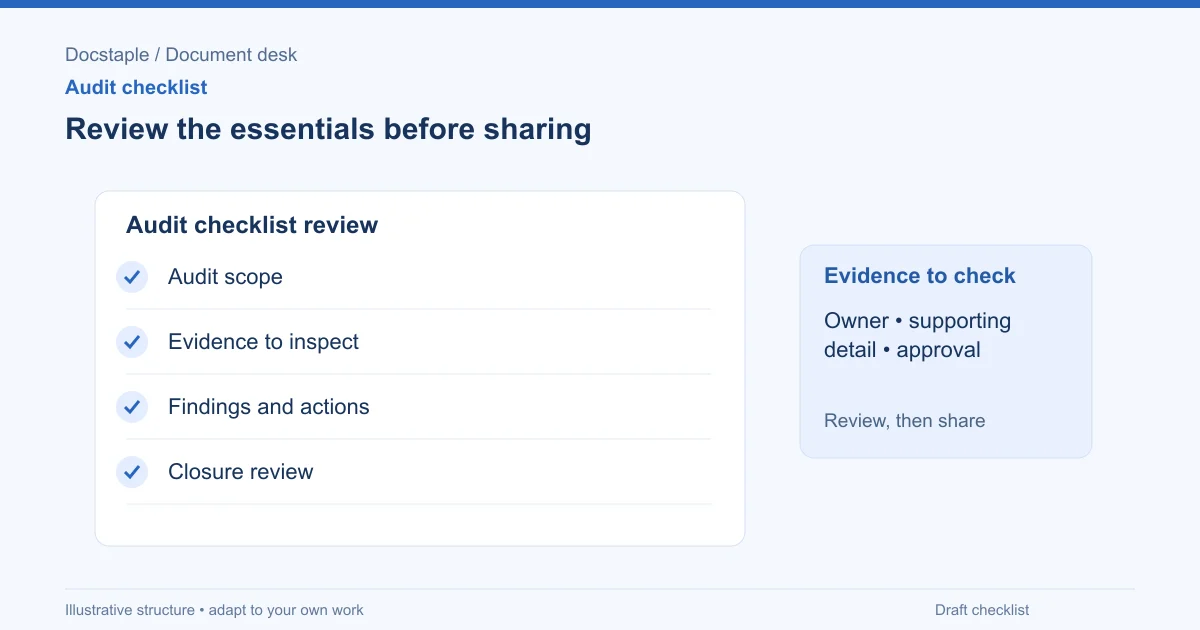
An audit checklist checklist is a review tool for the checklist itself. Before a reviewer uses a form in the field or against project records, someone should confirm that the form has a clear scope, names the evidence to inspect, records findings properly and includes a real closure step. Otherwise the audit may produce neat ticks and weak conclusions.
Use this scenario: a consulting firm has created a checklist for reviewing strategy engagement files before final client handoff. The first draft has promising headings but vague items such as "check evidence," "review decisions" and "confirm actions." Before it is used on ten client files, the quality lead reviews the checklist against the decision gates below.
Gate 1: Audit scope is specific
The first gate asks whether the checklist tells the reviewer exactly what is being audited. A checklist with no scope can drift into whatever the reviewer happens to notice.
Pass criteria:
- The audit objective is written as a decision.
- The period under review is stated.
- Locations, systems, projects or process steps are listed.
- Exclusions are named.
- The reviewer role is identified.
- The process owner or audit owner has approved the scope.
Draft language:
Scope: Review the Northstar strategy engagement file from kickoff through draft recommendations, including the statement of work, interview records, analysis workbook, decision log and draft report. Excluded: invoicing, staff performance review and unrelated account planning.
Fail signals:
- "Review project quality" is the full scope.
- No one can tell whether draft files are included.
- The checklist mixes finance, safety, HR and delivery questions without a stated audit objective.
- The reviewer can add or remove areas without approval.
The EPA describes technical audits as systematic and objective examinations against planning documents and project goals (EPA quality management tools for projects). That systematic quality starts with knowing what is inside the review.
Gate 2: Criteria are named
An audit compares evidence with criteria. If the checklist does not name the criteria, results become opinion. The reviewer may know what "good" looks like, but the report will not show the basis.
Pass criteria:
- Each section names the requirement source.
- Criteria are current and approved.
- The checklist distinguishes mandatory requirements from good-practice prompts.
- The checklist identifies jurisdiction or standard where relevant.
- The reviewer can cite the relevant clause, procedure or record.
Draft language:
Criterion source: signed statement of work section 3.2, quality procedure QP-04, client decision-record requirement dated 12 August 2026.
Fail signals:
- Items ask "acceptable?" without saying acceptable under what.
- The checklist references an old procedure number.
- The checklist imports regulatory-sounding language with no jurisdiction.
- "Best practice" items are treated as mandatory client requirements.
Be just as clear in your own checklist: identify whether you are auditing against a contract, policy, procedure, standard or improvement target. Do not imply that an internal checklist creates certification unless the audit program actually has that authority.
Gate 3: Evidence to inspect is concrete
This gate asks whether the reviewer can find the evidence without guessing. "Check training" is weak. "Inspect training attendance record for the three project analysts assigned before data handling began" is better.
Pass criteria:
- Each item lists the records, interview sources or observations to inspect.
- Sampling method is defined where not all records are reviewed.
- Evidence limitations can be recorded.
- The checklist avoids treating one example as proof of consistent performance unless that is the approved sample.
- Sensitive records are handled according to access rules.
Draft language:
Evidence to inspect: approved interview guide, interview notes for sampled participants, decision log entries approving changes to interview questions, and restricted-folder access record. Sample: five interviews selected across functions.
Fail signals:
- The checklist says "evidence attached" but not what kind.
- Reviewers can pass an item based only on verbal assurance.
- No field exists for unavailable records.
- Sample size is invented during the audit.
EPA quality materials describe quality project plans as documents that set out QA/QC requirements and technical activities needed to satisfy performance and acceptance criteria (EPA quality program FAQs). Your audit checklist should carry the same discipline at checklist scale: define the evidence before the review.
Gate 4: Findings require facts, effect and action
A finding should not be a complaint. It should say what requirement was not met, what evidence supports that conclusion and what effect or risk follows.
Pass criteria:
- The checklist has fields for requirement, evidence, result and effect.
- Finding categories are defined.
- Reviewers can mark conforming, nonconforming, observation, improvement opportunity, not applicable or not inspected.
- Process owners can add factual clarification.
- Required actions are linked to findings.
Draft language:
Finding: SOW section 3.2 requires written client approval for additional analysis. Evidence shows the margin analysis was approved by email on 5 September, but no approval was found for the pricing appendix. Effect: final advice may include work outside approved scope. Required action: obtain approval or remove appendix.
Fail signals:
- Findings read "team should improve documentation."
- No requirement is cited.
- The effect is exaggerated beyond the evidence.
- The action does not address the finding.
This gate protects both sides. The audited team can understand the issue, and the reviewer avoids unsupported conclusions.
Gate 5: Closure review is built in
An audit checklist is incomplete if it only records findings. It must also explain how actions will be verified and closed.
Pass criteria:
- Each action has an owner and due date.
- Required verification evidence is stated.
- Closure reviewer is named.
- Open findings cannot disappear without approval.
- Accepted risks are recorded by an authorized person.
- The final checklist is stored with supporting evidence.
Draft language:
Closure rule: A finding may be closed only when the closure reviewer confirms the required evidence is attached, or when the audit owner records written risk acceptance with reason and date.
Fail signals:
- "Done" is the only closure field.
- Actions have no owner.
- The same person who caused the gap can close the finding without review.
- Open findings are removed from the final version.
EPA Region 1's QAPP guidance asks projects to describe how assessment findings and corrective actions are documented, communicated and tracked to completion (EPA Region 1 QAPP guidance). That is the standard to borrow: action tracking is part of the audit, not an optional afterthought.
Gate 6: The checklist is usable under real conditions
The final gate is practical. Can a reviewer use this checklist without turning the audit into a paperwork marathon or a guessing game?
Pass criteria:
- Questions are short enough to apply consistently.
- Required evidence is available to the reviewer.
- Sensitive evidence is not copied unnecessarily.
- The checklist has room for notes and limitations.
- The form supports the audit workflow in Word or the chosen system.
- The approval record shows who authorized use.
Draft approval check:
Pre-use approval: The quality lead confirms that scope, criteria and evidence fields are complete. The process owner confirms the listed records exist and can be inspected. The audit owner approves the checklist for use on [project/process] for [period].
If the checklist fails one gate, fix it before use. If it fails several gates, it may be a topic list rather than an audit tool.
For an editable starting structure, the consulting audit checklist template includes Word sections for objective, scope, criteria, evidence, sampling, findings, corrective actions and approval. Adapt it to the exact audit, then run this checklist-of-the-checklist before issuing it.
The review takes a little time, but it prevents the expensive problem: an audit that looks complete and cannot support its own conclusions.
Last updated: September 26, 2026
Frequently Asked Questions
Related Articles
Audit Checklist Best Practices
Best practices for audit checklists, including scope, evidence, findings, actions, closure review, failure modes and sample wording.
Audit Checklist Examples: Scope, Evidence, Findings and Closure
Audit checklist examples for consulting work, covering audit scope, evidence to inspect, findings and actions, closure review and practical draft wording.
Business Continuity Plan Best Practices for Consulting Teams
Business continuity plan best practices for consulting teams, including critical services, recovery priorities, communications, exercises and review criteria.
Business Continuity Plan Checklist for Consulting Teams
A practical business continuity plan checklist for consulting work, covering critical services, recovery priorities, communications, exercises and review criteria.
Business Continuity Plan Examples: Consulting Scenarios and Recovery Priorities
Business continuity plan examples for consulting teams, with critical services, recovery priorities, communications, exercises and review criteria.
Confidentiality Agreement Best Practices
Best practices for drafting and reviewing confidentiality agreements, including confidential information, permitted use, exceptions, legal review and signatures.