Business Continuity Plan Examples: Consulting Scenarios and Recovery Priorities
Business continuity plan examples for consulting teams, with critical services, recovery priorities, communications, exercises and review criteria.
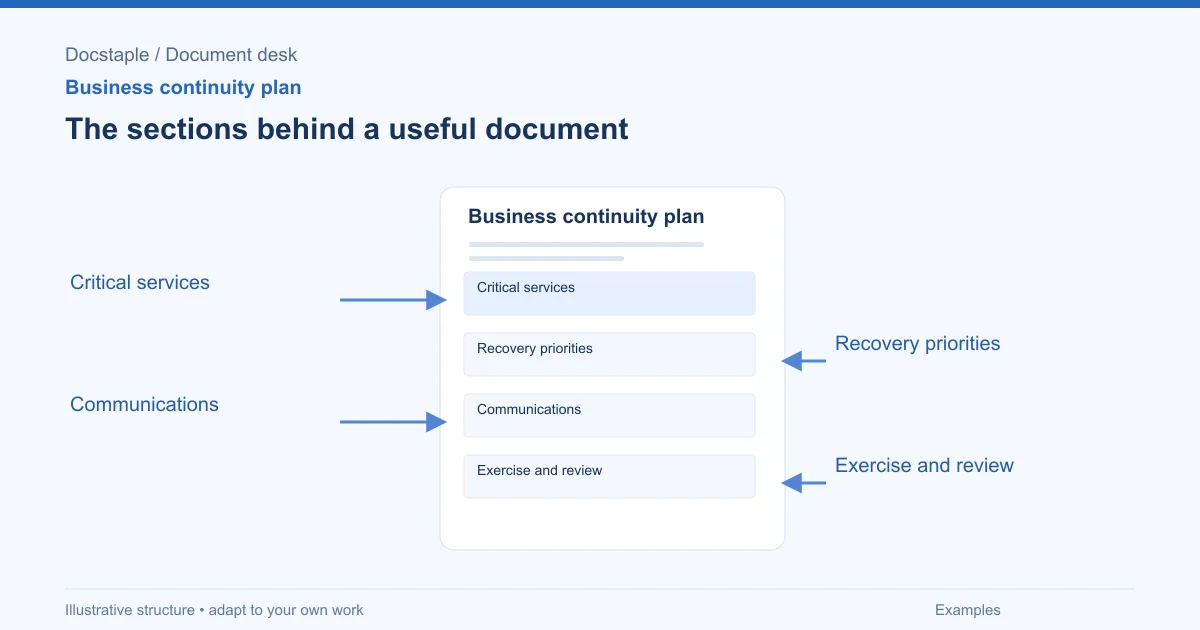
Business continuity plan examples help when they show decisions under pressure. A plan that says "restore normal service as soon as possible" sounds reassuring but does not tell a consulting team which client call, file, system or person matters first.
This guide uses a fictional consulting firm running a six-week strategy review for a regional distributor. The examples show how to document critical services, recovery priorities, communications, exercises and review. They are working examples, not guarantees of resilience.
Scenario: The Strategy Review Is Disrupted
The engagement is midway through discovery. Interviews are complete, analysis has started and the recommendations presentation is scheduled for the following week. On Monday morning, the firm's shared document platform is unavailable. The engagement lead is traveling, the analyst has the latest model on a laptop and the client sponsor wants to know whether the presentation date will move.
Ready.gov says business preparedness planning should include communications planning, IT support and recovery, and continuity plans, and notes that crisis communications are immediate because customers, employees, regulators and local officials may need information during an emergency (Ready.gov, United States). For a consulting firm, the "customer" is often a client sponsor who needs an honest status update before the team has perfect information.
Example 1: Critical Services
Start with the services that must continue, not with every task the firm performs. In this scenario, the critical services are client communication, secure access to current project records, analysis work needed for the recommendations report and the ability to hold the final presentation.
Draft language:
Critical service: Maintain the strategy review engagement at a minimum level during a disruption. Minimum operation means the client sponsor receives a status update, the team can access the latest approved scope and evidence register, and analysis can continue using approved backup records.
That wording avoids a common failure mode: listing tools instead of outcomes. "Restore SharePoint" is an IT task. "Access the latest approved scope and evidence register" is the business need. Ready.gov's business continuity plan template prompts organizations to identify recovery time objectives for business processes and information technology, as well as recovery point objectives for data restoration (Ready.gov BCP PDF).
For a consulting engagement, identify the critical service, minimum acceptable operation, owner and dependency:
| Critical service | Minimum operation | Owner | Dependency |
|---|---|---|---|
| Client communication | Sponsor update within agreed channel | Engagement lead | Current contact list |
| Evidence access | Latest approved scope and evidence register available | Project manager | Offline copy or alternate repository |
| Analysis | Analyst can continue from last verified dataset | Analysis lead | Current input file and assumptions log |
| Presentation | Meeting can proceed or be rescheduled with reason | Engagement lead | Client decision and materials |
Example 2: Recovery Priorities
Recovery priorities should follow business impact, not technical convenience. If the document platform fails, the first priority may be confirming which version is current, not recreating the entire folder structure.
Draft language:
Recovery priority 1: Confirm the current approved scope, next client commitment and status of the recommendations report.
Recovery priority 2: Restore access to the evidence register and analysis input file.
Recovery priority 3: Resume drafting of the recommendations report and agree whether the presentation date remains realistic.
NIST's contingency planning guide for federal information systems explains that contingency planning helps personnel evaluate systems and operations to determine planning requirements and priorities (NIST SP 800-34 Rev. 1). Although that publication is written for federal information systems, the principle transfers: priorities should be explicit before the disruption.
Avoid invented deadlines. Do not write "restore all files within two hours" because it sounds decisive. If the firm has not tested that capability, the plan should say "target to be confirmed by IT recovery test" or use an approved recovery objective.
Example 3: Communications
Continuity communication fails when nobody knows who may speak for the team. In the consulting scenario, the client sponsor needs one named contact and a short message that separates known facts from assumptions.
Draft language:
We are experiencing an outage affecting access to the project workspace. The team has confirmed access to the approved scope and the most recent evidence register. We are checking whether the analysis file in progress is current. We will send the next update by [time] through [channel]. No client action is needed yet.
The message does four things: it names the issue, states what is confirmed, states what is still being checked and gives the next update point. It does not blame a vendor or promise that the final presentation will happen before the team knows.
Your communications section should define activation authority, staff updates, client updates, supplier or subcontractor updates and approval for messages if normal systems are unavailable. Keep a current contact list somewhere the team can reach during the disruption.
Example 4: Workarounds and Recovery
A workaround is useful only if it has been checked. "Use personal email" may create confidentiality, retention and access problems. "Use the approved alternate workspace" is better, but only if people know how to access it.
Draft language:
If the primary project workspace is unavailable, the project manager creates an incident folder in the approved alternate repository and grants access only to the engagement team. The engagement lead confirms which documents may be moved before any client material is copied.
This is where consulting realities matter. The plan should cover confidential client materials, subcontractor access, version control and the handoff back to normal systems. A recovery section should also say who declares normal service restored. That declaration should require a check that records created during the workaround have been reconciled.
Exercise and Review Criteria
FEMA's continuity guidance says exercises help test capabilities, familiarize personnel with roles and responsibilities, and identify gaps; it also says plans are ongoing documents subject to regular, ideally annual, review and continuous revision (FEMA Continuity Guidance Circular). For a small consulting team, an exercise can be a 45-minute tabletop scenario rather than a full simulation.
Use an exercise with a concrete prompt:
The project workspace is unavailable at 9:00 a.m. The client presentation is tomorrow. The engagement lead is unreachable for two hours. Show how the team identifies the current version, updates the client sponsor and protects confidential files.
Review the plan against these criteria:
- Critical services: Are they written as business outcomes, not tool names?
- Recovery priorities: Has the service owner approved the order?
- Communications: Does each audience have an owner, channel and update rule?
- Workarounds: Has each workaround been tested with the people who would use it?
- Records: Can the team reconcile workaround files back into the approved repository?
- Review: Are contact details, assumptions and dependencies checked after exercises, incidents and major engagement changes?
Prepare a Continuity Draft
The consulting business continuity plan template is an editable Word document with sections for critical activities and priorities, activation and communication, workarounds and recovery, exercises and maintenance. Use it to turn the examples into a reviewed plan for your own engagement, with current contacts and tested workarounds.
A good continuity plan is not impressive because it is long. It is useful because, during a disruption, a tired person can find the next decision, the next owner and the next message without rebuilding the plan from memory.
Last updated: September 26, 2026
Frequently Asked Questions
Related Articles
Audit Checklist Best Practices
Best practices for audit checklists, including scope, evidence, findings, actions, closure review, failure modes and sample wording.
Audit Checklist Checklist: Review Your Audit Form Before You Use It
A practical audit checklist checklist with decision gates for scope, evidence, findings, actions and closure review.
Audit Checklist Examples: Scope, Evidence, Findings and Closure
Audit checklist examples for consulting work, covering audit scope, evidence to inspect, findings and actions, closure review and practical draft wording.
Business Continuity Plan Best Practices for Consulting Teams
Business continuity plan best practices for consulting teams, including critical services, recovery priorities, communications, exercises and review criteria.
Business Continuity Plan Checklist for Consulting Teams
A practical business continuity plan checklist for consulting work, covering critical services, recovery priorities, communications, exercises and review criteria.
Confidentiality Agreement Best Practices
Best practices for drafting and reviewing confidentiality agreements, including confidential information, permitted use, exceptions, legal review and signatures.