Business Continuity Plan Best Practices for Consulting Teams
Business continuity plan best practices for consulting teams, including critical services, recovery priorities, communications, exercises and review criteria.
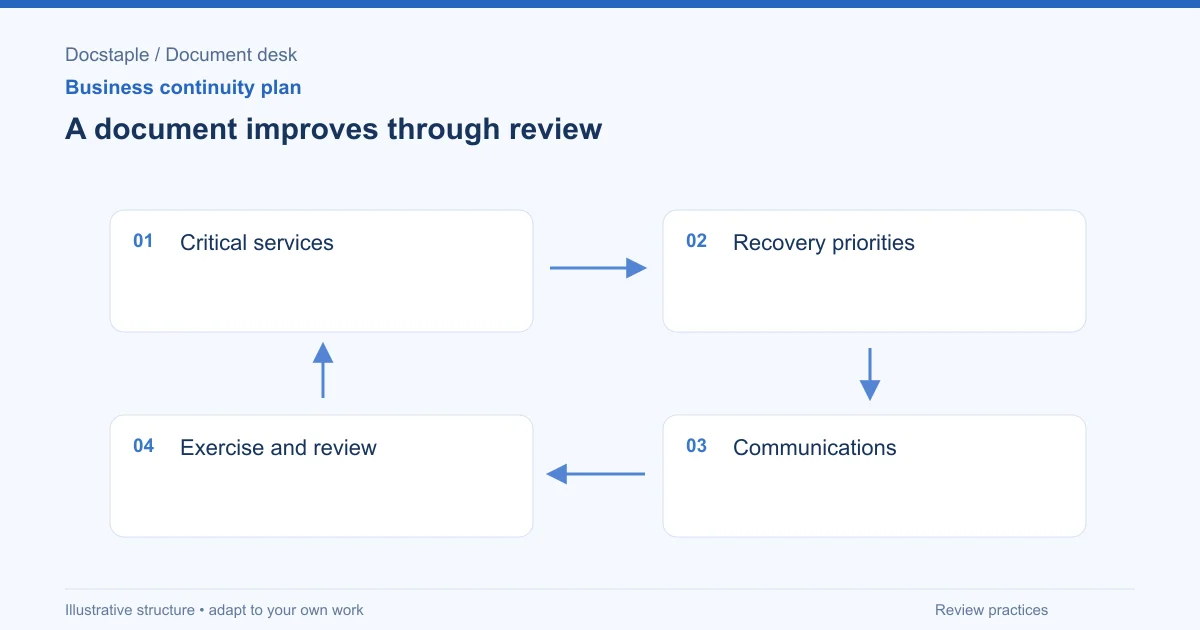
A business continuity plan is useful only if people can use it under pressure. A polished document that lists every possible disruption but never says which services come first will slow the team down. The strongest plans make a few hard choices before the disruption: which work matters most, what level of service is acceptable, who communicates, and how the plan is tested.
This guide uses a consulting scenario: a boutique advisory firm is halfway through a strategy review for a manufacturing client. The engagement team holds interview notes, financial extracts, a draft recommendations deck and a calendar of executive workshops. Then the firm's document platform is unavailable for a day and one senior consultant is unreachable. The continuity plan has to keep essential client work moving without leaking confidential material or pretending every deliverable is equally urgent.
Start with critical services
Do not begin with disasters. Begin with services. Ready.gov frames business preparedness around emergency planning, communications, IT support and continuity planning for businesses Ready.gov. NIST's contingency planning guidance also starts by evaluating operations and information systems to determine planning requirements and priorities NIST SP 800-34. For a consulting firm, that means asking what clients rely on you to do, not merely what tools you own.
In the scenario, the critical services are:
- keeping the client informed about the status of the engagement;
- preserving access to approved scope, interview evidence and current analysis;
- completing scheduled executive workshops or making a clear deferral decision;
- protecting confidential client material while using any workaround.
That list is more useful than "restore all systems." It tells the team which activities must continue at a minimum acceptable level. It also exposes dependencies: named consultants, client contacts, document repositories, conferencing tools, subcontractors and decision records.
Draft language:
During a disruption, the firm will prioritize the strategy review activities needed to protect client commitments, preserve confidential material and support agreed decision dates. The plan owner will identify the minimum service level for each critical activity before activating workarounds.
Review criterion: a person outside the project should be able to identify the firm's top three client-facing services and the records needed to continue them.
Set recovery priorities before the incident
Recovery priorities are not just technical targets. They are business decisions. NIST describes business impact analysis as a way to identify and prioritize information systems and components that support organizational mission and business processes NIST SP 800-34. Ready.gov also emphasizes planning for the restoration of critical business functions Ready.gov business plan brochure.
For the consulting team, priorities might look like this:
- Priority 1: maintain contact with the client sponsor and internal engagement lead.
- Priority 2: access the latest approved scope, contact list and safe copy of work-in-progress analysis.
- Priority 3: decide whether workshops proceed, move or pause.
- Priority 4: restore normal document workflows and reconcile any offline notes.
The best practice is to define recovery decisions in business terms. "Restore SharePoint within four hours" may be wrong if the real need is access to a read-only evidence pack and a secure way to brief the client. Conversely, a vague promise to "continue service" is not enough if nobody knows what to do first.
Use placeholders only after the business decision is made:
The engagement lead will aim to restore Priority 1 communications within [time target] and Priority 2 evidence access within [time target], using only approved contingency repositories listed in Appendix A.
Operational review criteria:
- Is every recovery priority linked to a named activity, not only a system?
- Are temporary workarounds approved for confidentiality and access control?
- Does the plan say who can accept degraded service or postpone a client event?
- Are assumptions visible, such as "finance data export available from last approved copy"?
Plan communications as a workstream
Continuity plans often fail quietly because communications are treated as an afterthought. The plan should say who activates updates, who approves external messages, which channels are used if normal systems fail and what information must not be shared casually.
NIST identifies crisis communications as a distinct plan type within contingency planning NIST SP 800-34 PDF. For consulting, communications also carry confidentiality risk. A rushed status note that includes client revenue numbers or employee interview details can create a second incident.
For the strategy review scenario, prepare three communication paths:
- internal team update, focused on assignments and workarounds;
- client sponsor update, focused on service impact and decisions needed;
- supplier or subcontractor update, limited to the information they need.
Short draft example:
Client update: We are experiencing a temporary outage affecting the project document workspace. The team has activated the continuity plan and is using the approved secure contingency copy of the workshop materials. Today's workshop can proceed at [time] if you approve use of the current pack by [decision time]. No interview notes will be circulated outside the approved workspace.
That wording separates facts, actions and decisions. It avoids overpromising a repair time and avoids exposing unnecessary detail.
Review criterion: every message template should make clear who sends it, who approves it, what channel is used and what must be excluded.
Make workarounds real enough to use
A workaround is not "use email." A workaround needs access, permissions, version control, security, people and a return-to-normal step. If the alternate process creates untracked files, the recovery may be worse than the outage.
For consulting work, define workarounds around deliverables:
- Interviews: reschedule, record manual notes in an approved local form, or pause if consent and confidentiality terms cannot be met.
- Analysis: use the last approved data export, mark assumptions and block new conclusions until the source is restored.
- Workshops: use a pre-approved contingency deck, prohibit live editing of confidential evidence, and record decisions in a temporary log.
- Client approvals: obtain written confirmation through the approved alternate channel.
Draft language:
Offline analysis may continue only from the most recent approved evidence pack. The analyst must mark the file "continuity copy," record the source version and reconcile all changes with the main workspace before the deliverable is released.
This is where a continuity plan becomes operational. It tells a real person what is allowed, what is blocked and what evidence must be retained.
Exercise and review the plan
Untested plans age quickly. NIST notes that testing, training and exercise activities help organizations determine a plan's effectiveness and help personnel understand their roles NIST contingency planning PDF. In a consulting firm, a tabletop exercise is often enough to expose gaps: old phone numbers, missing client escalation routes, inaccessible files, unclear authority or a workaround that breaches the engagement's confidentiality rules.
Run a simple exercise:
- Declare the document workspace unavailable for one day.
- Ask the engagement lead to activate the plan.
- Have the analyst find the approved evidence pack.
- Ask the client manager to draft a sponsor update.
- Record every delay, uncertainty and unsafe workaround.
Afterward, review the plan against these criteria:
- Critical services: were the true client-facing services identified?
- Recovery priorities: did the sequence match business impact?
- Communications: were messages accurate, calm and approved?
- Confidentiality: did the workaround avoid unnecessary sharing?
- Evidence: did the team record decisions and file versions?
- Maintenance: are contacts, repositories and authorities current?
The most important output is not a pass or fail label. It is an improvement list with owners.
Keep the document usable
A best-practice continuity plan is short enough to use and specific enough to guide action. Long appendices can hold contact lists and system details, but the first pages should answer: what is critical, who activates, what comes first, how we communicate and how we recover safely.
For a structured starting point, the consulting business continuity plan template includes editable sections for critical activities and priorities, activation and communication, workarounds and recovery, exercises, maintenance and approval. Use it as a working draft, then replace the example content with your own verified services, contacts, systems and decision rights.
Before issuing the plan, ask one final question: could a project lead use this document on a bad day without calling the person who wrote it? If not, simplify the wording, tighten the priorities and test it again.
Last updated: September 26, 2026
Frequently Asked Questions
Related Articles
Audit Checklist Best Practices
Best practices for audit checklists, including scope, evidence, findings, actions, closure review, failure modes and sample wording.
Audit Checklist Checklist: Review Your Audit Form Before You Use It
A practical audit checklist checklist with decision gates for scope, evidence, findings, actions and closure review.
Audit Checklist Examples: Scope, Evidence, Findings and Closure
Audit checklist examples for consulting work, covering audit scope, evidence to inspect, findings and actions, closure review and practical draft wording.
Business Continuity Plan Checklist for Consulting Teams
A practical business continuity plan checklist for consulting work, covering critical services, recovery priorities, communications, exercises and review criteria.
Business Continuity Plan Examples: Consulting Scenarios and Recovery Priorities
Business continuity plan examples for consulting teams, with critical services, recovery priorities, communications, exercises and review criteria.
Confidentiality Agreement Best Practices
Best practices for drafting and reviewing confidentiality agreements, including confidential information, permitted use, exceptions, legal review and signatures.