Business Continuity Plan Checklist for Consulting Teams
A practical business continuity plan checklist for consulting work, covering critical services, recovery priorities, communications, exercises and review criteria.
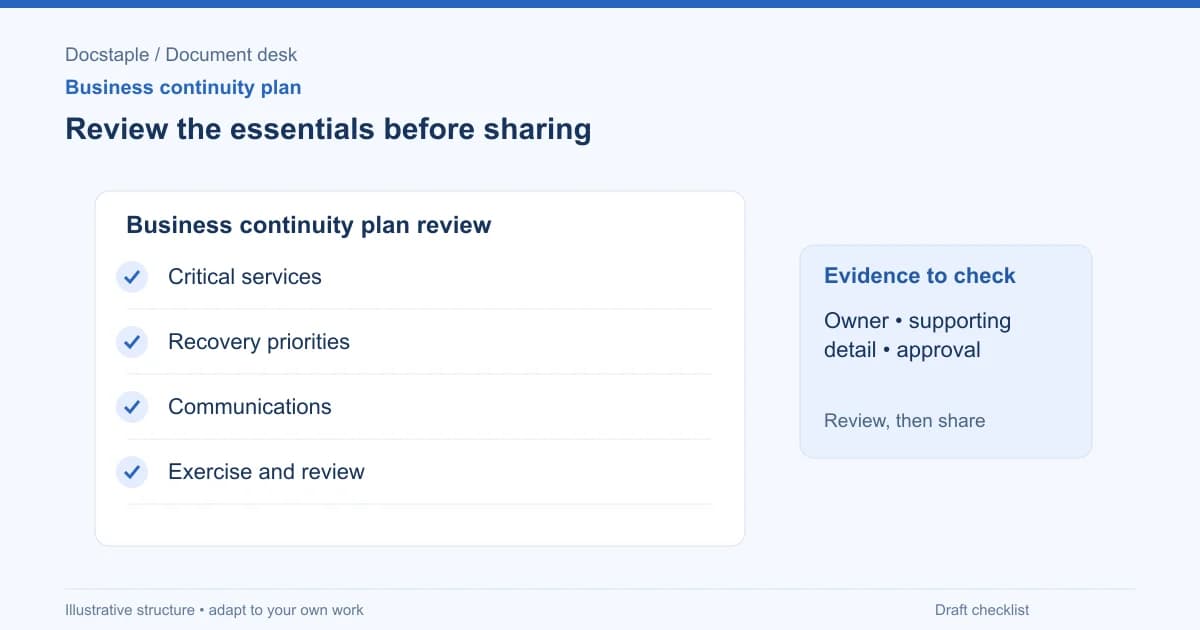
A business continuity plan checklist is useful only if it forces decisions. A tidy document that says "continue client service where possible" will not help a consulting team when the proposal library is offline, the engagement lead is unavailable, and a client presentation is due tomorrow. The checklist should make the team name the work that matters, the sequence for recovery, the people who can activate the plan, and the communications that need approval.
The scenario used here is a mid-sized consulting firm running a strategy review engagement. The team depends on interview notes, a recommendations report, client contact routes, a shared document repository, and a small group of senior reviewers. Adapt the checklist to your own services and contracts. A generic draft does not assure compliance, uninterrupted delivery or contractual performance.
Identify critical services
Start with services, not disasters. Ready.gov says a business impact analysis predicts consequences of disruption and gathers information needed to develop recovery strategies (Ready.gov business impact analysis). For a consulting firm, the critical service might be "deliver the board workshop pack by the agreed review date," not "keep laptops working."
Use these decision gates:
- What deliverable or client commitment would create the most serious harm if interrupted?
- Which activities are needed to keep that commitment at a minimum acceptable level?
- Which people, systems, records and suppliers does each activity depend on?
- Which activities can pause without immediate client, legal, safety or financial impact?
In the strategy review scenario, critical services might include scheduled executive interviews, analysis review, draft recommendation approval, and client updates. The supporting dependencies are more concrete: access to approved scope, interview log, draft report, project email, calendar, secure file storage, and the engagement lead's decision record.
Draft language:
Critical service: Prepare and issue the strategy review recommendations report. Minimum acceptable operation: the engagement lead can access current interview notes, the analyst can update the evidence table, and the client sponsor receives an approved status update within the agreed communication window. Dependencies: project repository, interview log, client contact list, senior reviewer, and approved scope.
Review criteria: every critical service should have a named owner, a clear minimum operating level, and at least one supporting record. If the service is described as a department name or a vague outcome, rewrite it.
Set recovery priorities
Recovery priorities should come from business impact, not from whichever system is easiest to restore. Ready.gov separates business continuity planning from IT disaster recovery and says an IT disaster recovery plan should be developed with the business continuity plan (Ready.gov emergency plans). NIST's contingency planning guide, written for U.S. federal information systems, also treats business impact analysis as part of developing recovery priorities and procedures (NIST SP 800-34 Rev. 1).
For consulting work, rank activities by harm and dependency:
- First: protect people, client confidential information, and the authority to communicate.
- Second: preserve live commitments such as workshops, interviews and decision meetings.
- Third: restore production work such as analysis, report drafting and review.
- Fourth: catch up deferred internal administration.
Avoid unsupported time promises. A checklist can ask for recovery targets, but the target should be approved by the owner who understands the client obligation and operational reality. "Restore all project files in two hours" is not a plan unless IT confirms that capability and the engagement lead accepts the tradeoff.
Draft language:
Recovery priority 1: preserve access to the approved scope, latest client contact list, and current recommendations draft. Recovery priority 2: confirm whether scheduled interviews proceed, move, or pause. Recovery priority 3: restore analysis workpapers and reviewer comments before non-urgent internal reporting.
Review criteria: each priority must identify the deciding role, the reason for the sequence, and any activity that intentionally waits. If two priorities compete for the same person, the checklist should expose that conflict.
Plan activation and communications
Continuity plans fail when nobody knows who can activate them or what to say. Ready.gov notes that advance planning helps business leaders respond promptly to communication needs during emergencies (Ready.gov emergency plans). In consulting, communications also need confidentiality discipline: an analyst should not improvise a client explanation about missing interview notes or a possible information incident.
Your checklist should ask:
- What events trigger plan activation?
- Who can activate the plan if the normal owner is unavailable?
- Which contacts are current, and where is the accessible backup copy?
- Which messages require approval before they go to clients, staff, subcontractors or suppliers?
- Which channels work if email, office access or the project repository is unavailable?
Concrete triggers for the strategy review engagement might include loss of access to the document repository, illness of the engagement lead before a client workshop, suspected disclosure of confidential interview notes, or an outage affecting scheduled remote interviews.
Draft language:
Activation authority: the engagement lead activates this plan. If unavailable for more than two hours during a client-facing disruption, the operations director may activate it. Client updates are approved by the engagement lead or operations director before release. Suspected disclosure of confidential client material is escalated to the firm's designated privacy or contract contact before external notification decisions are made.
Review criteria: every communication path should have a message owner, approval point, audience, backup channel and record location. Do not bury phone numbers in a live-only system that may be the thing disrupted.
Check workarounds and evidence
A workaround is not "use another tool." It is a tested substitute with access, instructions and limits. For example, if the consulting team says it can work from a local encrypted copy of the recommendations report, the checklist should ask who creates that copy, how often it is refreshed, who can open it, and how conflicts are reconciled when normal access returns.
Use a simple table during planning:
| Dependency | Workaround | Owner | Evidence | Limit |
|---|---|---|---|---|
| Project repository | Approved offline continuity folder | Engagement lead | Last refresh record | No new confidential interviews added while offline |
| Senior reviewer | Named backup reviewer | Practice director | Backup acceptance note | Backup cannot approve scope change |
This is where consulting adaptations matter. Subcontractors may have access to only part of the project record. Client systems may restrict downloads. Confidentiality terms may limit where backups can be stored. A continuity plan should route those constraints to the right reviewer instead of assuming convenience is allowed.
Review criteria: each workaround should be usable by the role named in the plan, supported by evidence, and limited where it could create new confidentiality, version control or scope problems.
Exercise and review the checklist
NIST says an information system contingency plan should be kept ready by training personnel for roles, exercising plans to validate content, and testing systems or components for operability in the specified environment (NIST SP 800-34 Rev. 1). Even when your consulting continuity plan is not a federal information system plan, that principle is useful: a plan you never exercise is mostly a hope.
Run a short tabletop exercise:
- Choose one realistic disruption, such as repository access failing four hours before a client workshop.
- Ask the named roles to follow the plan without extra explanation.
- Record unclear authority, missing contacts, inaccessible files and unrealistic recovery priorities.
- Assign corrective actions with owners.
- Update the plan and record the approval date.
Operational review criteria:
- Critical services are named as deliverables or obligations, not departments.
- Recovery priorities are justified by impact and dependencies.
- Activation authority includes backups.
- Staff, client and supplier messages have approval rules.
- Workarounds have been tested by the people expected to use them.
- Confidentiality, scope and client-system limits are visible.
- The exercise record includes failures, improvements and the next review date.
If you want a structured Word starting point, the consulting business continuity plan template includes sections for critical activities and priorities, activation and communication, workarounds and recovery, exercises and approval. Use it as an editable draft, then replace every example with verified facts.
Final approval check
Before issuing the plan, ask the approver to answer three questions in writing: does this reflect the current engagement, do the named people accept their roles, and are the recovery priorities realistic under the approved scope? Silence should not be treated as approval. Record approval, conditional approval or revision required, then keep both an editable master and the issued version where the team can reach them during disruption.
Last updated: September 26, 2026
Frequently Asked Questions
Related Articles
Audit Checklist Best Practices
Best practices for audit checklists, including scope, evidence, findings, actions, closure review, failure modes and sample wording.
Audit Checklist Checklist: Review Your Audit Form Before You Use It
A practical audit checklist checklist with decision gates for scope, evidence, findings, actions and closure review.
Audit Checklist Examples: Scope, Evidence, Findings and Closure
Audit checklist examples for consulting work, covering audit scope, evidence to inspect, findings and actions, closure review and practical draft wording.
Business Continuity Plan Best Practices for Consulting Teams
Business continuity plan best practices for consulting teams, including critical services, recovery priorities, communications, exercises and review criteria.
Business Continuity Plan Examples: Consulting Scenarios and Recovery Priorities
Business continuity plan examples for consulting teams, with critical services, recovery priorities, communications, exercises and review criteria.
Confidentiality Agreement Best Practices
Best practices for drafting and reviewing confidentiality agreements, including confidential information, permitted use, exceptions, legal review and signatures.