Change Request Examples: Scope, Schedule, Cost and Authorization
Practical change request examples for consulting projects, with annotated language for the reason, scope impact, schedule, cost, decision and authorization.
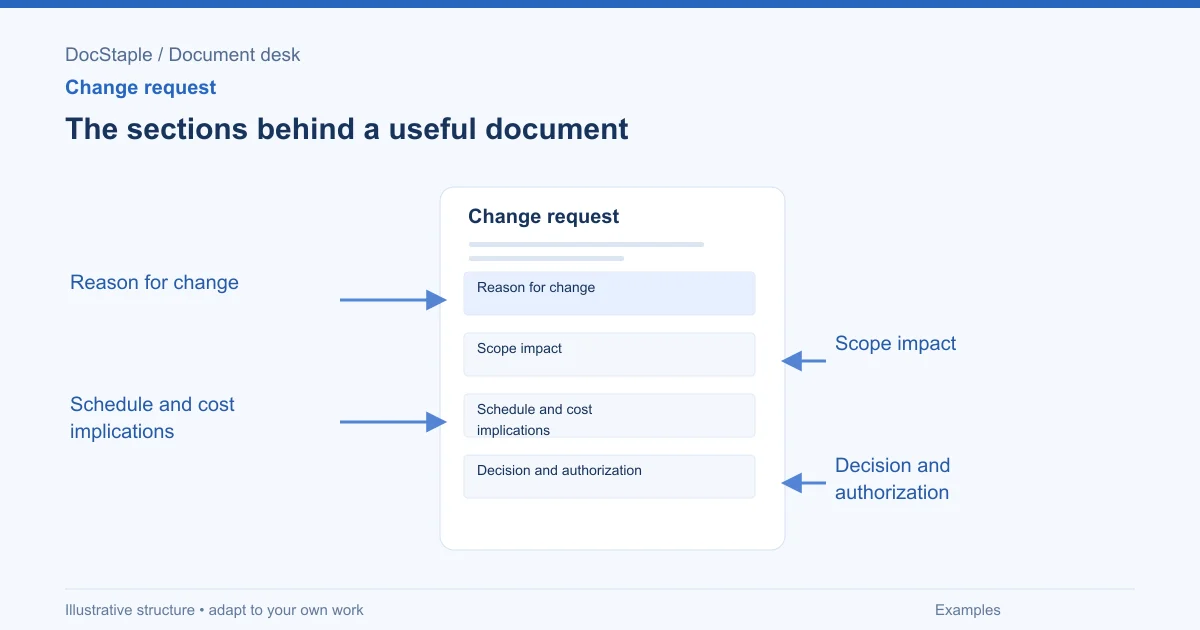
A change request is a pause button with a form attached. It gives the team a way to say, "This may be the right thing to do, but it changes the baseline. Let us show the effect before anyone treats it as approved."
The examples below use a fictional consulting project: a strategy review of customer onboarding. The original scope includes eight interviews, a current-state process map and a recommendations report. During discovery, the client asks for extra analysis, a new stakeholder group and an earlier executive presentation. These examples show how to write the request, not whether the request is commercially or legally acceptable in your situation.
Example 1: Add Interviews After Discovery Starts
Situation: The sponsor wants to add four implementation-team interviews because early findings suggest handoff issues.
Weak change request
Add more interviews with implementation because they may have useful information.
This states a task but not the baseline, impact or decision needed.
Stronger change request
Requested change: Add four implementation-team interviews to the discovery phase.
Reason: Initial interviews identified handoff delays that cannot be verified using the current interview group.
Baseline affected: Approved project brief dated [date], discovery plan limited to eight interviews.
Scope impact: Interview count increases from eight to twelve. Interview summary and evidence log will include the additional group.
Schedule impact: Discovery extends by [number] business days unless the client can schedule all four interviews by [date].
Cost impact: Additional fee of [amount] or use of [number] hours from the approved contingency, if applicable.
Decision needed: Sponsor to approve, reject or defer by [date].
The Federal Acquisition Regulation says government contract modifications include bilateral modifications signed by the contractor and contracting officer, as well as unilateral changes where authorized by contract clauses (FAR Part 43). That rule applies to U.S. federal procurement, not private consulting projects. The useful lesson is the formality: a material change should be recorded as a change to an approved baseline, not absorbed through informal conversation.
Example 2: Change The Deliverable Format
Situation: The statement of work calls for a written recommendations report. The client now wants a board presentation deck as well.
Requested change: Add a board presentation deck summarizing final recommendations.
Reason: Sponsor wants to brief the board on [date] using selected findings from the report.
Scope impact: New deliverable: up to [number] slides, based on the final report. Does not include new analysis, board-meeting attendance or redesign of client branding.
Schedule impact: Draft deck delivered [number] business days after sponsor approval of the report. If the board date remains [date], the report review deadline moves to [date].
Cost impact: [Amount], including one consolidated review round.
Authorization: Work starts only after written approval by [sponsor name].
Annotation:
- "Based on the final report" prevents the deck from becoming a second analysis project.
- "Does not include" names likely misunderstandings.
- "One consolidated review round" prevents endless slide revisions.
- The report review deadline is linked to the board date, so urgency has a visible trade-off.
Example 3: Move The Executive Presentation Earlier
Situation: The sponsor asks for final recommendations two weeks earlier because the leadership meeting moved.
Requested change: Move final presentation from [original date] to [new date].
Reason: Leadership meeting moved earlier.
Options assessed:
- Keep full scope and move the presentation only if client data is provided by [date].
- Present interim findings on [new date] and deliver final report on [original date].
- Reduce scope by removing [activity] and deliver final recommendations on [new date].
Recommendation: Option 2, because it supports the leadership discussion without removing evidence checks from the final report.
Decision needed: Sponsor to choose an option by [date].
This example shows that a change request does not always ask for yes or no. Sometimes it asks the decision owner to choose between trade-offs.
The Department of the Interior's service-contract checklist asks whether a statement of work specifies deliverables or requires progress reporting where contractor advice or recommendations may influence decisions (DIAR 1437.1). In a consulting change request, that same concern appears as: will the changed timing still give the client a reliable basis for decision?
Example 4: Add Implementation Support
Situation: After seeing draft recommendations, the client asks the consulting team to help implement two process changes.
Requested change: Add implementation support for recommendations R-02 and R-04.
Reason: Sponsor wants help turning approved recommendations into an action plan.
Baseline affected: Current engagement ends with delivery of the recommendations report and does not include implementation.
Scope impact: New work would include two planning workshops, action plan draft and handover meeting. It would not include project management of implementation, software configuration, staff training delivery or policy approval.
Schedule impact: New work begins only after final report acceptance. Estimated duration: [number] weeks.
Cost impact: To be priced as a separate phase or separate engagement letter.
Decision: Defer until final report is accepted, then approve a separate scope.
This is often the cleanest answer. If implementation is materially different work, do not stretch the old scope until it snaps.
Review The Decision And Authorization
Every change request should end with a decision block:
| Decision | Meaning |
|---|---|
| Approved | Baseline changes as described. Work may start after any stated conditions are met. |
| Approved with conditions | Baseline changes only if the listed conditions are satisfied. |
| Rejected | Baseline remains unchanged. |
| Deferred | No work starts. Request will be reconsidered on [date or event]. |
Add signatures or written approval references:
Approved by: [name, title]
Date: [date]
Conditions: [conditions or "none"]
Updated baseline documents: project brief v[x], status report dated [date], delivery plan v[x]
Do not treat silence as approval. If the sponsor verbally approves in a meeting, record it in minutes and ask for confirmation if your agreement requires written approval.
Also update the live project records after a decision. A change request that is approved but never reflected in the project brief, delivery plan, status report or invoice schedule becomes another source of confusion. Add a short implementation note:
Records to update: Project brief scope section, delivery plan milestone table, fee schedule and next weekly status report.
Update owner: Consulting delivery lead.
Update deadline: [date].
Verification: Sponsor receives updated baseline pack before changed work starts.
For rejected changes, keep the record. A rejected request can be useful later because it shows that the team considered the option and chose to keep the baseline. Use neutral wording:
Decision: Rejected.
Reason recorded by sponsor: Additional analysis is not needed for the current board decision.
Follow-up: Reconsider after final report if implementation planning requires more detail.
This avoids reopening the same request every week as if it had never been answered.
Start From An Editable Structure
The consulting change request template is an editable Word file with sections for requested change and reason, impact assessment, options, recommendation, decision and authorization. It is a starting record for scope control, not a substitute for the change procedure in your contract or engagement letter.
Last updated: September 26, 2026
Frequently Asked Questions
Related Articles
Change Request Best Practices for Client Delivery
Change request best practices for documenting the reason, scope impact, schedule and cost implications, and authorization before changed work starts.
Change Request Checklist for Reviewing Scope, Schedule and Cost
A change request checklist for consulting projects covering reason for change, scope impact, schedule and cost implications, and authorization.
Handover Document Best Practices for Client Delivery
Handover document best practices for completed work, outstanding actions, access, operating instructions, acceptance, and ownership.
Handover Document Checklist: Completed Work, Open Actions and Ownership
A practical handover document checklist for consulting work, with review gates for completed work, outstanding actions, access, operating notes and acceptance.
Handover Document Examples for Consulting Work
Handover document examples for consulting teams, covering completed work, outstanding actions, access and operating instructions, and acceptance and ownership.
How To Write A Construction Change Request
A construction-focused guide to writing a change request with scope, drawing impact, cost, schedule, site constraints, and authorization language.