Handover Document Checklist: Completed Work, Open Actions and Ownership
A practical handover document checklist for consulting work, with review gates for completed work, outstanding actions, access, operating notes and acceptance.
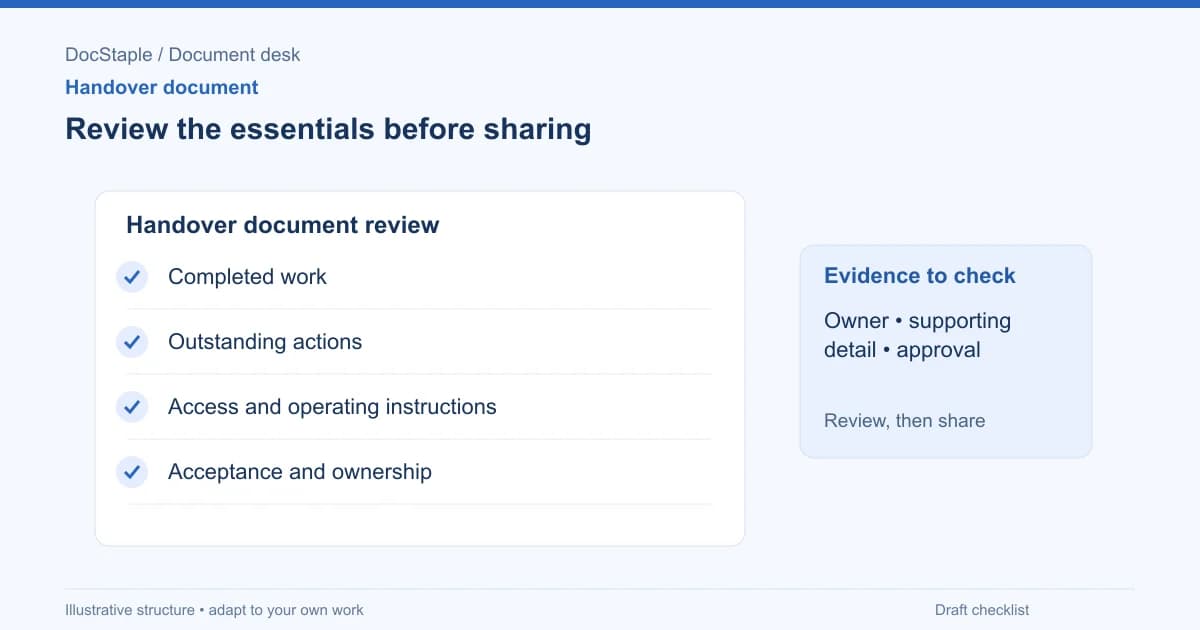
A handover document checklist is not a packing list for files. It is a readiness test for transferring responsibility. A useful checklist helps the incoming owner see what was completed, what remains unresolved, which systems or records matter, and what they are actually accepting.
This article uses a consulting scenario: a strategy review has finished, the final recommendations pack is ready, and ownership is moving from the consulting lead to the client operations manager. The checklist is operational rather than legal; it records status, evidence and responsibilities.
Start With The Transfer Boundary
Before reviewing details, check the boundary. A handover should say what is moving, when it moves and what stays outside the transfer.
Checklist items
- Handover purpose is stated in one paragraph.
- Effective date is clear.
- Outgoing and incoming owners are named.
- Included deliverables are listed by title and version.
- Exclusions are visible.
Worked example: clean boundary
This handover transfers the customer onboarding strategy review from [consulting lead] to [client operations manager] on [date]. It includes the final recommendations report, evidence log, decision register and open implementation-planning actions. It does not include implementation management, software configuration or legal review of customer-facing terms.
Decision analysis: this wording works because the incoming owner can accept the project records without accidentally accepting future implementation work. If the client expected the consultant to remain available for workshops, that belongs in a support-period or change section, not in a vague handover note.
Federal project closeout guidance from the Federal Acquisition Institute says closeout includes verifying scope completion, resolving discrepancies and completing deliverables (FAI Project Manager's Guidebook). That same logic fits a consulting handover: the boundary should match the approved scope, not someone’s memory of the project.
Add one more boundary test before moving on: ask what a reader might assume from silence. If the recommendations pack mentions a future training rollout, the handover should state whether training ownership is included, deferred or outside scope. Silence creates the worst kind of handover problem because everyone can later claim a different interpretation.
Verify Completed Work
Completed work should be reviewed against records. A checklist that says "report done" is too thin unless it identifies the report, version, location and acceptance status.
Checklist items
- Deliverable titles match the approved scope.
- Versions and dates are recorded.
- Storage locations are usable by the incoming owner.
- Evidence records are linked or identified.
- Known limitations are stated.
Worked example: evidence-based completion
Completed: Recommendations report v1.0, dated [date], stored at [location]. Supporting evidence log v0.4 lists interview notes, survey export and process map references. Sponsor comments from [date] are closed except item C-07, which is listed under outstanding actions.
Decision analysis: this entry separates completion from perfection. The report can be handed over while one sponsor comment remains open, but the unresolved item must appear in the action table. Without that link, the incoming owner might treat the report as fully settled.
Avoid phrasing like "all documents are complete" unless every required item has been checked. A better checklist asks whether the finished record would make sense to someone who did not attend the meetings.
For consulting work, evidence also needs a quality check. Confirm that the report does not cite interview notes the incoming owner cannot access, that file names match the document list, and that any client-sensitive material is stored in the approved location. A handover can fail even when the final report is excellent if the next owner cannot trace how the conclusions were reached.
Review Outstanding Actions
Open work is the place where handovers fail. Every action needs a responsible owner after the transfer, not just the name of the person who noticed it.
Checklist items
- Each open action has one owner.
- Next date or trigger is listed.
- Context explains why the action matters.
- Dependencies are shown.
- Escalation contact is named for blocked items.
Worked example: action table
| Open action | Owner after handover | Next date | Context | Escalation |
|---|---|---|---|---|
| Decide whether to fund recommendation R-03 | Client sponsor | [date] | Requires revised cost estimate from finance | Operations manager |
| Confirm process owner for onboarding dashboard | Client operations manager | [date] | Needed before implementation brief is drafted | Sponsor |
| Archive interview notes under retention process | Client PMO | [date] | Notes contain confidential business information | Records lead |
Decision analysis: this table is stronger than a task list because it gives the incoming owner a working map. The sponsor decision, dashboard ownership and archive step are different types of action. Treating them identically would hide risk.
The Federal Highway Administration describes closeout for state-grant projects as completing required work or deliverables and applicable administrative actions before closeout (FHWA Project Funds Management Guide Q&A). For a consulting handover, administrative actions may be file archiving, access transfer or final decision logging.
A second action review is useful for "waiting" items. Waiting is not a status unless the document says who is waiting, what they need and when it will be checked again. Replace "waiting on sponsor" with "client sponsor to confirm funding decision after finance provides estimate by [date]." That turns a passive note into a managed action.
Check Access And Operating Instructions
Access notes should help the incoming owner operate without exposing credentials. The checklist should confirm who grants access, where records live and how live documents should be maintained.
Checklist items
- Systems and repositories are named.
- Access approver is identified.
- Request path is included.
- Passwords and shared secrets are excluded.
- Operating rules are documented for living files.
Annotated sample language
Access to the evidence folder is controlled by [team]. The incoming owner should request access through [approved process]. The action tracker should remain in [location]; closed items should be marked closed with a date rather than deleted.
Why it works: the wording tells someone how to get access and how to maintain the file, while avoiding insecure credential transfer. If a file contains sensitive client or employee information, add the retention owner and any internal handling restriction.
Microsoft explains that tracked changes in Word must be accepted or rejected to remove markup; choosing a clean view only hides it temporarily (Microsoft Support). If your handover pack includes editable Word files, check that comments and tracked changes are intentionally resolved before issuing a final copy.
Confirm Acceptance And Ownership
Acceptance should not be a ceremonial signature. It should say what the incoming owner has reviewed and what remains conditional.
Checklist items
- Incoming owner acknowledges listed deliverables.
- Conditional items are named.
- Support period is stated, if agreed.
- Outgoing owner confirms status as of a date.
- Sponsor acceptance is captured when required.
Worked example: conditional acceptance
Incoming owner accepts custody of the deliverables listed in Section 2 and the open actions in Section 3, subject to receiving repository access by [date]. The outgoing owner remains available for clarification questions about the evidence log until [date]. This acknowledgment does not approve work outside the completed strategy review.
Decision analysis: this wording prevents a common mistake: treating acceptance as confirmation that no issues exist. The incoming owner can accept custody while preserving a condition about access.
Use The Checklist Before You Send
Run the checklist in sequence: boundary, completed work, outstanding actions, access, operating instructions and ownership. If one area is weak, fix it before asking for acknowledgment. The goal is not a longer document. The goal is a transfer record a busy incoming owner can use the next morning.
If the handover is urgent, mark unknowns directly instead of smoothing them over. "Evidence log access not yet confirmed; client PMO to confirm by [date]" is better than deleting the issue to make the document look finished. The receiving owner needs the true operating picture, especially when project staff will disperse after the transfer.
The consulting handover document template gives you an editable Word structure for scope, deliverables, open items, access notes, knowledge transfer and approval. Use it as a starting point, then replace every example with verified project facts.
Last updated: September 26, 2026
Frequently Asked Questions
Related Articles
Change Request Best Practices for Client Delivery
Change request best practices for documenting the reason, scope impact, schedule and cost implications, and authorization before changed work starts.
Change Request Checklist for Reviewing Scope, Schedule and Cost
A change request checklist for consulting projects covering reason for change, scope impact, schedule and cost implications, and authorization.
Change Request Examples: Scope, Schedule, Cost and Authorization
Practical change request examples for consulting projects, with annotated language for the reason, scope impact, schedule, cost, decision and authorization.
Handover Document Best Practices for Client Delivery
Handover document best practices for completed work, outstanding actions, access, operating instructions, acceptance, and ownership.
Handover Document Examples for Consulting Work
Handover document examples for consulting teams, covering completed work, outstanding actions, access and operating instructions, and acceptance and ownership.
How To Write A Construction Change Request
A construction-focused guide to writing a change request with scope, drawing impact, cost, schedule, site constraints, and authorization language.