How To Write A Construction Change Request
A construction-focused guide to writing a change request with scope, drawing impact, cost, schedule, site constraints, and authorization language.
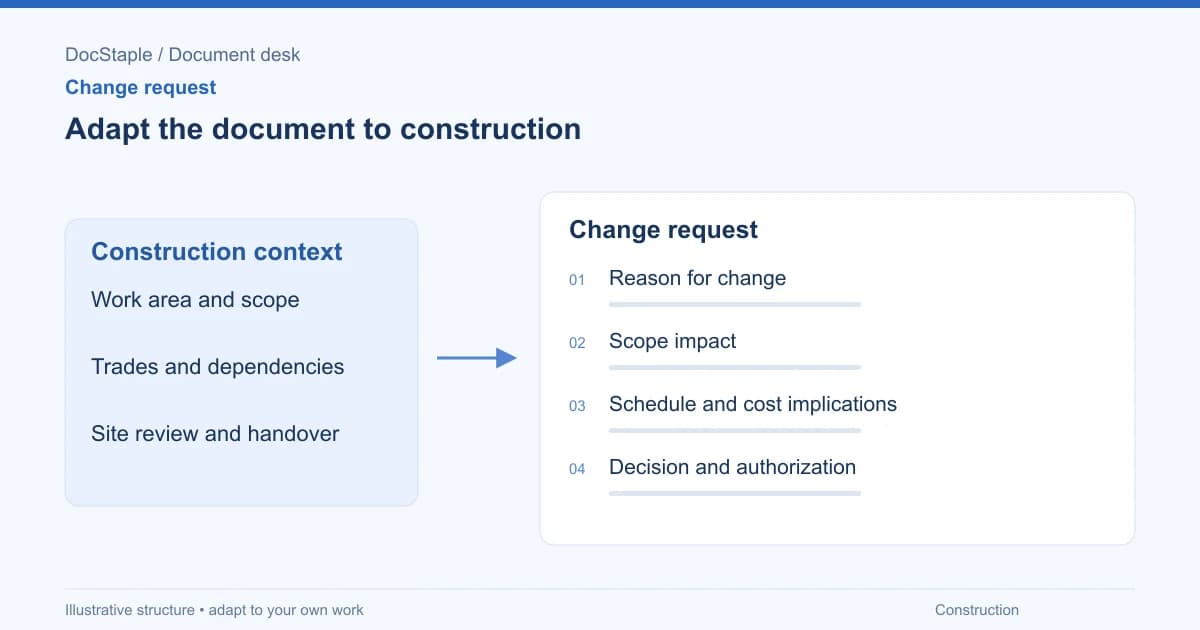
A construction change request has to do more than describe extra work. It must connect the requested work to drawings, site conditions, cost, schedule, safety constraints, and the person with authority to approve the change.
Use this scenario: a commercial fit-out project is underway. The approved drawings show standard floor boxes in a conference suite. During coordination, the client representative asks to upgrade to recessed connectivity boxes and add two wall-mounted displays. The subcontractor says lead times may affect inspection closeout.
The Federal Highway Administration says approval from the oversight agency is part of federal-aid procedures when contract changes are needed, and its construction program materials point users to guidance for contract changes and major revisions (FHWA change order guidance). That is a public highway context. For private work, your contract documents and local law control, but the approval principle is still useful: the right authority must approve the right change before it becomes the working instruction.
Step 1: Identify The Field Reason
The reason section should say why the approved work no longer fits. In construction, reasons often involve owner preference, discovered condition, coordination clash, code or inspection issue, unavailable material, or drawing clarification.
Weak wording:
Owner wants upgraded boxes and displays in the conference room.
Better wording:
Reason for change: Client representative requested recessed connectivity boxes and two wall-mounted displays in Conference Suite B to support hybrid meetings. Approved electrical drawings E-204 and AV schedule AV-02 show standard floor boxes and no wall display backing at that location.
Annotation: the stronger language names the request, business purpose, and affected drawings. It does not yet say the contractor agrees to cost, timing, or feasibility.
Add a site-status note:
Current site status: Framing is complete in Conference Suite B. Electrical rough-in is scheduled for [date]. Blocking for display mounts has not been installed.
That status note matters because the same change costs less before framing and more after finishes.
Step 2: Describe Scope Impact Precisely
A construction scope section should break the change into trade work and records.
Draft language:
Scope impact: Revise Conference Suite B to include [number] recessed connectivity boxes, power/data coordination for two wall-mounted displays, display backing/blocking, patching if required, and updated as-built records. This request does not include display procurement, display installation, network configuration, furniture relocation, or work outside Conference Suite B.
Annotation: this wording separates infrastructure from equipment and technology work. It protects the site team from accidentally absorbing owner-supplied items.
Decision analysis: if the displays are owner-provided, the change request should still identify mounting requirements, weight assumptions, blocking location, and coordination deadline. If the contractor supplies displays, the request becomes partly procurement and should address substitutions, warranty documents, and delivery risk.
For U.S. federal procurement, FAR Part 43 covers preparing and processing contract modifications, including construction and architect-engineer contracts (FAR Part 43). Do not cite it as controlling authority for a private tenant fit-out, but do borrow its habit of treating modifications as formal contract records.
Step 3: Show Schedule Effects At Activity Level
Construction schedule impact should be tied to activities, not just final completion.
Draft language:
Schedule impact: If approved by [date], rough-in can proceed with revised box locations and no expected delay to inspection closeout. If approved after rough-in, work may require rework, patching, and resequencing with drywall. Display backing must be confirmed before wall closure.
Annotation: this gives the decision-maker a timing consequence. It also tells the site manager which activity is at risk.
Second worked example: discovered slab obstruction.
Reason for change: Existing embedded obstruction prevents the floor-box conduit route shown on E-204. The obstruction was identified during layout on [date] and documented in photo log [reference].
Schedule impact: Proposed reroute adds [number] days if approved before saw-cutting begins. If decision is deferred, electrical rough-in in Conference Suite B will be held and may affect inspection sequencing.
This example is different from an owner upgrade. The first change is discretionary. The second is a field condition that blocks planned work. The request should not use the same tone for both.
Step 4: Break Out Cost Assumptions
Construction cost language should separate labor, material, subcontractor quotes, equipment, supervision, overhead or fee where applicable, and allowance or contingency treatment if the contract uses them.
Draft language:
Cost impact: Estimated change price is [amount], subject to final subcontractor quote. Estimate includes electrical labor, boxes, conduit adjustment, low-voltage coordination, backing installation, patching allowance, supervision, and approved markup. Estimate excludes owner-provided display hardware unless added by separate direction.
Annotation: “subject to final subcontractor quote” is useful only if the approver knows what remains unresolved. If the contract requires fixed pricing before approval, replace the estimate with the final quoted amount.
The Los Angeles Bureau of Engineering project delivery manual says its preliminary change order process is used to define proposed scope and obtain cost quotation and time impact analysis, while the finalized change order documents agreed scope, cost, and schedule adjustments (LA BOE change order finalizing). That is municipal guidance, but it is a clear model for separating proposal, negotiation, and contract amendment.
Step 5: Capture Decision And Authorization
Construction projects often have layered authority. The person requesting a change may not be the person allowed to approve cost or time.
Draft language:
Decision requested: Approve revised Conference Suite B connectivity scope, reject and keep approved drawings, or defer pending AV consultant review.
Authorization required: Written approval by [owner representative/title] and [contract administrator/title] before procurement or field rework begins. Site direction alone is not authorization unless the contract documents state otherwise.
Approval check:
| Check | Question |
|---|---|
| Drawing impact | Which sheets, sketches, or specifications change? |
| Trade impact | Which subcontractors or inspections are affected? |
| Site timing | Which activity will be delayed or resequenced? |
| Cost basis | Is the price final, estimated, allowance-based, or time-and-materials? |
| Authority | Who can approve cost and time changes? |
| Records | What photos, RFIs, quotes, or sketches support the request? |
Do not bury authorization in an email chain. Copy the approval reference into the change request or attach it in the project record.
Step 6: Update Site Records After The Decision
After approval, the change request is not finished until site records reflect it.
Update the drawing log, RFI log if relevant, change log, subcontractor direction, procurement tracker, inspection plan, and completion pack. If the change is rejected, tell the affected trades to proceed under the approved drawings and record any remaining constraints.
Worked decision: the client approves recessed boxes but rejects contractor-supplied displays. The approved change should say infrastructure only. The site completion pack should include revised box locations and display backing confirmation, but not a warranty for displays the contractor did not supply.
Second decision: the obstruction reroute is approved with a time extension but no added finish scope. The field team should document the reroute sketch, photo log, inspection implication, and revised rough-in date. Without those records, the closeout file will look inconsistent with the original drawing.
The construction change request template gives you an editable Word structure for reason, impact, options, approval and verification. Adapt it to the contract procedure, authority thresholds, and jurisdiction that govern your project.
Last updated: September 26, 2026
Frequently Asked Questions
Related Articles
Change Request Best Practices for Client Delivery
Change request best practices for documenting the reason, scope impact, schedule and cost implications, and authorization before changed work starts.
Change Request Checklist for Reviewing Scope, Schedule and Cost
A change request checklist for consulting projects covering reason for change, scope impact, schedule and cost implications, and authorization.
Change Request Examples: Scope, Schedule, Cost and Authorization
Practical change request examples for consulting projects, with annotated language for the reason, scope impact, schedule, cost, decision and authorization.
Handover Document Best Practices for Client Delivery
Handover document best practices for completed work, outstanding actions, access, operating instructions, acceptance, and ownership.
Handover Document Checklist: Completed Work, Open Actions and Ownership
A practical handover document checklist for consulting work, with review gates for completed work, outstanding actions, access, operating notes and acceptance.
Handover Document Examples for Consulting Work
Handover document examples for consulting teams, covering completed work, outstanding actions, access and operating instructions, and acceptance and ownership.