Handover Document Best Practices for Client Delivery
Handover document best practices for completed work, outstanding actions, access, operating instructions, acceptance, and ownership.
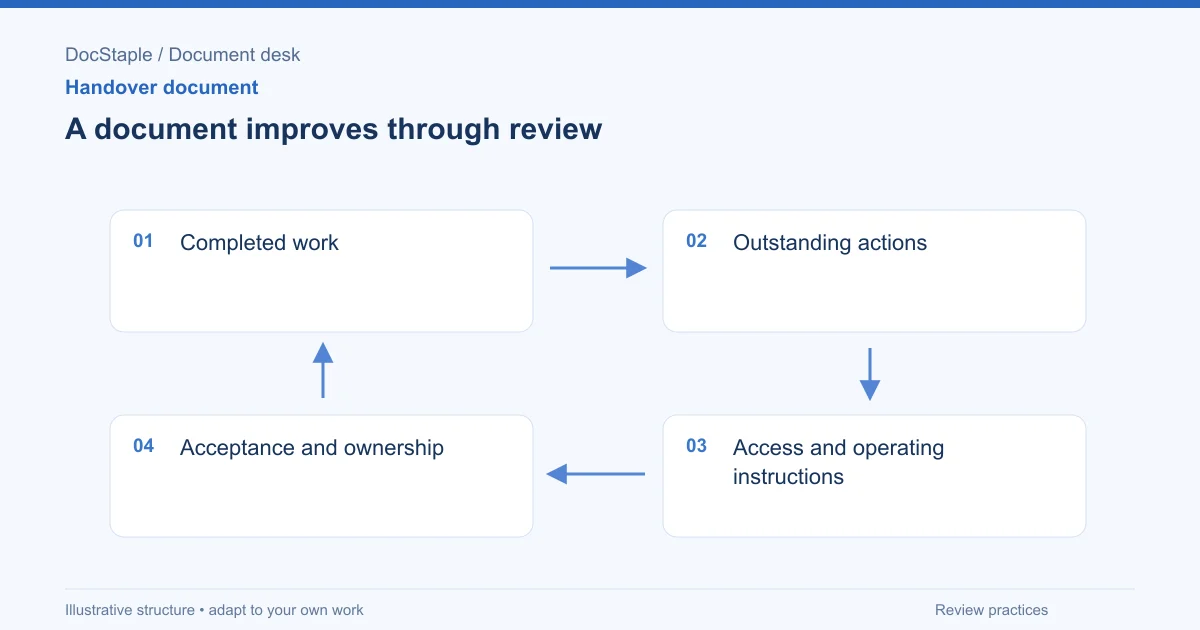
A strong handover document lets the next owner continue the work without guessing what is finished, what is fragile, and who owns the next move. It should feel like an operating record, not a goodbye note.
This article uses a consulting scenario: an engagement lead is transferring a strategy review engagement to another lead before the recommendations report is finalized. The handover must cover completed discovery, unresolved evidence questions, client access, and ownership of the final presentation.
HHS project completion guidance lists final deliverable acceptance, open issue resolution, final records, and knowledge transfer as key parts of project completion (HHS project completion guide). That guide is for a government project lifecycle, but the handover practices apply cleanly to client delivery work.
Record Completed Work So It Can Be Verified
“Mostly complete” is not a handover status. The incoming owner needs version names, locations, reviewers, and evidence references.
Weak wording:
Discovery is done and the report is almost ready.
Better wording:
Completed work as of [date]: Eight discovery interviews are complete. Findings matrix v0.4 is stored in [location]. Sponsor comments from [date] are incorporated through Section 3. Evidence references for recommendations R-01 through R-04 are listed in Appendix A.
Annotation: the better version makes the statement testable. The incoming lead can open the file, check the version, and see which recommendations have evidence.
Worked example: the outgoing lead says “client alignment is complete.” That might mean the sponsor agreed to the direction, or it might mean one stakeholder nodded in a meeting. The handover should use narrower language:
Client alignment status: Sponsor approved the recommendation themes in meeting [reference]. Finance has not approved the cost range for Option B. Operations supports Option B subject to implementation sequencing.
That is more useful than a broad claim because it shows where alignment exists and where it does not.
Turn Outstanding Actions Into Operating Items
Outstanding actions should have owners, dates, context, and consequences. A list of loose reminders only transfers anxiety.
Use a table:
| Open item | Owner | Due | Why it matters |
|---|---|---|---|
| Confirm cost range for Option B | Client sponsor | [date] | Needed before final recommendation wording |
| Update Appendix A evidence reference | Incoming lead | [date] | Prevents unsupported recommendation language |
| Schedule final presentation rehearsal | Project coordinator | [date] | Protects sponsor review date |
Decision analysis: if finance misses the Option B cost date, the incoming lead has three choices. They can delay the final report, present Option B with cost as an implementation dependency, or switch to Option A if the sponsor decides cost certainty matters more than operating fit. The handover should name that decision path instead of pretending the action is administrative.
Draft language:
If finance has not provided the cost range by [date], ask the sponsor whether to present Option B as evidence-led with cost pending, or to present both options without a preferred recommendation.
That sentence gives the incoming owner judgment context, not just a task.
Handle Access Without Exposing Secrets
A handover document may say whether access exists. It should not contain passwords, tokens, recovery codes, or shared credentials.
Draft language:
Access status: Incoming lead has access to the project folder, decision log, interview-note repository, and client review channel. Any credential transfer must use [approved secure process]. No passwords, tokens, or recovery codes are included in this handover.
NIST’s digital identity guidance describes authenticators as containing or comprising secrets, including passwords, private keys, and other shared secrets (NIST SP 800-63-4). For a business handover, that supports a simple rule: document access status and ownership, not the secret itself.
Operating instructions should then explain how to work safely:
Operating note: Use report v0.7 as the working file. Do not circulate Appendix C outside the named client reviewers because it contains confidential interview detail. Update the decision log before changing recommendation wording.
Annotation: this does not overexplain security. It gives the incoming owner exactly the practical boundary they need.
Define Acceptance And Ownership
A handover is incomplete until the incoming owner accepts what they have received, including known gaps. Acceptance does not mean every open item is solved. It means the right person now owns the next step.
Draft acceptance language:
Handover acceptance: Incoming owner confirms access to current files, understands the open items listed above, accepts ownership of assigned actions from [date], and has received knowledge transfer on recommendation logic and client decision history.
Conditional acceptance is often better than false confidence:
Accepted subject to access being granted to [repository] by [date]. Until access is confirmed, outgoing owner remains responsible for retrieving source interview notes.
The Federal Transit Administration’s closeout guidance says a project manager should prepare a checklist showing deliverables and submittals reviewed, inspected and accepted, then notify the contract administrator when the work is complete (FTA closeout guidance). That is procurement closeout guidance, but the acceptance habit is valuable for internal and client handovers too.
Preserve Decision Logic, Not Personal Memory
The hardest handover content is often not files. It is why the team currently believes one recommendation is better than another.
Worked example: two recommendations compete. Operations prefers Option B because it reduces handoffs. Finance prefers Option A because implementation cost may be lower. The outgoing lead has been carrying the nuance verbally.
Weak handover:
There is disagreement on Option A and Option B. Incoming lead should align stakeholders.
Better handover:
Decision logic: Draft report currently recommends Option B because interview evidence from operations, service, and sales identifies handoff delay as the main issue. Finance prefers Option A because the cost range may be lower. No confirmed budget cap appears in the decision log.
Add a boundary:
Do not change the preferred recommendation until the finance cost range is recorded or the sponsor instructs a different decision basis.
This language helps the incoming lead defend the current recommendation without becoming rigid. It separates evidence, opinion, and unresolved data.
Second worked example: the sponsor wants a final deck before the report is accepted. The handover should say:
Deck status: Draft executive deck is a summary of report v0.7. It should not be sent externally until sponsor comments on Section 4 are resolved. If the sponsor insists on early circulation, label slides 12-15 as draft findings pending evidence check.
That prevents a draft communication from being mistaken for an accepted deliverable.
Use A Clean Review And Storage Routine
Before issuing the handover, remove drafting instructions, check links, confirm owners, and store both editable and accepted copies. Microsoft recommends using Save a Copy before editing a shared Microsoft 365 file when you want to avoid overwriting the original (Microsoft Support).
Practical review sequence:
| Review point | What to confirm |
|---|---|
| Completed work | Versions, locations, reviewer status |
| Open actions | Owner, due date, reason, consequence |
| Access | Access confirmed or conditional |
| Instructions | Current file, prohibited circulation, update routine |
| Acceptance | Incoming owner accepts or states conditions |
| Storage | Editable master and accepted copy retained |
The consulting handover document template gives you an editable Word structure for completed work, outstanding actions, access, operating notes and ownership. Treat it as a transfer record that makes continuity possible.
Last updated: September 26, 2026
Frequently Asked Questions
Related Articles
Change Request Best Practices for Client Delivery
Change request best practices for documenting the reason, scope impact, schedule and cost implications, and authorization before changed work starts.
Change Request Checklist for Reviewing Scope, Schedule and Cost
A change request checklist for consulting projects covering reason for change, scope impact, schedule and cost implications, and authorization.
Change Request Examples: Scope, Schedule, Cost and Authorization
Practical change request examples for consulting projects, with annotated language for the reason, scope impact, schedule, cost, decision and authorization.
Handover Document Checklist: Completed Work, Open Actions and Ownership
A practical handover document checklist for consulting work, with review gates for completed work, outstanding actions, access, operating notes and acceptance.
Handover Document Examples for Consulting Work
Handover document examples for consulting teams, covering completed work, outstanding actions, access and operating instructions, and acceptance and ownership.
How To Write A Construction Change Request
A construction-focused guide to writing a change request with scope, drawing impact, cost, schedule, site constraints, and authorization language.