Handover Document Examples for Consulting Work
Handover document examples for consulting teams, covering completed work, outstanding actions, access and operating instructions, and acceptance and ownership.
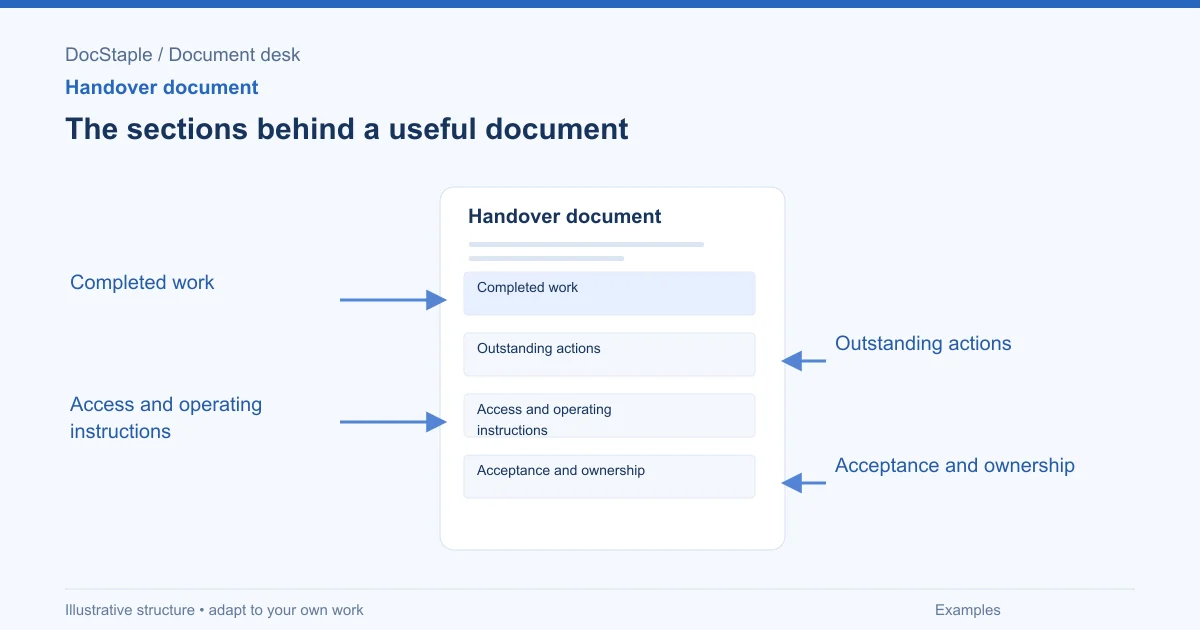
Handover document examples are useful when they show the difference between a vague farewell note and a record someone can operate from. This article uses a consulting engagement where an outgoing engagement lead transfers a strategy review to an incoming lead before the final recommendations meeting.
Project closeout guidance from HHS lists acceptance of final deliverables, open issues, lessons learned, archived records and knowledge transfer as key project-completion elements HHS project completion guide. The Federal Transit Administration's contract closeout best-practice page says a project manager should use a checklist showing deliverables and submittals reviewed, inspected and accepted, then notify the contract administrator when work is complete FTA closeout guidance. Those sources address government contexts, but the handover habits are broadly useful.
Example 1: Completed work
Weak draft:
Most discovery work is done and the report is nearly finished.
Stronger draft:
Completed work as of [date]. Discovery interviews are complete for operations, finance and sales. The findings matrix v[version] has been reviewed by [sponsor] and [subject matter expert]. The recommendations report v[version] includes Sections 1 to 4 and is stored in [location]. Evidence references are listed in Appendix A.
Annotation: the stronger version names status, versions, reviewers and location. The incoming owner can verify it.
Example 2: Outstanding actions
Weak draft:
A few items still need follow-up.
Stronger draft:
| Open item | Owner | Due | Context |
|---|---|---|---|
| Confirm cost range for Option B | Client sponsor | [date] | Needed before final recommendation |
| Add risk note on data definitions | Incoming lead | [date] | Based on decision log entry [number] |
| Schedule recommendation meeting | Project coordinator | [date] | Target week [number] |
Annotation: each row has one owner and a reason. "Follow up" is not enough; the incoming owner needs to know why the item matters.
Example 3: Access and operating instructions
Do not put secrets in the handover. Confirm systems, permissions and secure transfer route.
Access. Incoming owner has access to [document location], [project channel] and [client-approved folder]. Credentials, if any, are transferred through [approved secure process]. No passwords or tokens are included in this document.
Operating notes. Use report v[version] as the current working draft. Do not circulate Appendix C outside the named client reviewers because it contains confidential interview detail. Update the decision log before revising the recommendation table.
Annotation: this gives practical operating instructions without exposing credentials. It also highlights confidentiality risks.
Example 4: Acceptance and ownership
A handover should end with acknowledgment, not an assumption that the incoming owner has absorbed everything.
Acceptance. [Incoming owner] confirms receipt of current records, access to the working files, knowledge transfer on open items and ownership of the outstanding actions listed above. [Outgoing owner] remains available for [support period] for clarification on work performed before [date].
If acceptance is conditional, state the condition:
Accepted subject to access being granted to [folder] by [date]. Until then, [outgoing owner] remains owner of document retrieval.
Example 5: What not to include
Do not include passwords, unsupported opinions, private personnel comments, irrelevant chat history or unverified claims about client intent. Reference source records instead. If the handover relates to legal, regulated, safety or employment work, identify the jurisdiction and professional reviewer rather than pretending the handover document certifies compliance.
A strong handover protects continuity. Someone new should be able to find the current version, understand what is complete, see what remains open, access the right records and know who owns the next decision.
Worked example: transferring a live recommendation dispute
The hardest handover is not file transfer. It is the judgment call the outgoing lead has been carrying in their head. In this scenario, operations supports Option B because it simplifies handoffs, while finance prefers Option A because the cost range is lower. The final recommendations meeting is next week, and the incoming lead must take over without reopening every interview.
A weak handover says:
Client is split on Option A versus Option B. Incoming lead to align stakeholders before the meeting.
That leaves the new owner with a political problem and no trail. A better handover turns the dispute into operating context:
Open judgment call: Option B remains the draft recommendation because interview evidence from operations, service and sales points to handoff failures as the main source of delay. Finance prefers Option A due to lower estimated implementation cost. The cost range for Option B is not yet confirmed; sponsor asked finance to provide it by [date]. Do not change the recommendation table until that cost range is logged in decision entry [number] or the sponsor instructs otherwise.
Then add the transfer boundary:
Incoming lead owns: final recommendation wording, sponsor meeting preparation and update to decision log after finance response. Outgoing lead owns until [date]: factual clarification on interview history and file locations only. Client owns: cost confirmation and final selection of preferred option.
The competing choices are visible: preserve the evidence-led recommendation, switch to the lower-cost option or present both with the unresolved cost issue. The current draft favors Option B because the existing evidence points to operational delay, not because the outgoing lead likes it. That distinction helps the incoming lead defend the logic while staying open to new cost evidence.
If finance misses the date, the handover can include a default next step:
If no cost range is received by [date], present Option B as the evidence-led recommendation and mark cost confirmation as an implementation dependency, not as a completed analysis point.
This is the kind of detail a handover should preserve. It gives the new owner a next move, a source record and a boundary around what has not been proven yet.
The handover can also include the exact meeting stance the incoming lead should use. That is different from scripting them; it records the current logic so they do not have to reconstruct it under pressure.
Example stance:
In the sponsor meeting, present Option B first because it addresses the handoff delays found in the interview evidence. Present Option A as the lower-cost alternative if finance confirms the cost gap is material. Do not describe either option as final until sponsor records the cost decision.
This wording handles three competing pressures: the evidence favors Option B, finance has a legitimate unresolved concern and the sponsor still owns the final choice. The incoming lead can adjust tone in the room, but the decision logic remains anchored to the project record.
If the outgoing lead disagrees with the draft recommendation, say that plainly and professionally:
Outgoing lead view: Option B is stronger on operational fit, but Option A may be more realistic if implementation budget is capped below [amount]. No budget cap has been confirmed in the records reviewed.
That note is useful because it distinguishes an opinion from the evidence supporting it. It also tells the incoming lead exactly what to verify before changing the recommendation.
For a live handover, add the next three actions in sequence:
| Sequence | Action | Owner |
|---|---|---|
| 1 | Obtain finance cost range | Client sponsor |
| 2 | Update recommendation table | Incoming lead |
| 3 | Confirm meeting pack version | Project coordinator |
The order matters. Updating the table before the cost range arrives would be guesswork; sending the meeting pack before the table is updated would create version confusion.
Start from an editable Word draft
Use the consulting handover document template to transfer live files, open decisions, operating notes and ownership boundaries in one editable record.
Last updated: September 26, 2026
Frequently Asked Questions
Related Articles
Change Request Best Practices for Client Delivery
Change request best practices for documenting the reason, scope impact, schedule and cost implications, and authorization before changed work starts.
Change Request Checklist for Reviewing Scope, Schedule and Cost
A change request checklist for consulting projects covering reason for change, scope impact, schedule and cost implications, and authorization.
Change Request Examples: Scope, Schedule, Cost and Authorization
Practical change request examples for consulting projects, with annotated language for the reason, scope impact, schedule, cost, decision and authorization.
Handover Document Best Practices for Client Delivery
Handover document best practices for completed work, outstanding actions, access, operating instructions, acceptance, and ownership.
Handover Document Checklist: Completed Work, Open Actions and Ownership
A practical handover document checklist for consulting work, with review gates for completed work, outstanding actions, access, operating notes and acceptance.
How To Write A Construction Change Request
A construction-focused guide to writing a change request with scope, drawing impact, cost, schedule, site constraints, and authorization language.