How To Write A Consulting Change Request
A practical guide to writing a consulting change request, with scenario-based language for scope impact, schedule, cost, and client authorization.
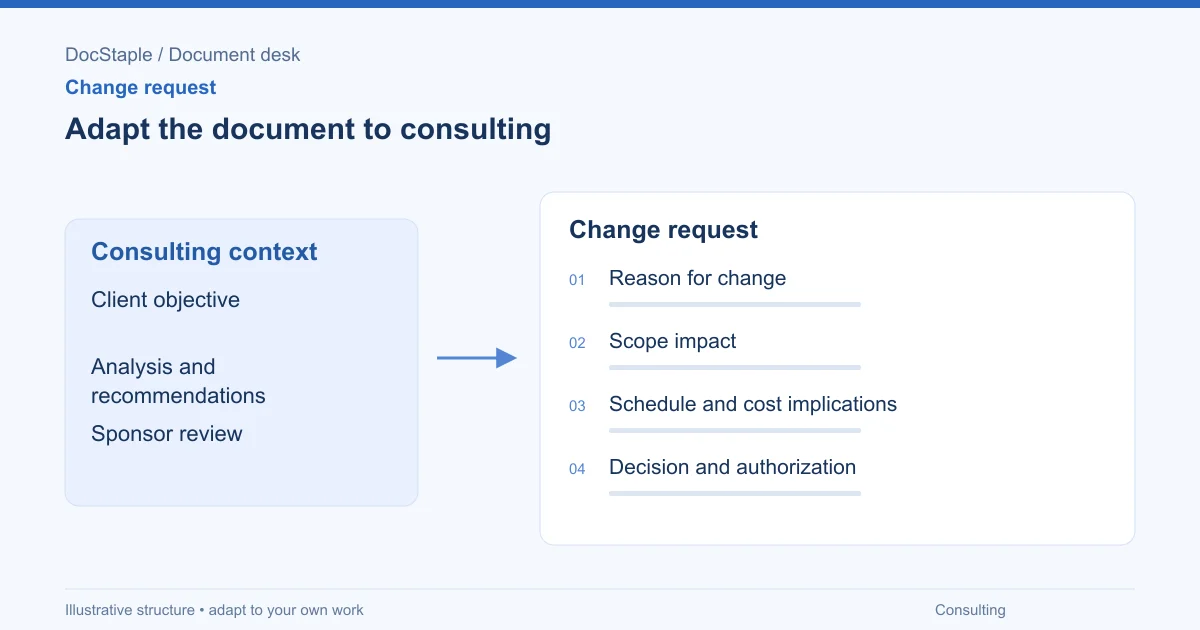
A consulting change request should help a sponsor make a clear trade-off. It is not just a note saying the client asked for more work. It is a short decision record showing what changes from the approved engagement and what the team needs before it proceeds.
Use this scenario: a consulting firm is completing a strategy review engagement. The approved scope includes eight discovery interviews, an analysis review, and a recommendations report. After the first interviews, the client sponsor asks the team to add a workshop with regional managers and deliver an executive readout one week earlier.
For U.S. federal contracts, FAR Part 43 says only contracting officers acting within their authority may execute government contract modifications, and it describes bilateral and unilateral modification types (FAR Part 43). That rule is specific to federal procurement. For a private consulting engagement, check the engagement letter and governing law, then use the same core discipline: identify who can authorize the changed baseline.
Step 1: Name The Consulting Baseline
Begin by anchoring the request to the work already approved. A consulting sponsor cannot evaluate the change unless the original promise is visible.
Draft language:
Baseline: Engagement letter and project brief dated [date] approve eight stakeholder interviews, current-state analysis, one recommendations report, and one sponsor review meeting. The approved delivery date for the final report is [date].
Annotation: this sentence gives the decision-maker the comparison point. It also prevents the change request from drifting into a new proposal.
Avoid this wording:
We need to update the project because the client wants a workshop.
That sentence skips the baseline. It sounds collaborative, but it leaves the commercial question unresolved.
Step 2: Explain The Reason For Change
The reason should describe the decision need behind the extra work. In consulting, the task is rarely the real reason. The real reason is usually confidence, stakeholder alignment, executive timing, or risk reduction.
Draft language:
Reason for change: Early interviews show different onboarding practices across regions. The sponsor wants regional managers to test whether the recommendations will work outside the headquarters process before the leadership readout.
Annotation: the request now has business logic. It says why the workshop matters and what the sponsor is trying to learn.
Decision analysis: if the sponsor only needs political alignment, a 60-minute alignment call may be enough. If the sponsor needs evidence to change the recommendation, a structured workshop with documented outputs may be required. The change request should distinguish those purposes.
Add the consequence of no change:
If not approved: The report will rely on the original interview set and will flag regional operating differences as an item for later validation.
That sentence gives the sponsor a real choice without pressuring them.
Step 3: Write The Scope Impact
Consulting scope impact should be precise about deliverables, review rounds, evidence, and exclusions.
Draft language:
Scope impact: Add one 90-minute regional manager workshop with up to [number] participants. Add workshop findings to the evidence log and update the recommendations report where regional differences affect implementation. This change does not add regional process mapping, separate regional recommendations, travel, training materials, or implementation planning.
Annotation: “up to [number] participants” controls facilitation load. The exclusions are practical, not hostile. They stop the workshop from expanding into a separate workstream.
Second worked example: the sponsor asks for a board deck in addition to the report.
Scope impact: Add a board-ready summary deck of up to [number] slides based on the approved recommendations report. The deck includes one consolidated review round. It does not include new analysis, board-meeting attendance, custom brand design, or separate appendices.
The structure is similar, but the decision is different. The workshop affects evidence. The board deck affects communication format. Treating both as “extra work” is too blunt for a useful change request.
Step 4: Connect Schedule And Cost
Schedule impact should say what changes under realistic conditions. Cost impact should say what the estimate includes and what assumption could change it.
Draft language:
Schedule impact: If the workshop occurs by [date], the executive readout can move to [new date] only by replacing the separate analysis review with one consolidated sponsor review. If the workshop occurs later, the original report date moves by [number] business days.
Cost impact: Additional fee is [amount], covering workshop design, facilitation, summary notes, evidence-log update, and report edits. Estimate assumes one workshop, remote delivery, and one consolidated review cycle.
Annotation: this language refuses the hidden fantasy that more work, faster timing, and the same review depth can all coexist without a decision.
The Department of the Interior’s service-contract guidance asks whether statements of work specify deliverables or progress reporting when contractor recommendations may influence decisions (DIAR 1437.1). In consulting, a change request should make the same relationship explicit: added activity should connect to a deliverable, decision, or acceptance point.
Step 5: Give The Sponsor Options
Options are helpful when the sponsor is balancing evidence, cost, and timing.
Use a compact options table:
| Option | What changes | Best when |
|---|---|---|
| A: Full workshop | Add workshop and update report | Sponsor needs evidence from regional managers |
| B: Short validation call | Add one focused call and risk note | Sponsor needs directional input fast |
| C: Keep baseline | No added regional input | Sponsor accepts lower certainty on regional fit |
Recommendation wording:
Recommendation: Option B if the executive readout date is fixed. Option A if the sponsor wants the report to include regional evidence rather than a stated implementation risk.
This is more useful than recommending the largest option by default. It shows professional judgment and lets the sponsor choose the trade-off intentionally.
Step 6: Record Decision And Authorization
Close with a decision block that names the authorized reviewer. Do not leave approval to inference.
Draft language:
Decision requested: Sponsor to approve Option A, approve Option B, reject the request, or defer until after the executive readout.
Authorization: Changed work begins only after written approval from [client sponsor/title] or another person authorized under the engagement letter.
FAR Part 43’s notification language says a contractor should notify the government when it believes government conduct may have changed the contract so the government can confirm, countermand, or say no change occurred (FAR 43.104). In private consulting, the parallel is simple: surface possible constructive change before the team silently performs work nobody has priced or authorized.
Approval check:
| Check | Pass condition |
|---|---|
| Reason | Business need is separate from proposed task |
| Scope | Added work and exclusions are visible |
| Schedule | Deadline impact is conditional and specific |
| Cost | Estimate includes assumptions |
| Authority | Named sponsor or approver can approve |
| Baseline update | Project brief, plan, and status report will be updated |
After approval, update the delivery plan before anyone acts on the new schedule. If the request is rejected, keep the record and state how the recommendations report will handle the unapproved evidence gap.
The consulting change request template is an editable Word draft for this workflow. Use it to turn a client request into a documented decision, then align the approval route with your engagement letter and jurisdiction.
Last updated: September 26, 2026
Frequently Asked Questions
Related Articles
Change Request Best Practices for Client Delivery
Change request best practices for documenting the reason, scope impact, schedule and cost implications, and authorization before changed work starts.
Change Request Checklist for Reviewing Scope, Schedule and Cost
A change request checklist for consulting projects covering reason for change, scope impact, schedule and cost implications, and authorization.
Change Request Examples: Scope, Schedule, Cost and Authorization
Practical change request examples for consulting projects, with annotated language for the reason, scope impact, schedule, cost, decision and authorization.
Handover Document Best Practices for Client Delivery
Handover document best practices for completed work, outstanding actions, access, operating instructions, acceptance, and ownership.
Handover Document Checklist: Completed Work, Open Actions and Ownership
A practical handover document checklist for consulting work, with review gates for completed work, outstanding actions, access, operating notes and acceptance.
Handover Document Examples for Consulting Work
Handover document examples for consulting teams, covering completed work, outstanding actions, access and operating instructions, and acceptance and ownership.