How to Write a Construction Handover Document for a Fit-Out Project
How to adapt a handover document for construction work, with a fit-out scenario, completion records, open items, access notes and acceptance language.
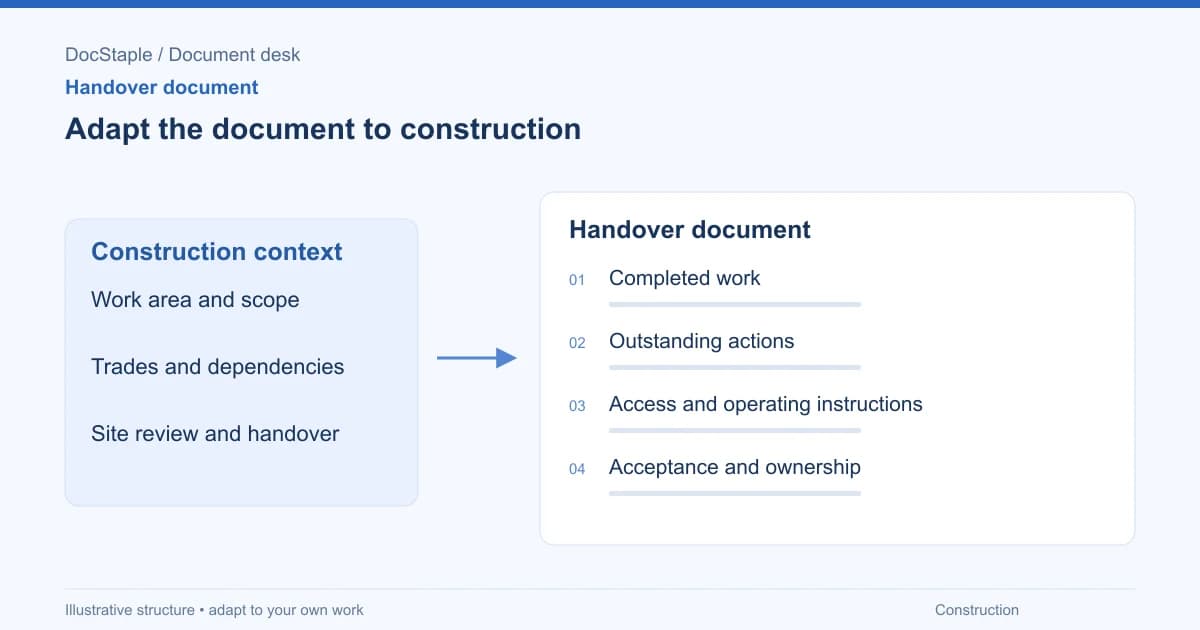
To write a construction handover document, adapt the structure to the work being transferred. A construction handover needs more than a project summary. It should identify the built scope, closeout records, unresolved site items, access information, operating instructions and the exact basis for acceptance.
This article uses a realistic scenario: a subcontractor is handing over a commercial office fit-out package to the general contractor and the owner’s facilities representative. The work includes partitions, finishes, access-control coordination and closeout records. Jurisdiction, contract terms and local building requirements can change what must be issued, so treat the examples as drafting language rather than legal or code advice.
Set The Construction Scenario
Start with the project and package. Construction teams often use the same word, "handover," for different events: trade closeout, owner occupancy, system operation, warranty start or final account. Your first paragraph should remove that ambiguity.
Draft language
This handover covers the tenant improvement fit-out package for [floor/area] at [project name]. It transfers the closeout records, completed work status, open punch items and operating notes from [subcontractor/project lead] to [general contractor or facilities representative] as of [date].
Approval check: compare the paragraph with the subcontract, drawings and latest approved change records. If the fit-out area changed during the job, name the revision or drawing set.
The Federal Transit Administration describes construction closeout as involving acceptance of contract deliverables, collection of documents and records such as as-built drawings, operation and maintenance manuals and warranties, and approval of final payments (FTA Construction Project Management Handbook). That is the mindset your construction handover should follow.
In a fit-out handover, the receiving party may care about different facts than the trade team. The subcontractor may think in packages and drawings. Facilities may think in rooms, keys, warranties and maintenance contacts. Write the document so both views meet: package references for project control, room-level notes for the people who will operate the space.
Describe Completed Work With Records
Completed work should be listed by package, location and supporting record. Avoid broad statements like "fit-out complete" unless the closeout file proves it.
Worked example: finished work entry
Completed work: Level 4 meeting-room partitions and finishes are complete in rooms [numbers] under drawing set [revision]. Inspection record [ID] was completed on [date]. As-built markup [reference] shows approved relocation of the door hardware schedule for rooms [numbers].
Decision analysis: this entry works because it ties the physical area to a drawing revision and inspection record. A facilities manager can later answer, "Which rooms were included?" and "Where is the evidence?"
For a second example, consider commissioning-sensitive work:
Completed work: Access-control rough-in coordination is complete at doors [numbers]. Final device programming remains with [security vendor] and is listed as an outstanding action. Cable pathway photos are stored at [location].
Decision analysis: the trade has completed its part, but the operational result depends on another party. The handover should show that distinction rather than marking the whole system complete.
Also separate installed work from accepted work. A wall finish may be installed, inspected and usable, while still awaiting a minor defect correction. A door access reader may be physically installed but not ready for facilities use until programming and testing are complete. The handover should not force these statuses into one column.
List Outstanding Actions And Site Risks
Outstanding items should not be buried in narrative paragraphs. Put them in a table with owner, timing and consequence.
| Item | Owner | Due date | Consequence if unresolved | Evidence |
|---|---|---|---|---|
| Replace scratched glazing film in conference room 4B | Subcontractor | [date] | Owner will not accept finish in that room | Punch photo [ID] |
| Confirm access-control programming at three doors | Security vendor | [date] | Facilities cannot issue final access procedure | Door list [ID] |
| Remove surplus material from service corridor | Subcontractor | [date] | Corridor remains obstructed | Site photo [ID] |
Construction handovers should also identify safety-sensitive items. OSHA explains that hazard identification and assessment is a critical element of an effective safety and health program (OSHA Hazard Identification). If a handover transfers an area with temporary protection, blocked access or incomplete corrective work, document who controls the issue and how it will be resolved.
Annotated sample language
Safety-sensitive open item: temporary edge protection at [location] remains under [responsible contractor] until [condition]. No other party should remove or alter it without approval from [site safety contact].
This is not a substitute for the site safety plan. It is a flag in the handover record so the incoming owner does not mistake temporary protection for abandoned material.
When multiple employers or contractors are active, role clarity matters. OSHA's multi-employer citation policy discusses creating, exposing, correcting and controlling employers on multi-employer worksites (OSHA Multi-Employer Citation Policy). Your handover should not attempt to assign legal responsibility casually, but it should record who is currently controlling each unresolved site item under the project process.
Add Access And Operating Instructions
Construction handovers often include keys, manuals, software portals, warranty contacts and maintenance instructions. Do not mix operational notes with private credentials.
Draft language
Keys for rooms [numbers] are logged in the key register under [reference]. Warranty documents for installed finishes are stored at [repository]. Access to the closeout folder is managed by [document controller]. Login credentials, if required, will be transferred through the approved access process and are not included in this handover.
Approval check: walk the list from the facilities user’s point of view. Can they locate manuals? Can they request access? Do they know who to call for a warranty issue?
If the handover includes operation and maintenance manuals, make sure the manual title and version appear in the document. "O&M uploaded" is weak. "Manufacturer care guide for [material/system], version [date], uploaded to [folder]" is usable.
One practical test is to imagine a facilities technician arriving six months later. They should not need to ask the former project manager which manual applies, which room the note refers to or who supplied the product. Add manufacturer, model, location and warranty contact where those details affect maintenance.
Write Acceptance And Ownership Language
Acceptance wording must reflect the actual state of the work. A fit-out handover with punch items should not read like unconditional final completion.
Worked example: conditional construction acceptance
The receiving representative acknowledges receipt of the closeout records listed in Section 2 and accepts operational custody of the areas listed in Section 1, subject to completion of the punch items in Section 3. This acknowledgment does not release unresolved warranty, defect, payment or contractual obligations unless the contract separately provides for that result.
Decision analysis: this wording separates custody of records from release of obligations. That matters when the owner can begin using the space while defects or administrative closeout items remain.
The Federal Highway Administration states that final documentation should follow final acceptance when required work, deliverables and applicable administrative actions are complete (FHWA Project Funds Management Guide). Private construction projects will have their own contract rules, but the principle is useful: do not call unresolved administrative work invisible.
Prepare The Draft For Review
Before issuing the handover, check the document itself. Confirm drawing references, remove draft comments, update dates and verify every attachment named in the text.
If the handover is prepared in Word with tracked changes, Microsoft says tracked changes must be accepted or rejected to remove markup; hiding markup with the view setting is temporary (Microsoft Support). Keep an editable internal copy if needed, but send a clean review copy unless your process requires redlines.
Use the construction handover document template as an editable starting structure for scope, closeout records, open items, access notes and acceptance. Replace the example fit-out language with your actual project records before sending it for approval.
Keep a marked internal copy if your team needs drafting history, but issue a controlled version with the attachment list frozen. Construction handovers often circulate after people have moved to the next job, so the document should be complete enough to stand without hallway explanations.
Last updated: September 26, 2026
Frequently Asked Questions
Related Articles
Change Request Best Practices for Client Delivery
Change request best practices for documenting the reason, scope impact, schedule and cost implications, and authorization before changed work starts.
Change Request Checklist for Reviewing Scope, Schedule and Cost
A change request checklist for consulting projects covering reason for change, scope impact, schedule and cost implications, and authorization.
Change Request Examples: Scope, Schedule, Cost and Authorization
Practical change request examples for consulting projects, with annotated language for the reason, scope impact, schedule, cost, decision and authorization.
Handover Document Best Practices for Client Delivery
Handover document best practices for completed work, outstanding actions, access, operating instructions, acceptance, and ownership.
Handover Document Checklist: Completed Work, Open Actions and Ownership
A practical handover document checklist for consulting work, with review gates for completed work, outstanding actions, access, operating notes and acceptance.
Handover Document Examples for Consulting Work
Handover document examples for consulting teams, covering completed work, outstanding actions, access and operating instructions, and acceptance and ownership.