How To Write A Consulting Handover Document
A step-by-step guide to writing a consulting handover document with completed work, open actions, access notes, operating instructions, and acceptance language.
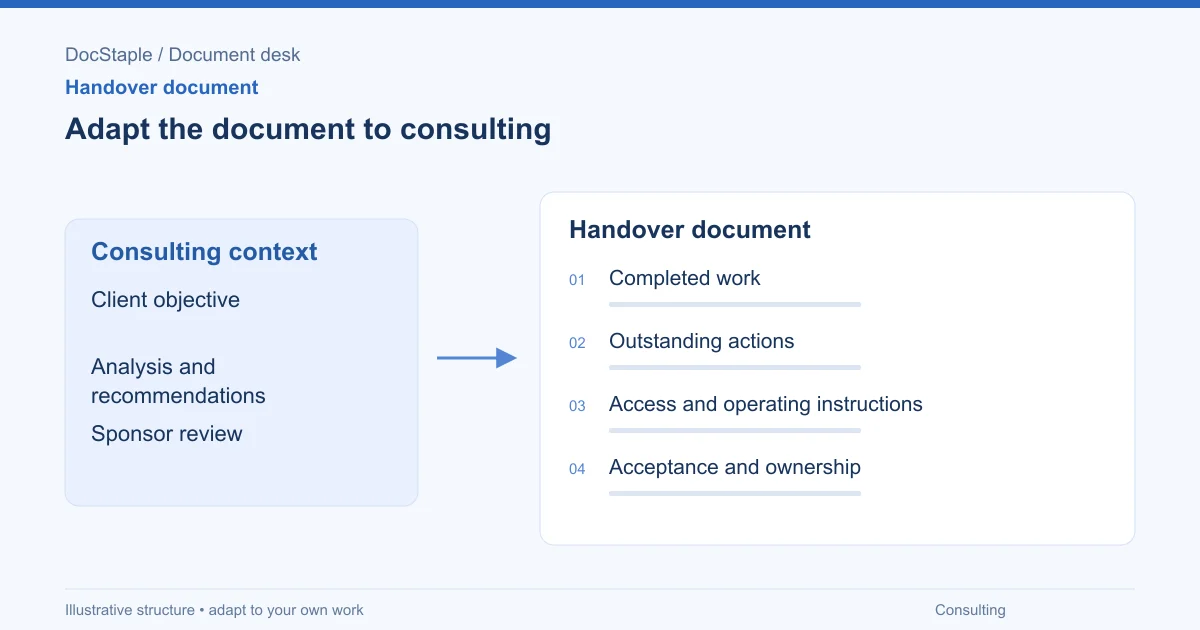
A consulting handover document should transfer judgment as well as files. The incoming owner needs to know what has been completed, what is still open, where the records are, and how to operate without damaging the client relationship or the evidence trail.
Use this scenario: a consulting team is delivering a strategy review engagement. The outgoing engagement lead is leaving the project after discovery and before the final recommendations presentation. The incoming lead must finish the recommendations report, handle sponsor questions, and preserve the logic behind the draft recommendation.
HHS project completion guidance includes customer acceptance of deliverables, open issue resolution, archiving final records, and knowledge transfer among project completion elements (HHS project completion guide). Your consulting project may be private and governed by its engagement letter, but those completion habits are directly useful.
Step 1: Set The Handover Scope
Open by saying what is being transferred and when ownership changes. Do not assume the reader knows whether the handover covers a workstream, the whole engagement, or only a deliverable.
Draft language:
Handover scope: Transfer ownership of the strategy review engagement from [outgoing lead] to [incoming lead] effective [date]. This handover covers the recommendations report, evidence log, decision history, sponsor review preparation, and outstanding actions listed below.
Annotation: the sentence names the project, people, date, and included responsibilities. It is much clearer than “handover notes for the strategy project.”
Add exclusions where needed:
Not included: Commercial negotiation for a proposed implementation phase remains with [partner]. Client invoicing remains with [operations role].
That boundary prevents the incoming lead from becoming accidental owner of commercial or administrative work.
Step 2: List Completed Work With Versions
Consulting handovers fail when they say work is “done” without naming versions and evidence.
Draft language:
Completed work: Discovery interviews are complete for operations, finance, support, and sales. Findings matrix v0.5 is stored in [location]. Recommendations report v0.7 includes draft Sections 1-4. Sponsor comments from [date] are incorporated except the unresolved cost range for Option B.
Annotation: the incoming lead can verify each item. The wording also flags the one exception, which matters more than a general status label.
First worked example: handing over an evidence concern.
Evidence note: Recommendation R-03 relies on interview comments from operations and support. No implementation manager has validated the handoff finding. If R-03 remains in the final report, describe it as a likely risk unless the sponsor approves additional validation.
This is the kind of context that often disappears. The handover should preserve it because it affects professional judgment.
Step 3: Convert Open Questions Into Actions
Open items should not read like a memory dump. Each item needs owner, due date, source, and consequence.
Draft table:
| Open item | Owner after handover | Due | Context |
|---|---|---|---|
| Confirm Option B cost range | Client sponsor | [date] | Needed before final recommendation strength is set |
| Resolve Section 4 sponsor comments | Incoming lead | [date] | Comments affect implementation sequence |
| Prepare final presentation agenda | Project coordinator | [date] | Sponsor wants decision time protected |
Decision analysis: if the cost range arrives high, the incoming lead should not silently change the recommendation. The decision path is to update the comparison table, brief the sponsor, and ask whether operating fit or implementation budget is the controlling factor.
Draft language:
If Option B cost exceeds [threshold], update the comparison table and ask the sponsor whether to retain Option B as the evidence-led recommendation or present Option A as the lower-cost alternative. Record the sponsor decision in the decision log before changing final wording.
That turns a vague risk into an operating instruction.
Step 4: Document Access And Operating Rules
Say which systems, folders, and records the incoming lead can access. Do not include secrets.
Draft language:
Access: Incoming lead has access to [project folder], [decision log], [interview note repository], and [client review channel]. Credential transfer, if needed, must occur through [approved secure process]. This handover does not contain passwords, tokens, recovery codes, or private links.
NIST’s digital identity guidance explains that authenticators contain or comprise secrets such as passwords, private keys, and shared secrets (NIST SP 800-63-4). In handover writing, the safe pattern is to confirm access status and transfer route, not to paste the secret into the document.
Operating rules should be short and practical:
Operating instructions: Use report v0.7 as the current working draft. Update the decision log before changing any recommendation. Do not send Appendix C outside the named client reviewers because it contains confidential interview detail.
Annotation: this gives the incoming lead exactly what to do on Monday morning.
Step 5: Preserve Client And Recommendation Context
A consulting handover should include the current client stance without inventing certainty.
Second worked example: the sponsor is supportive, but one subject matter expert disagrees.
Weak wording:
Client is aligned except finance.
Better wording:
Stakeholder position: Sponsor supports Option B for operational fit. Finance has not approved the cost range and prefers Option A if the cost gap is material. Operations supports Option B and asked for implementation sequencing detail. No stakeholder has approved final wording.
Annotation: this avoids false consensus. It also tells the incoming lead which conversation to have next.
Add suggested meeting language if the transition is imminent:
In the sponsor review, present Option B as the current evidence-led recommendation. Present Option A as the lower-cost alternative if finance confirms the cost gap. Do not describe either option as final until the sponsor records the decision.
This is not a script. It is a record of the current logic, so the incoming lead does not have to reconstruct it under pressure.
Step 6: Confirm Acceptance And Next Support
End with acceptance, conditions, and support period.
Draft language:
Acceptance: Incoming lead confirms access to current files, receipt of knowledge transfer, understanding of open actions, and ownership of the recommendations report from [date].
Support period: Outgoing lead remains available until [date] for factual clarification on interview history, file locations, and prior sponsor decisions.
Conditional wording:
Accepted subject to access to [repository] being granted by [date]. Until access is confirmed, outgoing lead remains responsible for retrieving source notes.
The Federal Transit Administration’s closeout guidance describes using a checklist showing required deliverables and submittals reviewed, inspected and accepted before notifying the contract administrator that work is complete (FTA closeout guidance). A consulting handover can use the same acceptance mindset, even though the project type and authority structure differ.
Approval check:
| Check | Pass condition |
|---|---|
| Scope | Transfer covers named responsibilities and date |
| Completed work | Versions and locations are stated |
| Open actions | Each item has owner, due date, and reason |
| Access | Status is confirmed without exposing secrets |
| Client context | Stakeholder positions are factual and current |
| Acceptance | Incoming owner accepts or states conditions |
Before issuing, create a working copy if you are editing a shared Word file. Microsoft recommends Save a Copy before editing when you want to avoid changing the original file (Microsoft Support).
The consulting handover document template provides an editable Word structure for scope, completed work, access, open actions, knowledge transfer and acceptance. Use it to make the handover operational, then adapt the approval route to your engagement and organization.
Last updated: September 26, 2026
Frequently Asked Questions
Related Articles
Change Request Best Practices for Client Delivery
Change request best practices for documenting the reason, scope impact, schedule and cost implications, and authorization before changed work starts.
Change Request Checklist for Reviewing Scope, Schedule and Cost
A change request checklist for consulting projects covering reason for change, scope impact, schedule and cost implications, and authorization.
Change Request Examples: Scope, Schedule, Cost and Authorization
Practical change request examples for consulting projects, with annotated language for the reason, scope impact, schedule, cost, decision and authorization.
Handover Document Best Practices for Client Delivery
Handover document best practices for completed work, outstanding actions, access, operating instructions, acceptance, and ownership.
Handover Document Checklist: Completed Work, Open Actions and Ownership
A practical handover document checklist for consulting work, with review gates for completed work, outstanding actions, access, operating notes and acceptance.
Handover Document Examples for Consulting Work
Handover document examples for consulting teams, covering completed work, outstanding actions, access and operating instructions, and acceptance and ownership.