How to Write Construction Meeting Minutes: Decisions and Actions
How to write construction meeting minutes for a site coordination meeting, including attendees, agenda, decisions, action owners, dates and approval records.
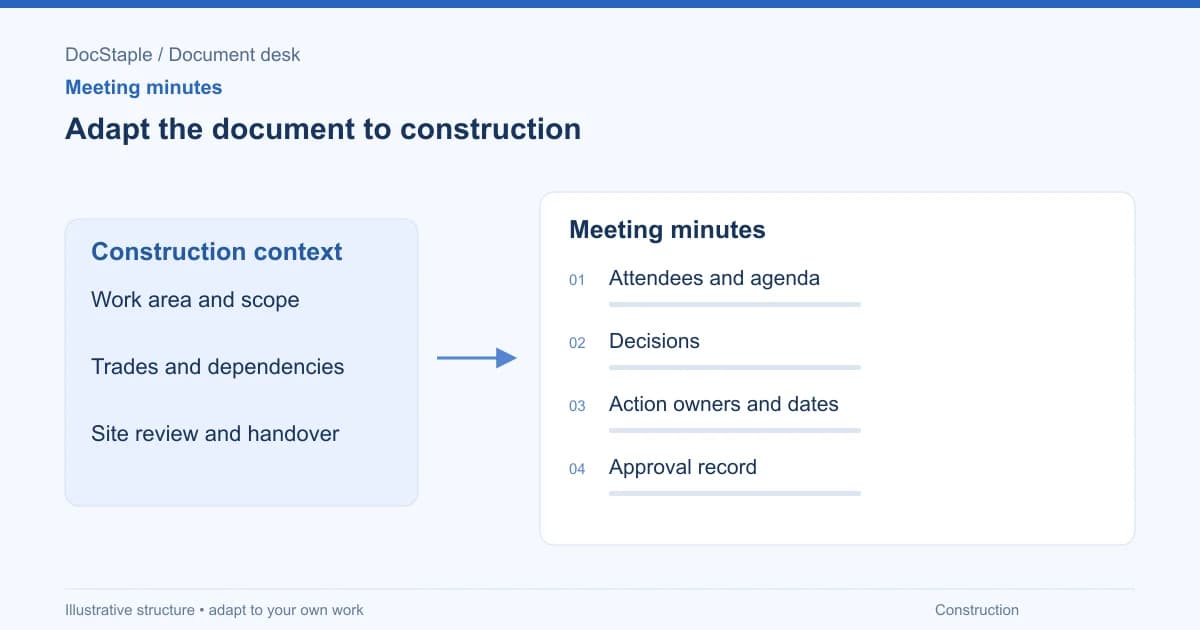
Construction meeting minutes are not a transcript. They are a working record of what was discussed, decided, assigned and left unresolved. On a busy site, weak minutes create two problems: people leave with different memories, and later readers cannot tell why an action was taken.
This walkthrough uses a fictional scenario: a weekly coordination meeting for a commercial fit-out project. The site manager, electrical subcontractor, mechanical subcontractor and client representative discuss ceiling access, inspection closeout and a late design clarification. The examples are document drafting guidance, not legal or safety advice. Construction record requirements vary by contract, project location and jurisdiction.
Step 1: Capture meeting details and attendees
Start with the facts that identify the meeting. If the project later has a dispute, a vague heading will not help.
Draft language
Project: [Commercial fit-out project name]
Meeting: Weekly trade coordination meeting
Date and time: [date and time]
Location: [site office / remote link]
Chair: [site manager name]
Attendees: [names, organizations and roles]
Apologies: [names]
Prepared by: [name]
Distribution: [approved circulation list]
Approval check: Use names, organizations and roles. "Electrical attended" is weaker than naming the person who can confirm the action.
If someone arrives late for a decision, note that only when it matters. Minutes should be accurate, not petty.
Step 2: Keep the agenda tied to evidence
Agenda notes should be concise, but they should reference the records used in discussion: drawings, RFIs, inspection reports, permits or photos.
Draft language
Agenda item: ceiling access above Level 2 corridor
The electrical subcontractor reported that cable tray access is blocked by the revised bulkhead detail. The chair referred to drawing [number, revision] and RFI [number]. Mechanical subcontractor noted that ductwork installation is planned for [date], which may affect access sequencing.
Annotation: The note does not reproduce the whole drawing or argue the design. It identifies the records and the coordination issue.
OSHA's recommended practices for communication and coordination say host employers and contractors should exchange information about workplace hazards and measures used to prevent or control them, and should make managers with decision-making authority available for day-to-day coordination issues (OSHA communication and coordination guidance). Ordinary construction minutes do not replace safety procedures, but they can record coordination decisions and owners.
Step 3: Record decisions separately from discussion
Discussion explains context. Decisions state what changed or what will happen.
Draft language
Decision 1: Ceiling access sequencing will follow revised marked-up drawing [reference] until formal design clarification is issued. Electrical subcontractor will complete accessible sections first and leave affected corridor section pending clarification.
Annotation: The decision is written as an action rule. It names the interim basis and the limitation.
If no decision was made, say that:
No decision: The meeting did not approve a change to the ceiling detail. Formal design clarification remains required before affected corridor works proceed.
That prevents minutes from being treated as approval when they only recorded discussion.
Step 4: Assign action owners and dates
Every action should have one owner and one due date. "Team to follow up" is not an action.
Draft table
| Action | Owner | Due date | Evidence or reference | Status |
|---|---|---|---|---|
| Submit design clarification request for corridor ceiling access | Site manager | [date] | RFI [number] | Open |
| Confirm mechanical installation sequence for Level 2 corridor | Mechanical subcontractor lead | [date] | Lookahead programme rev [number] | Open |
| Provide updated access constraint photos | Electrical subcontractor lead | [date] | Site photos dated [date] | Open |
| Confirm whether inspection closeout can proceed for unaffected areas | Client representative | [date] | Inspection record [number] | Open |
Approval check: If the owner cannot act without another person, either change the owner or add a dependency.
OSHA's management leadership guidance recommends defining and communicating responsibilities and authorities for implementing and maintaining safety and health programs (OSHA management leadership guidance). The same clarity helps meeting actions: the minutes should show who has responsibility, not just who was in the room.
Step 5: Note safety items without replacing safety records
If the meeting includes safety discussion, record it carefully and route formal reports through the correct system.
Draft language
Safety coordination item: Access to the Level 2 corridor must remain controlled while overhead coordination is unresolved. Site manager reminded trades that exclusion zones and permit requirements remain in force. No incident was reported in this meeting. Any incident, near miss or regulatory reporting requirement must be recorded through the project's safety procedure.
Annotation: This records the coordination item and avoids pretending the minutes are the whole safety record.
For U.S. construction employers, OSHA's construction quick start notes that OSHA generally requires construction employers to keep injury and illness records unless an exemption applies, and reporting obligations still apply for fatalities and severe injuries (OSHA construction compliance quick start). That is jurisdiction-specific U.S. guidance; use the rules that apply to your site.
Step 6: Circulate, correct and approve
Minutes should have a correction route. If people can correct factual errors, the approved record becomes more reliable.
Draft language
Draft minutes will be circulated by [date]. Corrections to factual accuracy must be sent to [minutes owner] by [date]. If no correction is received, the minutes will be submitted for approval at the next coordination meeting. Silence is not approval unless the project procedure states otherwise.
Approval check: Match this to the contract or project procedure. Some projects treat minutes as accepted if no objection is made within a stated period; do not invent that rule in the minutes unless the governing documents allow it.
Before issuing a Word version, use tables for actions and decisions so owners and due dates remain editable. Microsoft Support explains that Word reviewers can accept or reject tracked changes during review (Microsoft Support). Resolve internal drafting comments before wider circulation.
Before the next meeting, review open actions from the previous minutes and carry them forward deliberately:
| Previous action | Current status | Next step |
|---|---|---|
| Submit corridor ceiling RFI | Submitted on [date] | Await design response |
| Confirm inspection closeout areas | Partly complete | Client representative to confirm remaining rooms |
Do not delete an old action just because it is uncomfortable. Mark it closed, superseded or still open. That continuity is what turns minutes into a project control record instead of a weekly narrative.
Keep corrections factual. If someone disagrees with a decision after the meeting, record the objection or new action in the next meeting minutes rather than rewriting history. The approved record should show what was decided at the time, based on the information then available.
Start from an editable record
The construction meeting minutes template includes editable Word sections for meeting details and purpose, agenda discussion and evidence, decisions and actions, approval circulation and next meeting, plus review and approval prompts. Use it to create a concise record of decisions, action owners and dates, while keeping formal safety, contract and change records in their proper systems.
Sources: OSHA communication and coordination guidance, OSHA management leadership guidance, OSHA construction compliance quick start, Accept tracked changes, Microsoft Support
Last updated: September 26, 2026
Frequently Asked Questions
Related Articles
Change Request Best Practices for Client Delivery
Change request best practices for documenting the reason, scope impact, schedule and cost implications, and authorization before changed work starts.
Change Request Checklist for Reviewing Scope, Schedule and Cost
A change request checklist for consulting projects covering reason for change, scope impact, schedule and cost implications, and authorization.
Change Request Examples: Scope, Schedule, Cost and Authorization
Practical change request examples for consulting projects, with annotated language for the reason, scope impact, schedule, cost, decision and authorization.
Handover Document Best Practices for Client Delivery
Handover document best practices for completed work, outstanding actions, access, operating instructions, acceptance, and ownership.
Handover Document Checklist: Completed Work, Open Actions and Ownership
A practical handover document checklist for consulting work, with review gates for completed work, outstanding actions, access, operating notes and acceptance.
Handover Document Examples for Consulting Work
Handover document examples for consulting teams, covering completed work, outstanding actions, access and operating instructions, and acceptance and ownership.