How to Write Consulting Meeting Minutes That Capture Decisions
How to write consulting meeting minutes with attendees, agenda, decisions, action owners, dates, approval record and annotated sample language.
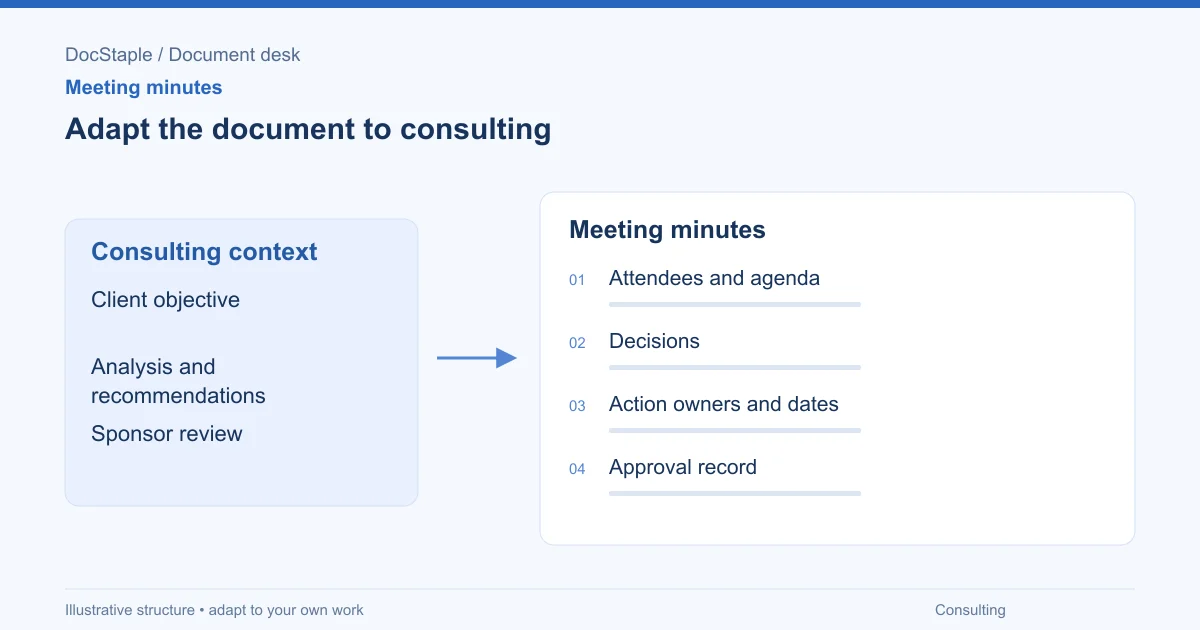
Consulting meeting minutes are a decision-control document. They should help people remember what was agreed, what evidence was considered, who owns the next action and which questions remain open.
This guide uses a realistic scenario: a weekly steering meeting for a strategy review engagement. The consulting team presents interview themes, the client sponsor challenges one recommendation, and the group must decide whether to add two operations interviews before the recommendations report is finalized.
Record Meeting Details And Attendance Precisely
Start with the facts that identify the meeting. Consulting projects often involve sponsors, subject matter experts, analysts and observers. Later, someone may need to know whether the actual decision owner was present.
Draft language
Project: Strategy review engagement
Meeting: Weekly steering review
Date and time: [date and time]
Chair: [client sponsor]
Prepared by: [consulting manager]
Attendees: [names, organizations and roles]
Apologies: [names and roles]
Purpose: Review evidence themes, confirm decision on additional operations interviews and agree next steps for the recommendations report.
Annotation: The purpose names the decision expected from the meeting. It is stronger than "weekly update" because it tells a later reader why the meeting mattered.
For public bodies in Massachusetts, meeting minutes must include date, time, place, members present or absent, discussion summaries, documents used, decisions and actions (Massachusetts General Laws Chapter 30A, Section 22). That law does not govern an ordinary private consulting engagement, but it is a useful reminder that minutes should identify the meeting and the basis for action.
Keep Agenda Notes Connected To Evidence
Agenda notes should be short, but they should show what information the group considered. Consulting minutes become weak when they say "team discussed findings" without naming the evidence.
Worked example: recommendation challenge
Agenda item: customer onboarding recommendation
The consulting team presented interview themes from eight stakeholder interviews and draft analysis from the customer journey review. The client sponsor asked whether the proposed handoff change is supported by operations evidence. The engagement lead noted that two operations interviews were not completed because the nominated managers were unavailable.
Annotation: This paragraph separates evidence from uncertainty. It records the challenge without turning the minutes into a debate transcript.
Use evidence references when they matter:
| Agenda item | Evidence referenced | Why it matters |
|---|---|---|
| Interview themes | Interview summary v2 | Shows source of finding |
| Handoff recommendation | Journey review notes | Links proposal to analysis |
| Operations gap | Interview tracker | Explains evidence limitation |
| Final report timing | Delivery plan v4 | Connects decision to deadline |
The Charity Commission for England and Wales advises charities to record information and advice used, options considered and main reasons for decisions when making significant decisions (GOV.UK decision-making guidance). That is charity governance guidance, not consulting-specific law, but the recordkeeping principle fits high-stakes client decisions.
Separate Decisions From Discussion
A decision should be written as an outcome, not as a comment somebody made. Put decisions in their own section so they are easy to find.
Draft decision language
Decision 1: The sponsor approved two additional operations interviews before the recommendations report is finalized. The final report timeline remains unchanged unless interviews cannot be scheduled by [date].
Annotation: This decision states what was approved and the condition that could affect the timeline. It does not say "everyone agreed more evidence would be helpful," which is too vague to manage.
If the meeting does not decide, write that clearly:
No decision: The steering group did not approve a scope expansion for pricing analysis. The engagement lead will prepare a short impact note before the next meeting.
Annotation: "No decision" is useful. It prevents a discussion from being mistaken for approval and gives the next action a place to live.
Decision analysis: record the objection or smooth it over?
If a sponsor challenges a recommendation, do not hide the challenge to make the minutes look harmonious. Record the relevant objection in neutral language:
The sponsor questioned whether the handoff recommendation is supported by operations evidence. The group agreed to complete two additional interviews before treating the recommendation as final.
That wording protects the quality of the recommendations report. It shows that the team responded to an evidence concern rather than pushing ahead with unsupported confidence.
Assign Action Owners And Dates
Every action should have one owner and a due date. If an action needs multiple contributors, name the accountable owner and list dependencies separately.
Action table
| Action | Owner | Due date | Evidence or output |
|---|---|---|---|
| Schedule two operations interviews | Client operations lead | [date] | Calendar holds |
| Update evidence log with new interview references | Consulting analyst | [date] | Evidence log v3 |
| Prepare impact note for pricing-analysis scope request | Engagement lead | [date] | One-page note |
| Confirm final report review slot | Client sponsor | [date] | Meeting invite |
Draft language
Action owners are accountable for updating the engagement lead before the due date if the action will not be completed. Open actions will carry forward in the next steering minutes until closed, superseded or moved to the decision record.
Annotation: This stops actions from disappearing between meetings. It also gives the minutes owner a rule for stale items.
Do not assign actions to "consulting team" or "client team" unless the governance document genuinely treats that group as accountable. In practice, group ownership often means no one updates the action before the next meeting.
Use a named owner and add contributors in the evidence column:
Owner: consulting manager. Contributors: analyst for evidence log update, client operations lead for interview scheduling. Due: [date].
That wording keeps accountability with one person while acknowledging that the task needs help.
Build An Approval Record
Consulting minutes often circulate quickly, then become the informal record. Add an approval process so recipients know whether they are reading a draft or approved version.
Draft approval language
Draft minutes will be circulated by [date]. Factual corrections must be sent to [minutes owner] by [date]. The chair will approve the final minutes by written confirmation or at the next steering meeting. Silence will not be treated as approval unless the engagement governance document says so.
Annotation: This language creates a correction path without inventing deemed approval. If the engagement letter or project governance has a different rule, use that rule instead.
Worked example: correction after circulation
Suppose the client sponsor says the minutes imply the steering group approved a pricing analysis. The meeting only asked for an impact note.
Revised minute:
Correction accepted on [date]: the steering group requested an impact note for possible pricing analysis. No pricing-analysis scope expansion was approved.
Annotation: The correction fixes the record without rewriting history as if the first draft never existed.
Approval Check Before Sending
Review the minutes before circulation:
- Do the meeting details identify the project, date, chair and attendees?
- Is the agenda tied to evidence or document versions where relevant?
- Are decisions separated from discussion?
- Are non-decisions recorded when a topic remains unresolved?
- Does each action have one accountable owner and a due date?
- Are confidential details minimized or referenced rather than repeated?
- Does the approval process match the engagement governance?
If the minutes include sensitive client material, reference the source by title or version rather than copying confidential details into a widely circulated file. Keep the detailed evidence in the approved project workspace.
Also check whether the minutes create a new commitment accidentally. A sentence like "the consulting team will look into pricing" can sound harmless, but it may imply work outside the agreed scope. Rewrite it as either a decision, an action to assess impact or a note that no scope change was approved.
Start From Editable Consulting Minutes
The consulting meeting minutes template is an editable Word file with sections for meeting details, agenda discussion, decisions, actions, approval circulation and next meeting. Use it to create a concise decision record for a strategy review engagement, then adapt the examples to your sponsor, evidence sources and governance route.
Last updated: September 26, 2026
Frequently Asked Questions
Related Articles
Change Request Best Practices for Client Delivery
Change request best practices for documenting the reason, scope impact, schedule and cost implications, and authorization before changed work starts.
Change Request Checklist for Reviewing Scope, Schedule and Cost
A change request checklist for consulting projects covering reason for change, scope impact, schedule and cost implications, and authorization.
Change Request Examples: Scope, Schedule, Cost and Authorization
Practical change request examples for consulting projects, with annotated language for the reason, scope impact, schedule, cost, decision and authorization.
Handover Document Best Practices for Client Delivery
Handover document best practices for completed work, outstanding actions, access, operating instructions, acceptance, and ownership.
Handover Document Checklist: Completed Work, Open Actions and Ownership
A practical handover document checklist for consulting work, with review gates for completed work, outstanding actions, access, operating notes and acceptance.
Handover Document Examples for Consulting Work
Handover document examples for consulting teams, covering completed work, outstanding actions, access and operating instructions, and acceptance and ownership.