How to Write a Construction Onboarding Checklist for Site Readiness
How to write a construction onboarding checklist with before-arrival preparation, site access, orientation, role training, completion evidence and approval.
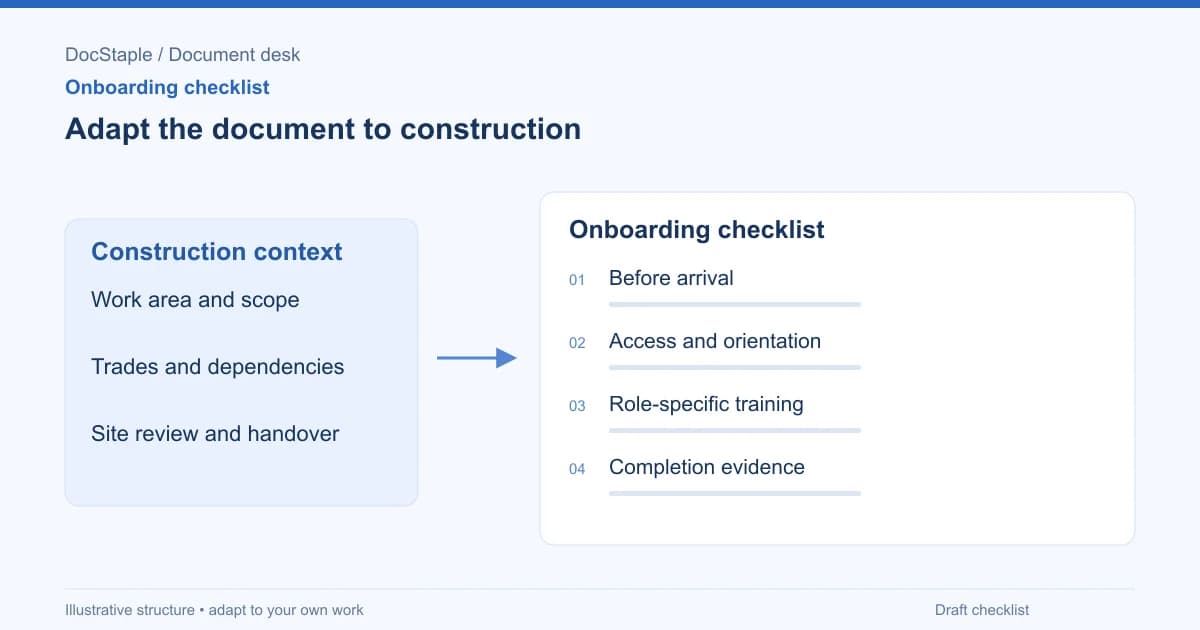
A construction onboarding checklist is a site-readiness document. It should show that a worker, subcontractor crew or supervisor can enter the project safely, understand the current work sequence and produce the evidence the project needs.
This guide uses a realistic scenario: a drywall subcontractor crew is joining a commercial fit-out project after framing has started on one floor. The site manager needs the crew inducted, access controlled, drawings confirmed and first work inspected before the crew is treated as fully onboarded.
Define The Site Readiness Standard
Begin with a clear readiness statement. Construction onboarding gets messy when the checklist mixes employment paperwork, safety induction, drawings, permits and first-task supervision without saying what completion means.
Draft language
Onboarding is complete when the drywall crew has completed the required site induction, received approved access, reviewed current drawings and work areas, demonstrated the first-task setup standard and recorded remaining actions with named owners and due dates.
Annotation: This wording does not claim that the checklist satisfies every legal or contractual requirement. It states the practical site condition the document is measuring.
For U.S. construction work, OSHA's construction safety and health provision at 29 CFR 1926.20 says standards in Part 1926 that require training impose a separate compliance duty for each covered employee (OSHA 29 CFR 1926.20). Use the jurisdiction and project rules that apply to your site; do not rely on an ordinary onboarding checklist as the required safety record.
Before Arrival: Check Documents, Access And Work Area
Before-arrival tasks should let the crew arrive ready for the actual site conditions. A checklist that starts at the gate is already late.
Worked example: drywall crew joining an active fit-out
| Task | Owner | Due | Evidence |
|---|---|---|---|
| Confirm crew roster and supervisor | Subcontractor | Before arrival | Roster received |
| Verify required induction bookings | Site administrator | Before arrival | Induction schedule |
| Issue current drawing set and work area plan | Site manager | Before arrival | Drawing register reference |
| Confirm permits or access restrictions for floor [x] | Safety lead | Before arrival | Permit/access note |
| Prepare first-work inspection hold point | Quality lead | Before work starts | Inspection item created |
Decision analysis: If the crew roster changes on the morning of arrival, do not simply add names after work begins. Decide whether the new person can be inducted and supervised that day or must wait. The checklist should make that choice visible.
Sample language
Crew members not listed on the approved arrival roster must complete the same site entry, induction and supervisor confirmation steps before entering the work area. The site manager may defer entry if induction capacity or supervision is unavailable.
Annotation: This keeps convenience from overriding the onboarding process. It also gives the gate and site team a clear rule.
Site Access And Orientation: Show The Route And The Limits
Construction access has a physical dimension that office onboarding often lacks. The checklist should cover where people may go, what they may use and who controls changes.
Use a site orientation table:
| Orientation item | Required demonstration | Evidence |
|---|---|---|
| Entry and sign-in process | Crew signs in correctly | Site register |
| Work area boundary | Supervisor identifies approved work zones | Orientation note |
| Emergency route | Crew can point to assembly point | Induction record |
| Material delivery route | Subcontractor confirms loading path | Logistics note |
| Drawing and RFI source | Supervisor finds current version | Drawing register check |
OSHA's recommended safety and health practices say training should cover policies, procedures, hazard reporting, emergencies and whom to contact with concerns, and should be provided at a language and literacy level workers understand (OSHA education and training). If your site uses multilingual crews, build that into the onboarding evidence instead of assuming a signed form proves understanding.
Draft language
The supervisor will walk the crew through approved access routes, exclusion zones, welfare facilities, emergency arrangements and the current drawing source. The supervisor records any language or literacy support used during induction.
Annotation: The wording focuses on understanding and route control. It does not reduce orientation to a signature.
Role-Specific Training: Tie It To The First Work Package
After induction, the checklist should test the work the crew will actually perform. For the drywall crew, role-specific onboarding might cover drawing interpretation, fixing method, fire-stopping interface, inspection hold points and coordination with mechanical and electrical trades.
Worked example: first wall section
| Training item | Standard | Evidence |
|---|---|---|
| Current drawing review | Supervisor identifies latest partition detail | Drawing revision noted |
| Set-out confirmation | Crew marks first wall line for review | Photo or inspection note |
| Interface awareness | Crew identifies service penetrations needing coordination | Coordination note |
| Hold point | Quality lead checks first completed section before repetition | Inspection record |
| Defect route | Crew knows how to report design conflict | RFI or issue process confirmed |
Sample completion language
First wall section in area [x] reviewed on [date]. Set-out matched drawing [number/revision]. Two service penetrations require coordination with mechanical subcontractor before board close-up. Crew may continue in areas [a-b] only; area [c] remains on hold.
Annotation: This note turns training into a controlled go/no-go decision. It avoids the vague and dangerous phrase "crew trained."
OSHA's construction recommended practices mention orientation training and toolbox talks as ways to cover hazards on each specific site, especially when new trades or equipment arrive for the next phase (OSHA construction recommended practices PDF). That is U.S. safety guidance; adapt the training evidence to your contract, regulator and site procedure.
Completion Evidence: Keep The Proof Inspectable
Construction onboarding evidence must be practical. The site manager should be able to see what was completed, what remains open and whether the crew can proceed.
Use evidence categories:
| Area | Evidence to keep | Why it matters |
|---|---|---|
| Site entry | Sign-in and induction record | Shows access route was followed |
| Safety orientation | Training or briefing record | Supports site procedure |
| Drawing awareness | Revision checked with supervisor | Prevents working to superseded drawings |
| First work | Inspection or photo reference | Confirms standard before repetition |
| Restrictions | Open hold areas listed | Prevents uncontrolled work |
Draft language
Onboarding approved subject to restrictions: drywall crew may work in zones A and B. Zone C remains closed pending mechanical clearance. Owner: site manager. Review date: [date].
Annotation: Conditional approval is often the honest site answer. It lets safe, ready work proceed while keeping unresolved areas controlled.
Also record what evidence is deliberately not in the checklist. For example, incident reports, statutory training records, permit registers and inspection certificates may live in separate systems. The onboarding checklist should reference those records by number or location rather than duplicating them inaccurately.
That prevents the checklist from becoming a shadow safety file. It remains a coordination document while the required project records stay in their proper place.
Approval Check Before The Crew Is Released
Before closing the checklist, run an approval check that fits construction reality:
- Does the checklist name the project, work package and crew supervisor?
- Are required induction and training records stored in the right system?
- Is the work area current against the latest drawing register?
- Are access routes, exclusion zones and emergency arrangements understood?
- Has first-task supervision produced inspectable evidence?
- Are permits, hold points or restricted areas clearly listed?
- Do open actions have owners and dates?
Approval language
Reviewed by [site manager] on [date]. Approved for the listed crew to proceed with drywall works in zones A and B under supervisor [name]. Approval excludes zone C, hot work, ceiling close-up and any activity requiring a separate permit.
Annotation: This approval is narrow on purpose. It prevents a checklist from being misread as blanket permission for unrelated work.
Start From An Editable Construction Checklist
The construction onboarding checklist template is an editable Word file with sections for before the start date, initial orientation, supervised practice, readiness and approval. Use it to structure site onboarding, then add the project-specific drawings, induction records, permit references, inspection evidence and sign-off route required for your jurisdiction and contract.
Last updated: September 26, 2026
Frequently Asked Questions
Related Articles
Change Request Best Practices for Client Delivery
Change request best practices for documenting the reason, scope impact, schedule and cost implications, and authorization before changed work starts.
Change Request Checklist for Reviewing Scope, Schedule and Cost
A change request checklist for consulting projects covering reason for change, scope impact, schedule and cost implications, and authorization.
Change Request Examples: Scope, Schedule, Cost and Authorization
Practical change request examples for consulting projects, with annotated language for the reason, scope impact, schedule, cost, decision and authorization.
Handover Document Best Practices for Client Delivery
Handover document best practices for completed work, outstanding actions, access, operating instructions, acceptance, and ownership.
Handover Document Checklist: Completed Work, Open Actions and Ownership
A practical handover document checklist for consulting work, with review gates for completed work, outstanding actions, access, operating notes and acceptance.
Handover Document Examples for Consulting Work
Handover document examples for consulting teams, covering completed work, outstanding actions, access and operating instructions, and acceptance and ownership.