How to Write a Consulting Onboarding Checklist for Client Delivery
How to write a consulting onboarding checklist with before-arrival setup, access orientation, role training, completion evidence and approval language.
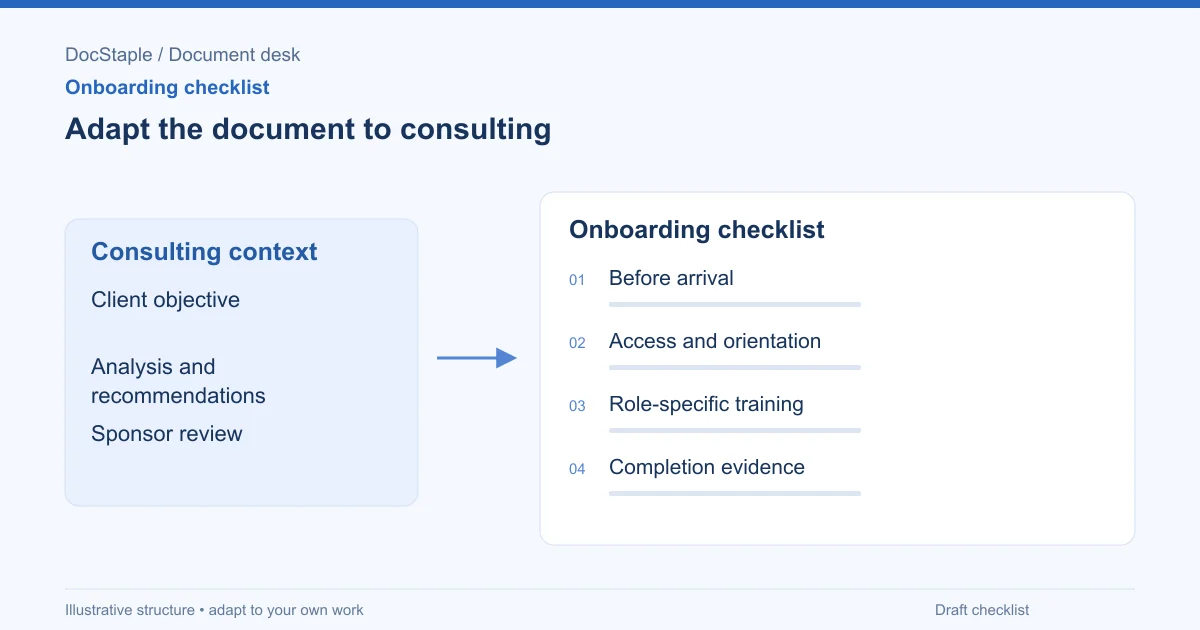
A consulting onboarding checklist should do more than welcome a new hire or contractor. It should prove that the person can step into the engagement without losing context, widening scope or mishandling client information.
This guide uses a realistic scenario: a senior analyst joins a strategy review engagement two weeks before the recommendations report is due. The team has interview notes, an approved scope, a decision record and a sensitive client data room. The checklist must prepare the analyst quickly while keeping evidence and access under control.
Define Readiness For This Engagement
Start by writing the checklist around a readiness statement. This keeps the document from becoming a pile of administrative reminders.
Draft language
Onboarding is complete when the senior analyst can access approved project materials, explain the engagement objective and scope boundary, apply the evidence standard for draft findings, prepare the assigned analysis pack and identify remaining actions with owners and due dates.
Annotation: This sentence names the role, the work, the evidence expectation and the point at which onboarding can reasonably close. It avoids the weak phrase "all onboarding tasks complete."
For this consulting scenario, readiness has five parts: before-arrival preparation, access and orientation, role-specific training, completion evidence and approval. The U.S. Office of Personnel Management describes onboarding as staged activity that includes preparation before arrival and support beyond the first day (OPM onboarding model). A consulting handover needs the same staged logic because the work context changes faster than a generic HR checklist.
Before Arrival: Prepare Context, Not Just Accounts
Before-arrival tasks should remove friction before the analyst opens the project folder. They should also prevent accidental access to information that is not needed.
Worked example: senior analyst joining a strategy review
| Task | Owner | Due | Evidence |
|---|---|---|---|
| Confirm analyst start date and assignment scope | Engagement lead | Before day 1 | Staffing note updated |
| Create project workspace access request | Project coordinator | Before day 1 | Ticket number recorded |
| Prepare briefing pack with approved scope and decision record | Workstream lead | Before day 1 | Link sent in approved channel |
| Identify restricted materials not needed for the role | Engagement lead | Before access grant | Access note added |
| Schedule evidence-review practice session | Delivery manager | Day 2 | Calendar invite accepted |
Decision analysis: Do not copy another analyst's permissions automatically. In this case, the new analyst needs interview notes and analysis workpapers, but not commercial pricing, personnel material or unrelated client files. NIST defines least privilege as restricting access to the minimum necessary to accomplish assigned tasks (NIST glossary). Put that decision directly in the checklist so access is intentional.
Use wording like this:
Access will be requested by role and folder. The analyst receives the strategy review workspace and evidence log. Commercial contract files, prior HR interview notes and unrelated client folders are excluded unless separately approved.
Annotation: The sentence records both what is granted and what is not granted. That is more useful than a checkbox labeled "access set up."
Access And Orientation: Teach The Boundaries
Access is not complete because the login works. The person must know what the workspace contains, which records are authoritative and how to escalate uncertainty.
Create an orientation section that asks the new analyst to demonstrate the workflow:
| Orientation item | Demonstration required | Evidence |
|---|---|---|
| Approved scope | Analyst can state in-scope and out-of-scope questions | Manager note |
| Evidence log | Analyst can find supporting records for two findings | Screen-share confirmation |
| Client contact rules | Analyst knows who may contact the client sponsor | Checklist initial |
| Version control | Analyst saves analysis in the approved folder | File link |
| Escalation route | Analyst names decision owner for scope questions | Handover note |
Draft language
The analyst will not contact client stakeholders directly until the engagement lead confirms the communication route. Questions about scope, data quality or unsupported findings must be logged in the project issue tracker before client circulation.
Annotation: This orientation language prevents the most common consulting onboarding error: a capable person acting quickly before they understand the client boundary.
Role-Specific Training: Practice The Work They Will Do
Role-specific training should be tied to the actual deliverable. A senior analyst does not need a generic "how we consult" lecture. They need to apply the firm's evidence standard to this engagement.
Worked example: evidence triage before recommendations
Give the analyst three draft recommendation bullets:
| Draft recommendation | Training task | Completion standard |
|---|---|---|
| Consolidate intake forms across regions | Identify supporting interviews and data | Evidence log has at least two approved sources |
| Remove manual approval step | Mark evidence gap if operations owner not interviewed | Gap noted with proposed follow-up |
| Change customer handoff metric | Check whether metric is in scope | Scope question raised before use |
Sample completion note
Analyst reviewed three draft findings on [date]. Finding 1 is supported by interview notes I-04 and I-07. Finding 2 is partially supported and needs operations validation. Finding 3 may exceed current scope and is escalated to the engagement lead by [date].
Annotation: The checklist records judgment, not attendance. That distinction matters because consulting onboarding often fails when someone has read the deck but cannot distinguish supported recommendations from attractive guesses.
OSHA's training policy for required workplace safety training says instruction must be presented in language and vocabulary workers can understand (OSHA training policy statement). That is U.S. safety guidance, not consulting law. The drafting lesson still transfers: onboarding should verify understanding in the terms people actually use for the work.
Completion Evidence: Show What Is Finished And What Remains
Completion evidence should be useful to the manager who inherits the checklist. Avoid proof that says only "done."
Use evidence that a later reader can inspect:
| Checklist area | Good evidence | Weak evidence |
|---|---|---|
| Access | Ticket number and active folder test | "IT done" |
| Scope orientation | Analyst summary reviewed by lead | "Briefing held" |
| Evidence practice | Annotated findings with lead comments | "Training complete" |
| Client route | Communication rule acknowledged | "Introduced to team" |
| Open actions | Owner and due date listed | "Pending" |
Draft language
Onboarding is approved with one open action: access to the survey export remains pending under ticket [number]. Owner: project coordinator. Due: [date]. Interim route: workstream lead provides approved extracts only.
Annotation: This wording allows onboarding to close without hiding a dependency. It also prevents the analyst from improvising a workaround outside the approved process.
Add a short "not ready" route for high-risk gaps. For example, if the analyst cannot access the evidence log, do not approve them to revise recommendation language. Approve only background reading and internal note-taking until the missing evidence route is fixed.
That distinction protects the engagement lead. It also prevents a new analyst from making edits based on memory, screenshots or forwarded copies outside the approved workspace.
Approval Check Before You Issue The Checklist
Keep the approval specific to the engagement. A useful check asks whether the person is ready to perform defined work, not whether a manager likes the document.
Before approval, confirm:
- The checklist names the actual engagement and role.
- Before-arrival tasks include project context, not only HR items.
- Access decisions exclude materials the role does not need.
- Orientation tests understanding of scope, evidence and communication routes.
- Role-specific practice uses the next deliverable.
- Remaining actions have owners, dates and interim controls.
- The approval record names the reviewer and decision.
Approval language
Reviewed by [engagement lead] on [date]. Approved for the analyst to work on the assigned analysis pack and attend internal delivery reviews. Client-facing communication remains subject to engagement lead approval until [condition/date].
Annotation: The approval grants a defined level of readiness. It does not imply unlimited authority on the engagement.
Start From An Editable Consulting Checklist
The consulting onboarding checklist template is an editable Word document with sections for before the start date, initial orientation, supervised practice, readiness and approval. Use it as the starting structure, then replace the example entries with your engagement scope, access rules, evidence requirements and reviewer names.
Last updated: September 26, 2026
Frequently Asked Questions
Related Articles
Change Request Best Practices for Client Delivery
Change request best practices for documenting the reason, scope impact, schedule and cost implications, and authorization before changed work starts.
Change Request Checklist for Reviewing Scope, Schedule and Cost
A change request checklist for consulting projects covering reason for change, scope impact, schedule and cost implications, and authorization.
Change Request Examples: Scope, Schedule, Cost and Authorization
Practical change request examples for consulting projects, with annotated language for the reason, scope impact, schedule, cost, decision and authorization.
Handover Document Best Practices for Client Delivery
Handover document best practices for completed work, outstanding actions, access, operating instructions, acceptance, and ownership.
Handover Document Checklist: Completed Work, Open Actions and Ownership
A practical handover document checklist for consulting work, with review gates for completed work, outstanding actions, access, operating notes and acceptance.
Handover Document Examples for Consulting Work
Handover document examples for consulting teams, covering completed work, outstanding actions, access and operating instructions, and acceptance and ownership.