How to Write a Construction Project Brief Before Scope Gets Locked
How to write a construction project brief for a commercial fit-out, with business context, success criteria, dependencies, decision owners and approval language.
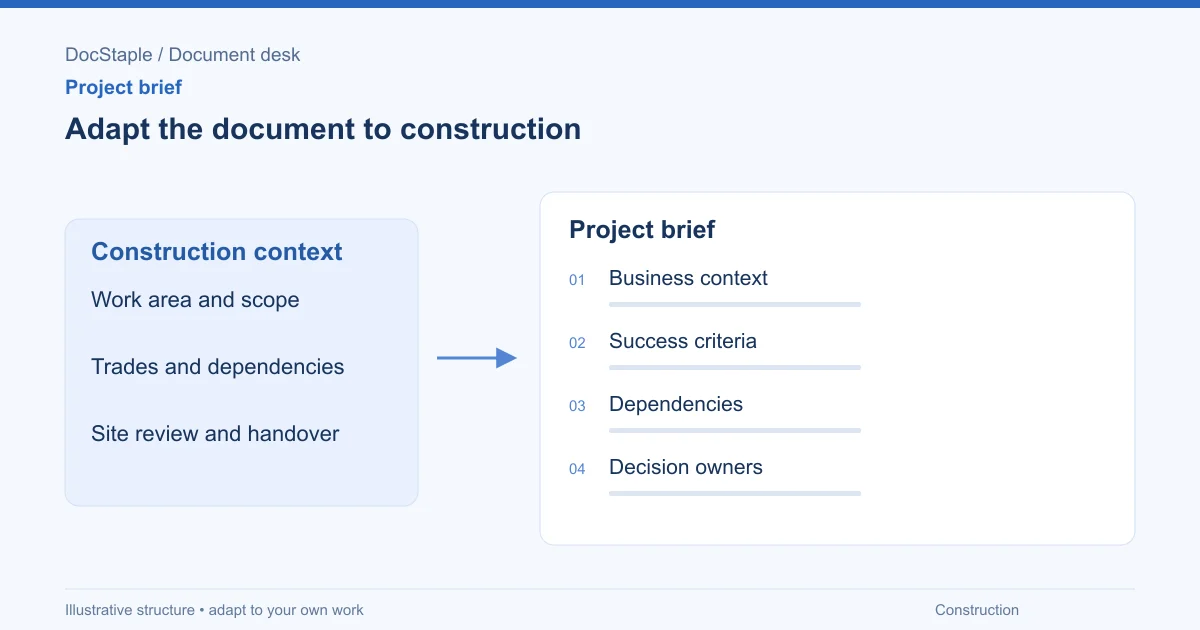
A construction project brief sits before the detailed statement of work. It helps the sponsor decide whether the project should proceed, what outcome matters and which constraints must shape the scope. This example uses a commercial fit-out in an occupied office where a tenant needs a new training room, two focus rooms and a revised reception area.
The brief is not the contract, construction phase plan or permit file. It should point to the records that will inform those documents. In Great Britain, HSE explains that as a project moves from pre-construction into construction, the principal contractor takes the lead in planning, managing, monitoring and coordinating health and safety while liaising with the client and principal designer HSE planning guidance. That matters if your project is in that jurisdiction and role structure; adapt the brief for the law and contract that actually apply.
Business context
Start with why the work is needed. Avoid jumping straight into finishes and quantities.
Context. [Client] is converting part of Level [number] from open-plan desks into training and focus areas because [business reason]. The current layout cannot support [named use], and the requested completion date is linked to [event or operational need].
Annotation: this wording ties the construction work to a business decision. It also gives later reviewers a reason to challenge scope additions that do not support the outcome.
Add evidence:
- approved floor plan or test fit
- tenant requirement or occupancy plan
- current access or operational constraints
- known permits, landlord approvals or building rules
If evidence is missing, say so. A brief should expose uncertainty early.
Success criteria
Success criteria should describe the outcome to be authorized, not every method.
The project is successful when the training room, focus rooms and revised reception area are ready for client use; the site manager signs the punch-list closeout; required handover records are received; and any outstanding items have named owners and dates.
This mirrors the construction template's acceptance idea without pretending the brief itself closes the job. For projects with more than one contractor in Great Britain, HSE's CDM guidance says a health and safety file is required for projects involving more than one contractor and contains information likely to be needed for future work HSE L153 guidance. If that applies, the brief should identify who will confirm the handover information route.
Dependencies
A construction brief should make dependencies visible before the team prices or sequences work.
| Dependency | Owner | Needed by | Consequence if late |
|---|---|---|---|
| Approved drawings | Client representative | [date] | Scope cannot be finalized |
| Landlord access approval | Client representative | [date] | Programme start moves |
| Site rules and induction process | Principal contractor/site manager | [date] | Mobilization cannot be confirmed |
| Long-lead items | Subcontractor | [date] | Finish date may need revision |
Annotation: the final column is the useful one. It stops dependencies from becoming a polite wish list.
Decision owners
A brief should distinguish input from authority. The architect, facilities manager and tenant users may all provide input, but only one person may be authorized to approve cost, sequence or scope.
Draft language:
[Client representative] owns the proceed/defer decision. [Site manager] approves site access and closeout readiness. [Subcontractor lead] confirms buildability assumptions. User representatives may provide comments on layout and disruption windows, but they do not approve scope changes.
This is especially important in occupied sites, where well-meaning users may request changes during walkthroughs. The brief should make clear where those requests go.
Show draft language and approval check
Use an approval section that gives the sponsor choices.
Decision requested. Approve the project to move into detailed SOW and pricing; approve with the conditions listed below; defer pending missing evidence; or reject because the business case is no longer current.
Conditions. Approval is conditional on confirmation of [landlord approval], [drawing revision], [access window] and [budget range].
Approval check:
- Does the brief state the business reason for acting now?
- Are success criteria tied to usable space and handover evidence?
- Are constraints and dependencies owned?
- Is the decision owner authorized for cost, timing and scope?
- Are jurisdiction-specific safety or building requirements referenced without overclaiming compliance?
A good construction brief makes the later SOW easier because it has already separated desired outcome, constraints and authority.
Worked decision: one-stage fit-out or phased occupation
In the occupied-office scenario, the sponsor wants the training room ready quickly, but the reception revision affects visitors, deliveries and daily staff movement. The brief should not jump straight to a single "complete by" date if the evidence shows different parts of the project have different business value and disruption profiles.
Two choices are on the table. A one-stage fit-out may be cheaper to coordinate because trades mobilize once and finish the whole area together. A phased approach may let the training room open earlier while reception work waits for a quieter access window. The brief should compare the choices against the business reason, not against convenience alone.
Example brief wording:
Recommended decision: proceed to SOW and pricing on a phased option. Phase 1 prioritizes the training room and two focus rooms because they support the scheduled onboarding programme. Phase 2 covers the reception revision after landlord access and visitor-routing conditions are confirmed. The SOW should price any premium for phasing separately from base construction cost.
Why this belongs in the brief: the business evidence is an onboarding need plus an occupied reception constraint. That evidence supports asking for a phased price rather than assuming the fastest construction sequence is the best business answer. It also gives the later SOW a clearer job: define packages for each area, state handover criteria for usable rooms and keep reception disruption from becoming an unpriced surprise.
The brief can make that decision more useful by naming what the sponsor is trading. A one-stage option might reduce coordination time but delay the training room until reception works are ready. A phased option might require extra protection, repeated induction steps or additional delivery bookings, yet it gives the business usable rooms earlier. Those are different decisions, not merely different schedules.
Write the comparison in business language:
Option A completes all areas together after reception access is settled. Option B opens the training and focus rooms first, then returns for reception. Option B should be priced with any remobilization or protection premium shown separately so the sponsor can decide whether earlier training-room availability justifies the extra cost.
This keeps the brief at the right altitude. It does not choose partition details or site methods; it tells the project team what outcome matters enough to test in pricing. If the sponsor later rejects the premium, the record still explains why phasing was considered and what evidence changed the decision.
Add one owner to the open question. For this scenario, the client representative can own the business tradeoff, while the site manager owns whether reception access and visitor routing can support Phase 2. Splitting those decisions stops the brief from treating a site constraint as a business preference, or a business deadline as a construction method.
Start from an editable Word draft
Use the construction project brief template to capture the fit-out reason, phasing decision, dependencies and success criteria before scope hardens. Once the brief is ready for delivery detail, use the construction statement of work template for work packages and acceptance criteria.
Last updated: September 26, 2026
Frequently Asked Questions
Related Articles
Change Request Best Practices for Client Delivery
Change request best practices for documenting the reason, scope impact, schedule and cost implications, and authorization before changed work starts.
Change Request Checklist for Reviewing Scope, Schedule and Cost
A change request checklist for consulting projects covering reason for change, scope impact, schedule and cost implications, and authorization.
Change Request Examples: Scope, Schedule, Cost and Authorization
Practical change request examples for consulting projects, with annotated language for the reason, scope impact, schedule, cost, decision and authorization.
Handover Document Best Practices for Client Delivery
Handover document best practices for completed work, outstanding actions, access, operating instructions, acceptance, and ownership.
Handover Document Checklist: Completed Work, Open Actions and Ownership
A practical handover document checklist for consulting work, with review gates for completed work, outstanding actions, access, operating notes and acceptance.
Handover Document Examples for Consulting Work
Handover document examples for consulting teams, covering completed work, outstanding actions, access and operating instructions, and acceptance and ownership.