How to Write a Consulting Project Brief
How to write a consulting project brief with realistic business context, success criteria, dependencies, decision owners and approval-ready draft language.
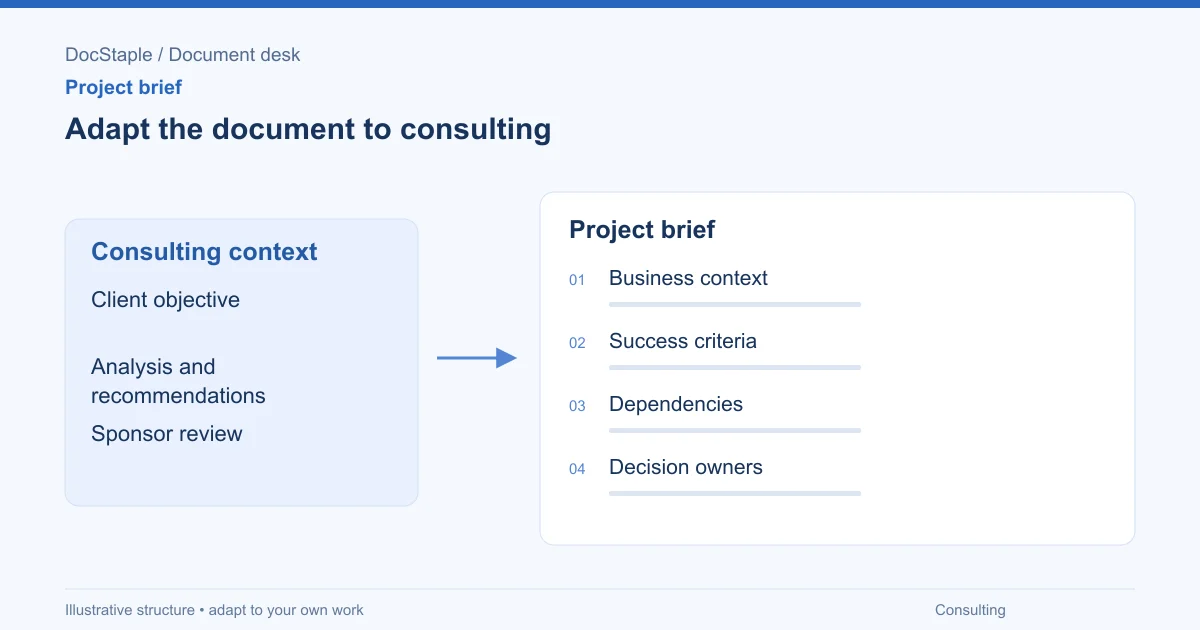
To write a consulting project brief, move from the client's decision to the team's delivery plan. The document should tell a senior sponsor why the work matters and tell the consulting team what evidence, access and approvals they need before they begin.
This walkthrough uses a realistic consulting scenario: a software company has asked a consulting firm to review its enterprise renewal process. Renewal managers report that handoffs between customer success, finance and legal delay some high-value renewals. The sponsor wants a recommendation before annual planning. The project brief must support discovery without assuming the answer.
Step 1: Define The Consulting Situation
Begin by identifying the commercial and operational setting. A consulting brief should stay aligned with the approved engagement, but it should not repeat the sales proposal word for word.
Use three inputs:
- The approved proposal or engagement letter.
- Sponsor conversations about the decision they need.
- Evidence already available, such as process notes, system reports or prior meeting records.
Draft the context like this:
[Client] needs to decide whether the enterprise renewal process should keep its current team-by-team handoffs or move to a single renewal-readiness owner. The sponsor reports late legal review, inconsistent discount approval timing and limited visibility before renewal deadlines. The project will diagnose the current workflow, identify the highest-impact delays and recommend practical changes for annual planning.
Annotation: "Needs to decide" points the project toward a business choice. "Sponsor reports" avoids presenting untested claims as findings. "Practical changes for annual planning" limits the level of detail expected from the engagement.
For U.S. federal procurement, FAR 8.405-2 requires statements of work for covered service orders to include work description, place of performance, period of performance, deliverable schedule, performance standards and special requirements (Acquisition.GOV FAR 8.405-2). Your private consulting brief may not fall under that rule, but those categories make a useful completeness check.
Step 2: Turn Context Into Scope
Scope should tell readers what the consulting team will examine and what it will leave alone. In consulting, the dangerous items are usually adjacent topics that feel related to the sponsor's problem.
For the renewal review, write scope boundaries this way:
Included: stakeholder interviews with customer success, finance and legal; review of supplied renewal-stage data; current-state workflow map; delay-pattern analysis; recommendation options; sponsor presentation.
Excluded: contract redlining, legal advice, CRM configuration, compensation-plan changes, customer negotiations and implementation management.
The exclusions matter because they protect the engagement from silent expansion. If legal review delays renewals, someone may ask the consultants to rewrite legal playbooks. If discount approval delays renewals, someone may ask for compensation changes. Those may be valid projects, but they are not automatically part of this brief.
Add a change route:
Requests that change the intended outcome, deliverables, timeline or excluded topics require sponsor approval and a revised brief or change request.
That sentence gives the delivery lead a calm way to handle expansion requests.
Step 3: Write Success Criteria
A consulting project brief should define success in terms of a usable decision, not a guaranteed business result. Renewal speed may improve later, but this project may only produce a recommendation.
Weak version
The project will improve renewal performance and reduce delays.
Better version
The project succeeds when the sponsor can approve, reject or defer each recommended workflow change because the report states the evidence reviewed, affected teams, expected operational impact, implementation owner, assumptions and unresolved decisions.
This version gives the sponsor a review standard. The report either contains evidence, owners and assumptions or it does not.
If the client asks for measurable targets, state the evidence condition:
Any quantified delay estimate will use [system report] for [period]. If the available data does not support a reliable estimate, the report will describe observed patterns and state the limitation.
FAR Subpart 11.4 says U.S. federal delivery or performance schedules should be realistic and reflect the nature and complexity of the project (Acquisition.GOV FAR Subpart 11.4). For a consulting brief, apply the same judgment before promising a review date that depends on interviews, data access and sponsor availability.
Step 4: Map Dependencies And Evidence
Dependencies are the materials, access and decisions the consulting team cannot control. Write them before the kickoff so the sponsor sees what the project needs.
Worked dependency example
| Need | Owner | Due | If missing |
|---|---|---|---|
| Renewal-stage export for last [period] | Revenue operations lead | [date] | Findings state data limitation |
| Interview access to finance approvers | Sponsor delegate | [date] | Approval-delay analysis narrowed |
| Current discount approval policy | Finance lead | [date] | Policy-related findings remain draft |
| Midpoint review with sponsor | Sponsor | [date] | Options not finalized for report |
Annotation: The table does not just ask for inputs. It tells the team what happens when inputs do not arrive. That keeps the project from quietly absorbing delay.
Also define the evidence log. A consulting brief can say:
The delivery team will maintain an evidence log showing source type, date received, owner and related finding. Recommendations will distinguish verified records, stakeholder observations and consulting assumptions.
This is useful in a renewal process review because interviews may conflict with system data. The brief should tell the team how to label that conflict.
Step 5: Name Decision Owners
Consulting projects often attract reviewers who have strong opinions but limited authority. A brief should respect their expertise without letting review turn into diffuse approval.
Draft decision ownership like this:
Executive sponsor: [Name]. Approves the brief, confirms trade-offs and accepts the recommendations report for annual planning.
Process owners: [Names]. Validate current-state facts for customer success, finance and legal.
Consulting engagement lead: [Name]. Owns delivery method, workplan and evidence sufficiency.
Quality reviewer: [Name]. Reviews whether recommendation language is supported by documented evidence before the sponsor presentation.
The U.S. Department of the Interior service-contract rule asks agencies to consider whether they have resources to evaluate contractor performance when advice or recommendations may influence agency decisions (DIAR 1437.1). For private consulting, the same practical question matters: who can judge the recommendation before it becomes the basis for action?
Step 6: Assemble Approval-Ready Language
After drafting the pieces, combine them into a compact brief section:
Business context. [Client] needs a decision before annual planning on whether enterprise renewal handoffs should stay team-owned or move to a single renewal-readiness owner. The sponsor reports late legal review, inconsistent discount approval timing and limited visibility before renewal deadlines.
Intended outcome. The project will produce a recommendations report comparing practical workflow changes, supported by interview findings, supplied renewal data and policy review.
Scope. Included activities are stakeholder interviews, renewal-data review, current-state workflow mapping, delay-pattern analysis and sponsor presentation. Excluded activities are contract redlining, legal advice, CRM configuration, compensation-plan changes and implementation management.
Success criteria. The sponsor can approve, reject or defer each recommendation because the report states evidence, assumptions, affected teams, owner and next step.
Dependencies. The timetable depends on interview access, renewal-stage data, current approval rules and sponsor review dates listed in Appendix A.
Decision owners. [Sponsor] approves project trade-offs and final recommendations. Process owners validate facts. The consulting engagement lead owns evidence sufficiency.
Before using the brief, run this approval check: does the sponsor understand the decision, do process owners agree the fact-review role is theirs, and does the delivery lead have a clear route for missing evidence? If one answer is no, revise before kickoff.
Start From An Editable Consulting Brief
The consulting project brief template gives you an editable Word structure for problem and intended outcome, scope and constraints, stakeholders, delivery plan, success criteria and approval. Use it to draft the first version, then replace the sample language with verified facts from the approved engagement and sponsor review.
Last updated: September 26, 2026
Frequently Asked Questions
Related Articles
Change Request Best Practices for Client Delivery
Change request best practices for documenting the reason, scope impact, schedule and cost implications, and authorization before changed work starts.
Change Request Checklist for Reviewing Scope, Schedule and Cost
A change request checklist for consulting projects covering reason for change, scope impact, schedule and cost implications, and authorization.
Change Request Examples: Scope, Schedule, Cost and Authorization
Practical change request examples for consulting projects, with annotated language for the reason, scope impact, schedule, cost, decision and authorization.
Handover Document Best Practices for Client Delivery
Handover document best practices for completed work, outstanding actions, access, operating instructions, acceptance, and ownership.
Handover Document Checklist: Completed Work, Open Actions and Ownership
A practical handover document checklist for consulting work, with review gates for completed work, outstanding actions, access, operating notes and acceptance.
Handover Document Examples for Consulting Work
Handover document examples for consulting teams, covering completed work, outstanding actions, access and operating instructions, and acceptance and ownership.