How to Write a Construction Project Status Report: Milestones, Risks and Decisions
How to write a construction project status report for a commercial fit-out, with draft language for site milestones, decisions, risks, blockers and next reporting period.
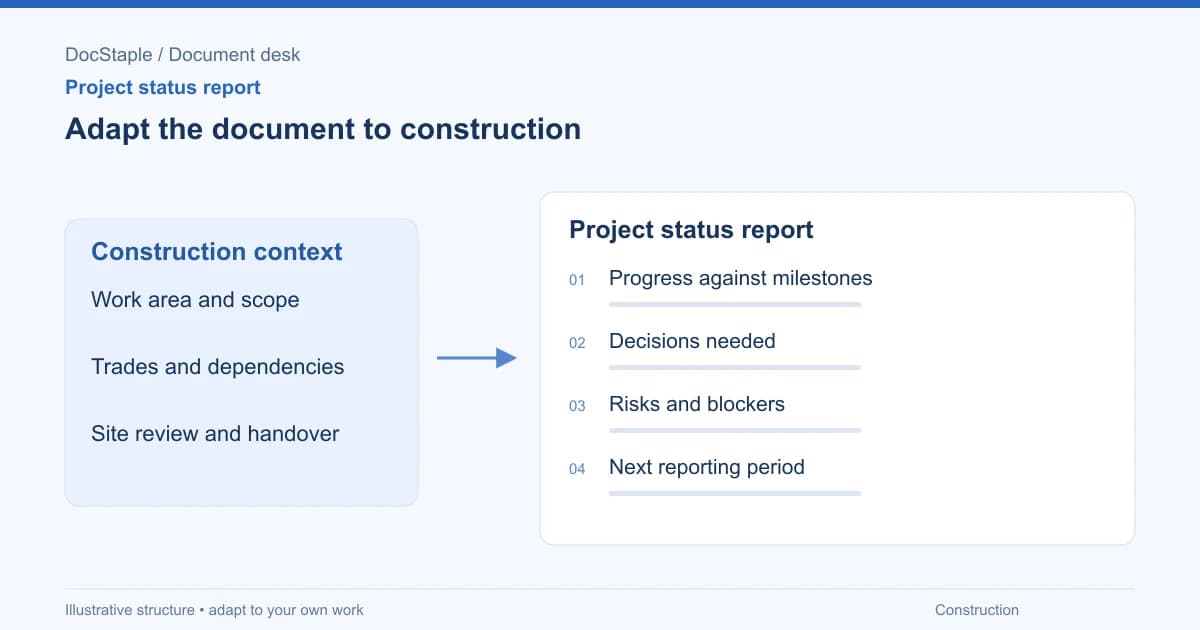
A construction project status report is not a site diary. It is the management view of what changed, what is on track, what needs a decision and what could affect the next period. A good report connects progress to drawings, milestones, access, inspections and open risks.
This guide uses a fictional scenario: a commercial office fit-out is midway through construction. Partitions are mostly complete, ceiling works are starting, several client finish selections are late, and the site manager needs decisions before the next trade sequence. Laws, permits, safety duties and contract requirements vary by jurisdiction. Follow the project contract and qualified advice for legal or safety obligations.
Start With Period, Baseline And Site Position
The report header should make the status clear without requiring a meeting.
Project: [Commercial fit-out project]
Reporting period: [dates]
Baseline: Programme revision [number], drawings [numbers and revisions], approved change register dated [date]
Overall status: Needs attention. Partition works are progressing to revised programme, but ceiling close-in may be affected unless lighting selections are confirmed by [date].
Do not rely on color alone. Explain the site fact behind the status.
The Federal Highway Administration describes major project delivery as moving through planning, design, construction and closeout phases with cost and schedule risk assessments, financial plans and project management plans at defined points for major projects (FHWA Major Project Delivery Process). A private fit-out is much smaller, but the same reporting logic applies: status should show where the project is in the delivery sequence and what risks affect cost or schedule.
Report Progress Against Construction Milestones
Construction status should be tied to milestones and evidence, not only percent complete.
Sample table:
| Milestone | Baseline | Current status | Evidence | Impact |
|---|---|---|---|---|
| Partitions to zones A and B | [date] | Complete except room [x] | Site inspection [ref] | No programme impact if resolved by [date] |
| Ceiling grid start | [date] | Ready in zone A, delayed in zone B | Drawing R[rev], site photo ref | Dependent on lighting selection |
| Client finishes approval | [date] | Late | Selection schedule | May affect flooring order |
Draft narrative:
Partition installation in zones A and B is substantially complete against drawing [number, revision]. Room [x] remains open because [reason]. Ceiling grid can start in zone A on [date]. Zone B depends on lighting selection approval by [date].
The State of Michigan Project Management Methodology says status reporting provides information on progress and key activities and identifies issues and risks that must be resolved (Michigan PMM Manual). In construction, "progress" should be anchored to the programme, drawings and inspection records.
Make Decisions Needed Impossible To Miss
Late decisions often create site delay. Put them near the top.
Decision needed by [date]: Confirm final lighting selection for meeting rooms.
Owner: Client representative.
Reason: Ceiling close-in cannot proceed in zone B without fixture confirmation.
Impact if delayed: Ceiling and follow-on finishes may move by [number] days, subject to subcontractor availability.
Add only decisions the recipient can make. If the client cannot decide a technical issue without designer input, identify both:
Designer to confirm compatibility by [date]. Client representative to approve selected option by [date].
This keeps the report from blaming the wrong person.
Separate Risks, Blockers And Changes
A construction report should distinguish:
- Risk: possible future event.
- Blocker: current obstacle.
- Change: approved or proposed alteration to scope, cost or time.
Example:
Risk: Flooring delivery may miss planned install date if color selection is not approved by [date].
Trigger: No approved selection by [date].
Response: Supplier to confirm last order date; client representative to approve selection.
Blocker: Access to level [x] loading bay unavailable during [dates].
Owner: Building management.
Action: Site manager to confirm alternate delivery window by [date].
Change: CR-04 for upgraded reception joinery submitted on [date]. Awaiting client approval. No procurement or fabrication starts until approval is received.
FAR Part 43 covers preparing and processing U.S. federal contract modifications, including construction and architect-engineer contracts (FAR Part 43). Your private project may use a different contract, but the management principle is portable: changed work should be recorded against the baseline and authorized through the agreed route.
State Next Reporting Period Commitments
End with the next period. Construction teams need to know what is coming, not only what happened.
Next period commitments
- Complete partition closeout in room [x] by [date], subject to access.
- Start ceiling grid in zone A on [date].
- Confirm lighting selection for zone B by [date].
- Update change register after decision on CR-04.
- Issue revised two-week lookahead by [date].
If a commitment is conditional, state the condition. Do not make the programme look cleaner than the site.
Add evidence references where they matter:
Evidence references: Site inspection record [ref], drawing register [date], selection schedule [date], change register [date], two-week lookahead revision [number].
This keeps the status report linked to the working project records. It also prevents the report from becoming the only place where an issue is described. A status report can summarize the open lighting decision, but the selection schedule should still hold the detailed finish information and the change register should still hold approved changes.
Use careful wording for estimated impacts:
Potential delay is currently estimated at [number] days, subject to subcontractor availability and approval of the revised sequence. This estimate is for status reporting and is not a formal contract notice.
That distinction matters. Many construction contracts contain notice procedures with specific wording, timing and recipients. A weekly report should not accidentally imply that those procedures have been satisfied.
Approval Check Before Sending
Review the report:
- Does it identify the period and baseline programme?
- Are drawing revisions current?
- Are milestone claims supported by inspection, photo or site records where appropriate?
- Are decisions assigned to people who can make them?
- Are risks, blockers and changes separated?
- Are schedule and cost impacts stated as estimates when not approved?
- Are next-period commitments realistic?
- Does the report avoid replacing formal notices required by the contract?
Formal notices, claims and safety reports may have required formats or deadlines. A status report should not pretend to satisfy those requirements unless qualified counsel or the contract administrator confirms it.
Add a final reviewer when the project is sensitive:
Review before issue: Site manager confirms progress statements; project manager confirms schedule impacts; contract administrator confirms whether any separate notice is required.
This three-part review is especially useful when the report mentions delay, access restrictions, design information or proposed changes. It keeps factual site progress, programme effect and contract administration from being blended into one unreviewed paragraph.
Keep the issued report with the project records.
Start From An Editable Structure
The construction project status report template is an editable Word file with sections for period and overall assessment, progress against milestones, decisions needed, risks and blockers, next reporting period and approval. It helps structure site reporting, but it does not replace contract notices, statutory records or safety documentation required in the project jurisdiction.
Last updated: September 26, 2026
Frequently Asked Questions
Related Articles
Change Request Best Practices for Client Delivery
Change request best practices for documenting the reason, scope impact, schedule and cost implications, and authorization before changed work starts.
Change Request Checklist for Reviewing Scope, Schedule and Cost
A change request checklist for consulting projects covering reason for change, scope impact, schedule and cost implications, and authorization.
Change Request Examples: Scope, Schedule, Cost and Authorization
Practical change request examples for consulting projects, with annotated language for the reason, scope impact, schedule, cost, decision and authorization.
Handover Document Best Practices for Client Delivery
Handover document best practices for completed work, outstanding actions, access, operating instructions, acceptance, and ownership.
Handover Document Checklist: Completed Work, Open Actions and Ownership
A practical handover document checklist for consulting work, with review gates for completed work, outstanding actions, access, operating notes and acceptance.
Handover Document Examples for Consulting Work
Handover document examples for consulting teams, covering completed work, outstanding actions, access and operating instructions, and acceptance and ownership.