How to Write a Consulting Project Status Report for Sponsors
How to write a consulting project status report with milestone progress, decisions needed, risks, blockers, next period commitments and approval checks.
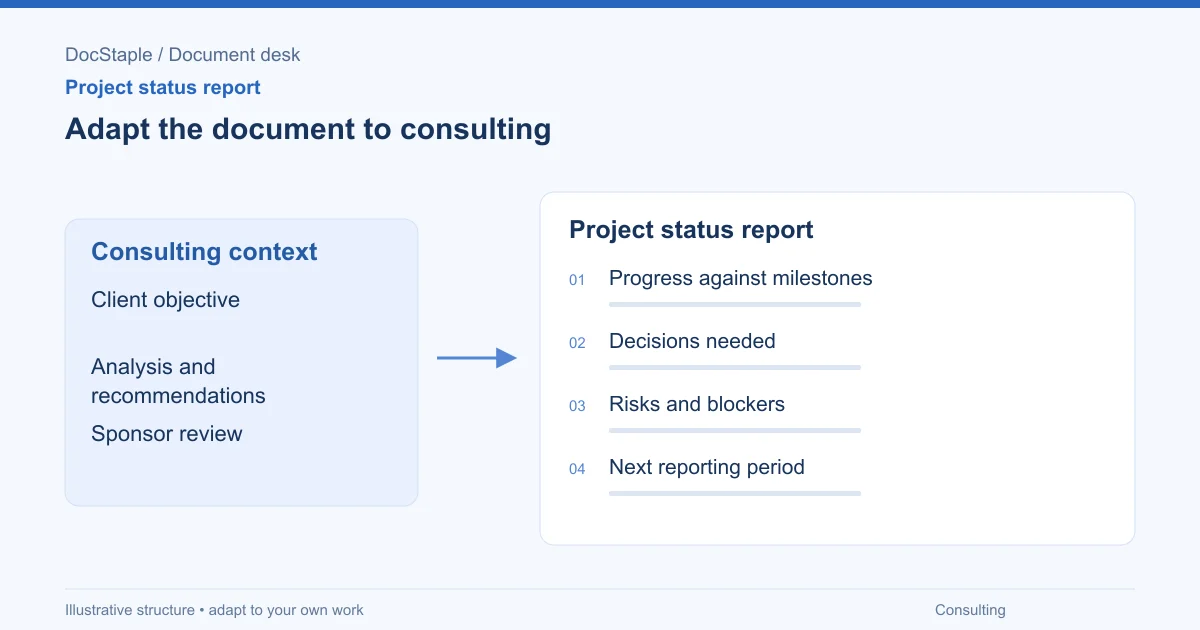
A consulting project status report should tell the sponsor what changed, what is blocked, what decision is needed and what the team will deliver next. It should not be a diary of meetings.
This guide uses a realistic scenario: a strategy review engagement is halfway through. Discovery interviews are complete, the analysis team has early findings, one data set is incomplete and the client sponsor must decide whether to add operations interviews before the recommendations report.
Start With Period And Overall Assessment
The first lines should make the reporting period and management message unmissable.
Draft language
Reporting period: [dates]
Overall assessment: Needs attention. Discovery interviews are complete, but the customer data file is missing the first-use timestamp needed for quantitative validation. The recommendations report remains achievable if the corrected file is received by [date] and the sponsor decides on additional operations interviews by [date].
Annotation: This opening explains why the project is not simply "green." It also states the two conditions that determine whether the next milestone stays achievable.
The State of Michigan Project Management Methodology describes status reporting as a way to communicate progress, key activities, issues and risks that must be resolved (Michigan PMM manual PDF). That is government project guidance, but it captures the role of a consulting status report: support decisions, not decorate activity.
Add a baseline reference in the header whenever the engagement is moving quickly:
Baseline: Project brief v2, delivery plan v4 and decision log updated [date].
That small line helps the sponsor know which version the report is measuring against. It also reduces arguments about whether a late request is a delay, a change or a new workstream.
Report Progress Against Consulting Milestones
Consulting milestones are often deliverable-based: discovery complete, analysis reviewed, options agreed, recommendations presented. Tie each milestone to evidence and variance.
Worked example: strategy review milestone table
| Milestone | Baseline | Current status | Evidence | Impact |
|---|---|---|---|---|
| Complete discovery interviews | [date] | Complete | Interview tracker v3 | No impact |
| Receive customer onboarding data | [date] | Incomplete | Data receipt note | Quantitative validation delayed |
| Draft recommendations outline | [date] | In progress | Outline v1 | Depends on evidence gap |
| Sponsor options review | [date] | Scheduled | Calendar hold | Agenda pending |
Draft narrative
Discovery interviews are complete against the approved participant list. The team identified three recurring onboarding issues: handoff delay, inconsistent first-use guidance and unclear ownership after implementation. Quantitative validation remains limited until the corrected data file is received.
Annotation: This language separates what is known from what is not yet validated. It helps the sponsor understand confidence level, not just task completion.
Put Decisions Needed Near The Top
Consulting reports are most useful when they name the decision the sponsor can make now.
Decision table
| Decision needed | Owner | Needed by | Impact if delayed |
|---|---|---|---|
| Approve two operations interviews | Client sponsor | [date] | Operations evidence may be absent from final report |
| Confirm whether pricing analysis is out of scope | Client sponsor | [date] | Team may spend time on unapproved analysis |
| Choose review format for recommendations | Steering chair | [date] | Final meeting may not reach sign-off |
Draft language
Decision required by [date]: approve or reject two additional operations interviews. If approved, the consulting team will add findings to the evidence log by [date]. If not approved, the recommendations report will state that operations validation was not completed.
Annotation: The decision has two paths. That is better than "awaiting client input," which does not tell the sponsor what happens next.
The California Project Management Framework says monitoring and controlling uses current metrics and progress reports against plans to identify issues and risks early (California PMF monitoring and controlling). A visible decisions section turns that early warning into something the sponsor can act on.
When a decision is outside the sponsor's authority, say so. For example:
Sponsor input requested by [date]. Formal approval, if required, sits with the steering group on [date].
That prevents the report from assigning approval pressure to the wrong person.
Separate Risks And Blockers
Risks are possible future events. Blockers are already stopping work. A consulting status report should not blur them.
Worked example: risk versus blocker
Risk: Recommendations may be challenged if operations interviews are not added.
Trigger: No sponsor decision by [date].
Response: Engagement lead will mark affected recommendations as limited or remove them.
Blocker: Customer data file lacks first-use timestamp.
Owner: Client data lead.
Action: Provide corrected file by [date].
Current impact: Quantitative comparison cannot be completed.
Annotation: The risk is conditional. The blocker is current. Each has a different owner and response.
Decision analysis: include a confidentiality risk?
If the engagement involves sensitive interview notes, include confidentiality only when it affects delivery behavior:
Risk: Interview quotations may reveal individual employees if used verbatim in the sponsor deck. Response: consulting manager will aggregate themes and remove identifying details before circulation.
That is better than a generic "confidentiality risk remains." It tells the sponsor what control is being applied.
Commit To The Next Reporting Period
The next-period section should be testable next week. Avoid phrases like "continue analysis" unless they are paired with concrete outputs.
Draft commitments
| Commitment | Owner | Due | Condition |
|---|---|---|---|
| Complete qualitative findings synthesis | Consulting analyst | [date] | None |
| Receive corrected onboarding data | Client data lead | [date] | Client export access |
| Add operations interviews if approved | Consulting manager | [date] | Sponsor decision |
| Issue recommendations outline | Engagement lead | [date] | Evidence review complete |
Sample language
Next period, the team will complete the qualitative findings synthesis, resolve the data dependency or record it as a limitation, and issue the recommendations outline for sponsor review. The outline will not include pricing analysis unless the sponsor approves a scope change.
Annotation: This sentence protects scope and evidence quality. It also gives the sponsor a clear expectation for the next report.
If the next period includes a client workshop, report the preparation commitment separately from the workshop outcome:
Consulting team will issue the options pack by [date]. Sponsor will confirm attendee list by [date]. Workshop decision output depends on the required decision-makers attending.
This avoids promising a decision when attendance is still uncertain.
For U.S. federal contracts, FAR 42.1106 says production progress reporting requirements should be limited to information essential to government needs and should take advantage of contractor management-system data where possible (FAR 42.1106). Private consulting engagements have different rules, but the same drafting discipline applies: keep the report essential and evidence-based.
Approval Check Before Sending
Before sending the report, review it against the engagement governance:
- Does the report name the period, baseline scope and prepared-by role?
- Does the overall assessment explain the reason for the status?
- Are milestones compared with the approved delivery plan?
- Are decisions assigned to people with authority?
- Are risks, blockers and scope changes separated?
- Are evidence gaps stated plainly?
- Are next-period commitments specific and conditional where needed?
- Does the reviewer confirm that confidential details are handled correctly?
Approval language
Reviewed by [engagement lead] on [date]. Approved for sponsor circulation. Scope, evidence gaps and requested decisions have been checked against the approved project brief and decision record.
Annotation: This approval is about report readiness. It does not say the sponsor approved the decisions inside the report.
If the report includes a potential scope change, add one more reviewer before circulation. The reviewer should confirm whether the wording is only a status update or whether it must trigger the engagement's formal change route. That protects the report from becoming an accidental authorization trail.
Start From An Editable Consulting Report
The consulting project status report template is an editable Word document with sections for period and overall assessment, progress and milestones, risks, issues, decisions and next commitments. Use it as a structure for sponsor reporting, then replace the example text with your engagement scope, evidence records, decision owners and approval route.
Last updated: September 26, 2026
Frequently Asked Questions
Related Articles
Change Request Best Practices for Client Delivery
Change request best practices for documenting the reason, scope impact, schedule and cost implications, and authorization before changed work starts.
Change Request Checklist for Reviewing Scope, Schedule and Cost
A change request checklist for consulting projects covering reason for change, scope impact, schedule and cost implications, and authorization.
Change Request Examples: Scope, Schedule, Cost and Authorization
Practical change request examples for consulting projects, with annotated language for the reason, scope impact, schedule, cost, decision and authorization.
Handover Document Best Practices for Client Delivery
Handover document best practices for completed work, outstanding actions, access, operating instructions, acceptance, and ownership.
Handover Document Checklist: Completed Work, Open Actions and Ownership
A practical handover document checklist for consulting work, with review gates for completed work, outstanding actions, access, operating notes and acceptance.
Handover Document Examples for Consulting Work
Handover document examples for consulting teams, covering completed work, outstanding actions, access and operating instructions, and acceptance and ownership.