How to Write a Change Request for Scope, Schedule or Cost
How to write a change request for consulting work, with reason for change, scope impact, schedule and cost implications, and authorization language.
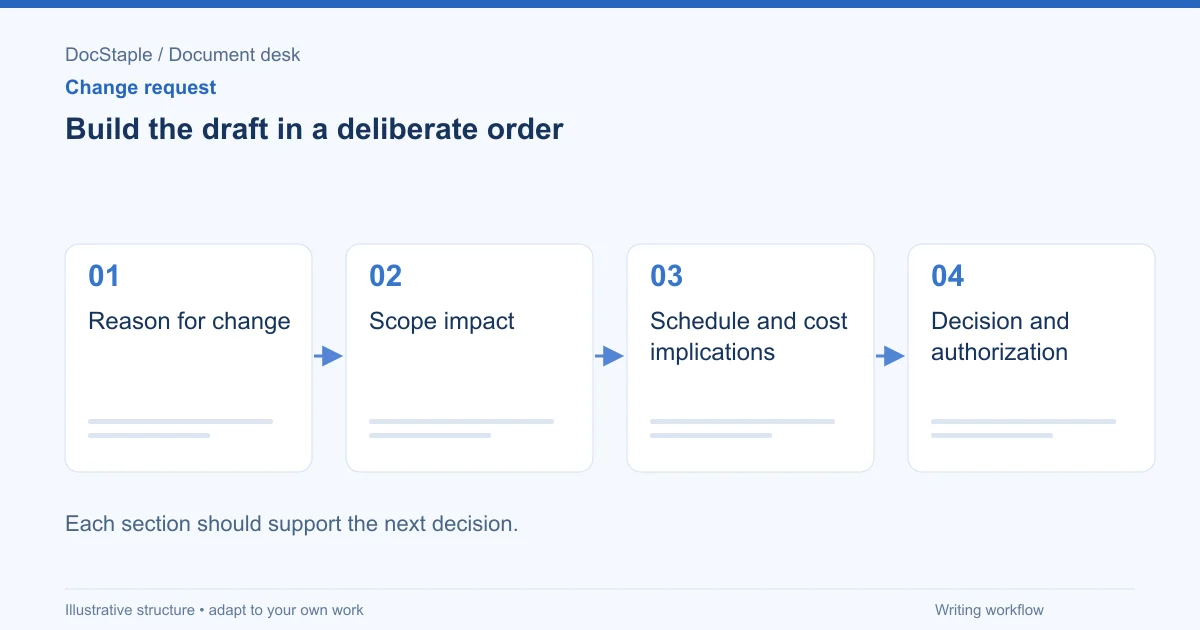
A change request turns a new ask into a decision. Without it, scope changes happen through chat messages, meeting optimism and good intentions. That is how a consulting engagement quietly becomes larger, later and harder to accept.
Scenario: a consulting team is writing a recommendations report after a six-week strategy review. The client now wants two additional stakeholder workshops and a board-ready summary. Those may be sensible, but they were not in the approved SOW.
The California Project Management Framework says a change request form documents information consistently so change approvers can make better project-wide decisions, and its template library includes a change request form and log CA-PMF templates. The Social Security Administration's archived change request template asks for change type, impact area, current baseline, proposed new cost, rationale, baseline impact and required approvals SSA change request template. Use those as structure prompts, not as authority for your private contract.
Explain the reason for change
Start with the baseline, then the request.
Approved baseline: SOW dated [date] includes one recommendations report and one sponsor review meeting.
Requested change: Add two stakeholder workshops and one board-ready summary deck.
Reason: The sponsor wants stakeholder feedback before the recommendation is presented to the executive committee. If the baseline remains unchanged, the report can still be delivered, but it will not include structured workshop input or board-format slides.
Annotation: this separates the need from the solution. The decision maker can approve the request, choose another route or keep the baseline.
Describe scope impact
Do not write "minor scope change" without evidence. List what is added, removed or altered.
| Area | Baseline | Proposed change |
|---|---|---|
| Workshops | None | Two 90-minute workshops, up to [number] participants each |
| Deliverables | Recommendations report | Add summary deck, up to [number] slides |
| Acceptance | Sponsor approves report evidence | Sponsor approves report and deck evidence |
If something is not included, say so. For example: workshop facilitation is included; detailed implementation planning is not.
State schedule and cost implications
A change request is incomplete without timing and fee effects.
Schedule impact: Draft report moves from [date] to [date] because workshops require preparation, delivery and analysis. If approval is received after [date], the revised date will be recalculated.
Fee impact: Additional fixed fee of [amount] plus pre-approved expenses. No additional work starts until approval.
If the impact is an estimate, label it and state who must validate it. Do not hide uncertainty.
Record options and recommendation
The decision maker should see alternatives, including no change.
Option 1: No change. Deliver the report as planned.
Option 2: Add workshops only. Report date moves by [number] days; no deck.
Option 3: Add workshops and board summary deck. Recommended if the executive committee will decide at [meeting].
Annotation: options stop the change request from becoming a disguised sales note. They also make rejected changes easier to document.
Capture decision and authorization
End with the approval block.
Approved / rejected / deferred by [authorized person] on [date]. If approved, the SOW baseline changes as described above. All other terms remain unchanged unless expressly stated.
Make sure the approver actually has authority under the contract or project governance. If the change affects legal terms, liability, payment remedies or regulated work, route it to the right reviewer for the relevant jurisdiction before implementation.
Worked example: choosing the smallest change that solves the need
The sponsor asks for two stakeholder workshops and a board-ready summary deck. The instinct may be to package both as one change, but a good request can show that the business need and the delivery options are not identical.
Start by naming the problem:
The sponsor needs enough stakeholder input to avoid presenting an unsupported recommendation to the executive committee on [date].
Then compare choices:
| Option | What changes | Impact | When it fits |
|---|---|---|---|
| A: no change | Report and sponsor review only | No fee or schedule change | Sponsor is comfortable presenting current evidence |
| B: one validation workshop | Add one 90-minute workshop and a short findings note | Smaller delay and fee | Sponsor needs a challenge session, not broad consultation |
| C: two workshops plus board deck | Add workshops and separate deck | Largest impact | Executive committee needs a standalone decision pack |
Recommended wording:
Recommendation: approve Option B unless the executive committee requires a separate deck. The current evidence gap is stakeholder validation, not board formatting. Option B tests the recommendation with the affected leaders while preserving the report date as far as possible. If the sponsor confirms the committee needs a standalone pack, approve Option C and move the report date to [date].
This is not indecision. It is a better commercial conversation. The evidence says the risk is untested stakeholder reaction. A board deck may be useful, but it solves a presentation-format problem rather than the evidence problem. Putting both into one bundled change can make the sponsor pay for more work than the immediate decision requires.
If the sponsor chooses Option C anyway, the request should make the trade clear:
Sponsor selects Option C because the executive committee will receive the summary deck without the full report. Sponsor accepts revised delivery date of [date] and additional fee of [amount].
That sentence protects the project from later confusion. The team is not merely adding slides; it is creating a separate deliverable for a different audience, with its own timing and acceptance path.
The change request should also say what happens to the original report if the new deck is approved. Otherwise the team may build two overlapping products and invite conflicting comments.
Example wording:
The recommendations report remains the primary evidence record. The board summary deck will summarize the agreed recommendation, decision options and implementation considerations for executive review. Comments on the deck will not reopen interview evidence unless the sponsor raises a factual error or approves additional analysis.
That boundary follows from the scenario. The original SOW promised a recommendations report. The added deck serves a presentation purpose, so it should not silently become a second route for rewriting the analysis.
If the sponsor asks for both speed and extra consultation, the request can make the trade visible:
To preserve the original report date, approve Option B and hold one validation workshop by [date]. To include two workshops and a separate deck, approve Option C and move the draft report to [date]. The team does not recommend attempting Option C on the original schedule because workshop preparation, attendance, synthesis and deck review would overlap with final report quality control.
That paragraph is useful because it names the operational reason behind the schedule impact. It is not just "more work takes longer." It shows where the time goes: preparation, delivery, synthesis and review.
If procurement or finance will read the request, include the fee driver in the same plain language:
Fee is based on workshop preparation, facilitation, synthesis and deck production. It does not include additional executive interviews or implementation planning.
Finally, decide whether the change should expire. Workshop availability and executive dates can move quickly. Add:
This change request is valid if approved by [date]. After that date, consultant will confirm workshop availability and revised milestone dates before starting the additional work.
Now the request cannot be approved weeks later as though capacity and calendar assumptions were unchanged.
Start from an editable Word draft
Use the consulting change request template to compare options, state the baseline impact and record the authorized scope, fee and timing change.
Last updated: September 26, 2026
Frequently Asked Questions
Related Articles
Change Request Best Practices for Client Delivery
Change request best practices for documenting the reason, scope impact, schedule and cost implications, and authorization before changed work starts.
Change Request Checklist for Reviewing Scope, Schedule and Cost
A change request checklist for consulting projects covering reason for change, scope impact, schedule and cost implications, and authorization.
Change Request Examples: Scope, Schedule, Cost and Authorization
Practical change request examples for consulting projects, with annotated language for the reason, scope impact, schedule, cost, decision and authorization.
Handover Document Best Practices for Client Delivery
Handover document best practices for completed work, outstanding actions, access, operating instructions, acceptance, and ownership.
Handover Document Checklist: Completed Work, Open Actions and Ownership
A practical handover document checklist for consulting work, with review gates for completed work, outstanding actions, access, operating notes and acceptance.
Handover Document Examples for Consulting Work
Handover document examples for consulting teams, covering completed work, outstanding actions, access and operating instructions, and acceptance and ownership.