How to Write Meeting Minutes: A Step-by-Step Method for Project Meetings
How to write meeting minutes in four steps: prepare the header and agenda, capture decisions and action owners during the meeting, then circulate a draft and record approval. Includes a consulting worked example and a review checklist.
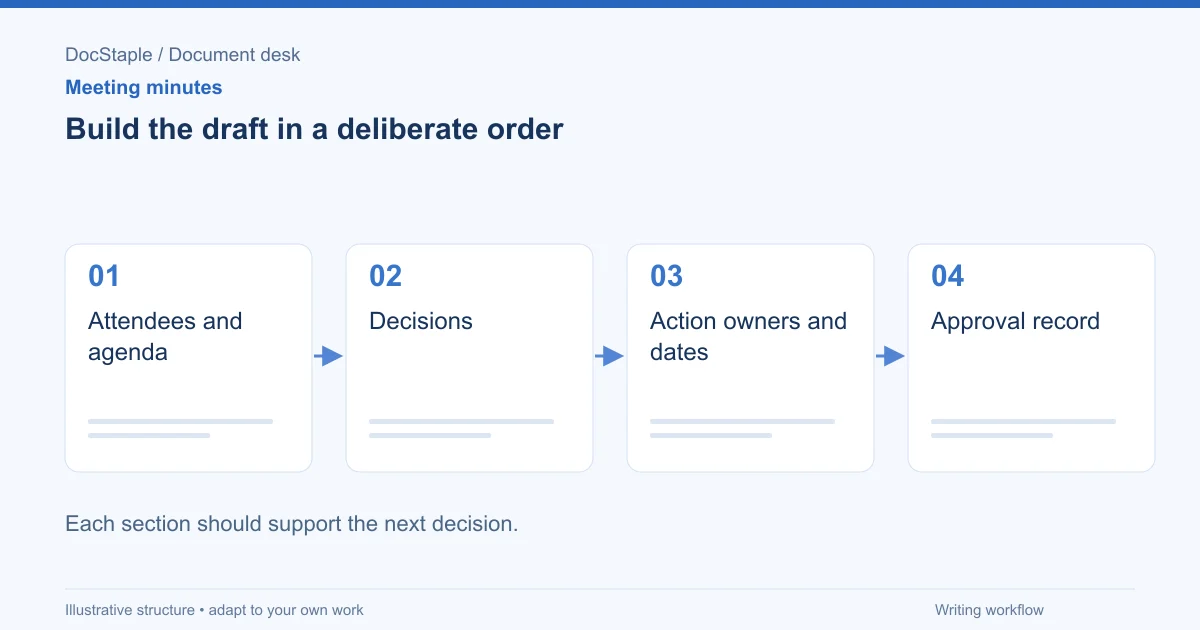
Most guidance on minutes tells you what the finished document should look like. This article covers the part that comes first: how to get from a blank page to minutes that people trust. The method has four steps, and each one takes place at a different point in the meeting cycle.
The worked example is a fictional one. A consulting firm is running a strategy review engagement, and today's meeting is a steering meeting where the team presents draft recommendations to the client sponsor. Every name, date and figure below is a placeholder to replace with your own verified facts.
Step 1: Decide what the minutes are for
Before you type anything, settle the level of detail. The most widely repeated rule is that minutes are a record of what was done, not what was said. The official Robert's Rules of Order FAQ puts it this way: "Minutes are a record of what was done at a meeting, not a record of what was said." MRSC, an advisory service for Washington State local governments, gives the same principle in its guidance on action minutes: they "record what is done at a meeting and not what is said".
Both sources are written for formal assemblies and public bodies, so treat them as a reference point and not as a rule for a consultancy. MRSC also recommends that a body formally adopt its minutes practice in a policy, and the same idea works for a project team. Write down one house style, so every set of minutes from the engagement looks alike and readers know where to look.
For client work, a practical default is:
- Record decisions, conditions and actions in full.
- Record discussion only where it explains why a decision was made.
- Record unresolved points as unresolved.
- Leave out attribution of arguments and side conversations.
Step 2: Prepare the frame before the meeting
Half of the minutes can be written before anyone arrives. The chair or organiser sends an agenda, and the minute-taker turns it into a skeleton with a header, numbered agenda items and empty space for outcomes.
For the steering meeting, the skeleton might start like this:
Strategy review engagement: steering meeting 3 Date and time: [Date], [start]–[end]. Location: [Room or video link] Chair: [Name, role]. Minutes: [Name, role] Present: [Name, role, organisation]. Apologies: [Name, role] Papers: Draft recommendations report v2; interview log v3; approved scope v1. Agenda: 1. Draft recommendations. 2. Open questions on scope. 3. Actions and next meeting.
Three preparation habits pay off later:
- List papers by version. Minutes that point to "the deck" become ambiguous once the deck changes. "Draft recommendations report v2" is precise.
- Put roles beside names. A reader who joins the project later can see who had authority to decide.
- Agree the approver in advance. Decide who reviews the draft and how long they have, so approval is not improvised after the fact.
If the Word file will hold a table for attendees or actions, set it up now. Microsoft Support explains how to insert a table for Word for Microsoft 365, 2024, 2021, 2019 and 2016: on the Insert tab, choose Table and either drag across the grid or use Insert Table to enter the number of rows and columns. Build the action table once, with columns for number, action, owner, due date and status, and reuse it for every meeting.
Step 3: Capture outcomes during the meeting
While the meeting runs, listen for outcomes, not sentences. A useful mental filter is to write something down only when it is a decision, a condition, an action or an open question.
Decisions. Note the decision, who took it and any condition attached. A draft entry for the example could read:
Item 1: Draft recommendations Decision 1.1: The report will present three options. The client sponsor agreed to drop the fourth option because it falls outside the approved scope. Condition: The engagement lead will confirm in writing that dropping the option leaves the agreed deliverables unchanged. Not agreed: Whether to add a regional comparison. The sponsor asked for a cost estimate first. Carried to the next meeting.
Naming who agreed matters. "The client sponsor agreed" carries more weight than "it was agreed". If your contract requires a formal change to scope for an item like this, the minutes should say so and point to the change process, not replace it.
Actions. Capture each action while the room is still agreeing it. Read it back before moving on: owner, deliverable, date. An action such as "team to follow up on scheduling" cannot be checked. "[Name] to send the revised interview schedule to the client sponsor by [date]" can be. Keep one accountable owner per action, even when several people will help.
Unclear moments. If you are not sure whether something was decided, ask the chair to confirm before the meeting moves on. Asking at the time takes seconds. Reconstructing it afterwards from memory takes far longer and is less reliable.
Step 4: Write up, circulate and record approval
Turn your notes into a clean draft soon after the meeting, while the context is fresh. There is no universal deadline: your contract, internal policy or, for public bodies, local rules may set one. If none does, agree a circulation date at the start of the engagement.
When you write up, tidy the wording without changing the substance. Check that:
- Each decision is separate from proposals.
- Each action has an owner, a deliverable and a date.
- Restricted or sensitive material is handled through your approved circulation process.
Then add an approval record at the end of the document:
Status: Draft for approval. Circulated to: Chair; client sponsor. Circulated on: [Date]. Corrections requested by: [Date]. Approved by: [Name, role]. Date approved: [Date]. Next meeting: [Date, time, location].
Decide what happens if nobody replies. Your contract or policy may treat silence as acceptance after a set period, or it may not. Write down the rule you agreed, and do not assume one.
Corrections also need a rule. Under Robert's Rules, the FAQ explains that corrections made when minutes are first submitted for approval are made in the text being approved, and that a later correction is recorded as a marginal notation instead of by altering the original. Those rules govern formal assemblies, but the underlying habit transfers well: keep a visible trail. Keep the reviewed draft alongside the approved copy so a reader can see what changed and why.
A short review checklist
Run this list on your draft before you send it:
- Header: Are the date, time, location, chair and minute-taker recorded?
- Attendance: Are attendees and apologies listed with roles?
- Papers: Are documents listed by version?
- Decisions: Does each decision state who agreed and any condition?
- Open points: Are unresolved items marked as such, with who will bring them back?
- Actions: Does every action have one owner, a checkable deliverable and a date?
- Length: Is discussion limited to what explains a decision?
- Approval: Does the document say whether it is a draft or approved, and by whom?
- Storage: Will the approved copy be kept with the papers it refers to?
Minutes support your project record, but they do not on their own show that a legal, contractual or regulatory requirement has been met. Some public bodies must keep minutes by law, and the rules differ by jurisdiction. If a meeting covers employment, safety, privacy or a formal governance duty, check the rules that apply to you and have a qualified adviser review your process.
Start from an editable Word draft
If you prefer not to rebuild the layout for every meeting, the consulting meeting minutes template is an editable Word file with sections for meeting details and purpose, agenda discussion and evidence, decisions and actions, and approval circulation. The steps above show how to fill those sections with verified content in place of placeholders.
Sources: Official Robert's Rules of Order FAQs, Less Is More: Action Minutes Save Time, Serve the Agency Best, MRSC, Insert a table, Microsoft Support
Last updated: September 26, 2026
Frequently Asked Questions
Related Articles
Change Request Best Practices for Client Delivery
Change request best practices for documenting the reason, scope impact, schedule and cost implications, and authorization before changed work starts.
Change Request Checklist for Reviewing Scope, Schedule and Cost
A change request checklist for consulting projects covering reason for change, scope impact, schedule and cost implications, and authorization.
Change Request Examples: Scope, Schedule, Cost and Authorization
Practical change request examples for consulting projects, with annotated language for the reason, scope impact, schedule, cost, decision and authorization.
Handover Document Best Practices for Client Delivery
Handover document best practices for completed work, outstanding actions, access, operating instructions, acceptance, and ownership.
Handover Document Checklist: Completed Work, Open Actions and Ownership
A practical handover document checklist for consulting work, with review gates for completed work, outstanding actions, access, operating notes and acceptance.
Handover Document Examples for Consulting Work
Handover document examples for consulting teams, covering completed work, outstanding actions, access and operating instructions, and acceptance and ownership.