How to Write an Onboarding Checklist
How to write an onboarding checklist that covers before arrival, access and orientation, role-specific training and completion evidence.
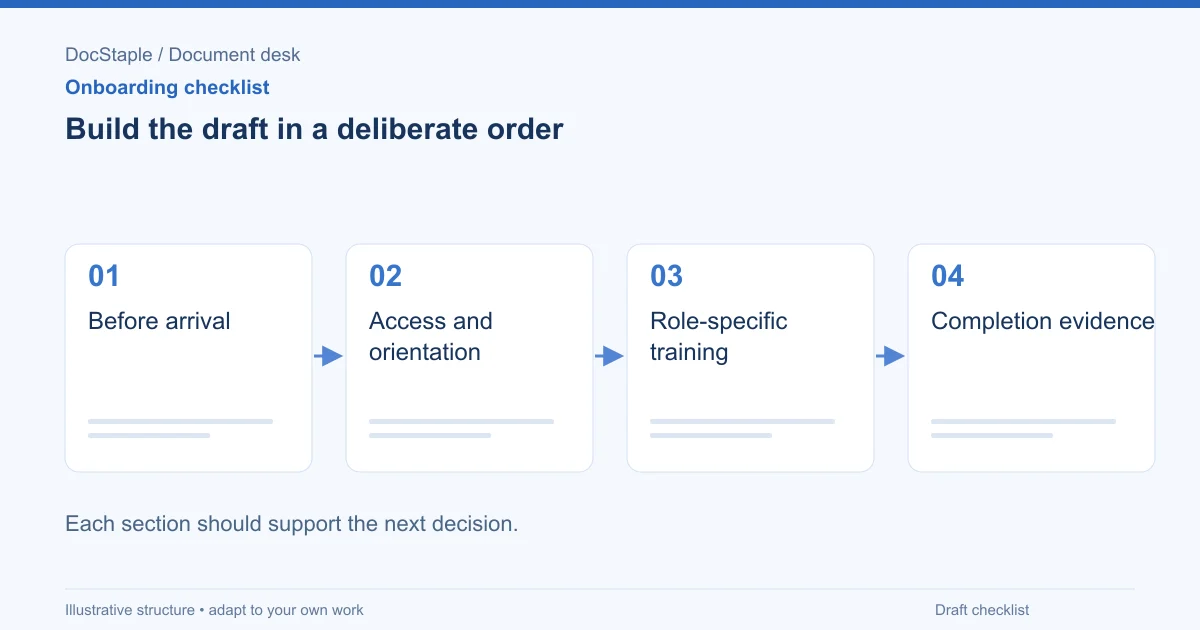
An onboarding checklist should do more than remind people to send a welcome email. It should coordinate the work that must happen before a person can contribute safely, understand their role and know where to get help.
This article uses a consulting example: a firm is onboarding a new senior analyst onto a client strategy review engagement. The analyst will handle interview notes, client documents and internal analysis. The checklist must cover HR basics, project access, role-specific training and evidence that the analyst is ready for assigned work. Employment and safety requirements vary by jurisdiction; the U.S. workplace references below are examples, not universal rules.
Define The Onboarding Outcome
Start by writing the condition that makes onboarding complete. If you skip this step, the checklist can become a long list of tasks with no clear finish line.
For the senior analyst, write:
Onboarding is complete when the analyst has required company and project access, understands confidentiality and client-communication expectations, can use the approved interview-note and evidence-log process, has completed assigned role training, and has manager sign-off for the first client-facing work package.
This sentence helps you decide which tasks belong. A generic office tour may be useful, but it does not carry the same weight as project-folder permission or confidentiality acknowledgment.
The U.S. Office of Personnel Management's sample supervisor checklist includes pre-arrival, first-day, first-week and later activities such as confirming the start date, identifying a buddy or mentor and preparing workspace arrangements (OPM sample supervisor checklist). That federal checklist is not a private-sector legal standard, but its staged structure helps you avoid cramming onboarding into day one.
Build The Before-Arrival Section
Before-arrival tasks remove friction. They also reveal ownership gaps before the new person starts.
Use a table with owner, due date and evidence:
| Task | Owner | Due | Evidence |
|---|---|---|---|
| Confirm start date, work location and first-day agenda | People operations | [date] | Confirmation sent |
| Prepare laptop and standard software | IT | [date] | Asset ticket closed |
| Create email, chat and document-system account | IT | [date] | Account record active |
| Assign onboarding buddy | Manager | [date] | Buddy notified |
| Prepare project overview pack | Engagement lead | [date] | Pack linked in onboarding file |
Annotation: The evidence column matters. "Prepare laptop" can mean ordered, imaged, shipped or ready. The checklist should make the completion point visible.
Add privacy-conscious wording for sensitive information:
Personal information and employment records will be collected only through approved HR systems. The onboarding checklist will record task status, not unnecessary personal details.
That keeps the checklist from becoming a catch-all record with information it does not need.
Add Access And Orientation Gates
Access deserves its own section because a person can be employed but still not ready to see client material. Split general company access from project access.
Worked example: project-folder access
Project folder access may be granted after the analyst completes confidentiality onboarding, the engagement lead confirms the analyst's project role, and IT applies the approved permission group. The checklist owner records the access-ticket number and date granted.
This is stronger than "grant SharePoint access" because it includes conditions and evidence. It also prevents broad access from arriving before the manager confirms need.
Orientation tasks should answer practical questions:
| Orientation task | Owner | Evidence |
|---|---|---|
| Introduce team roles and escalation contacts | Manager | First-day agenda completed |
| Review client communication route | Engagement lead | Acknowledgment recorded |
| Walk through file naming and version rules | Buddy | Sample file checked |
| Confirm timekeeping and expense process | Operations | System login verified |
OSHA says U.S. employers must provide safety training in a language and vocabulary workers can understand (OSHA employer responsibilities). If your onboarding includes safety, workplace or site procedures, record not just that training occurred but that the person could understand and apply it.
Write Role-Specific Training Items
Role-specific training should focus on the work the person will perform first. Avoid a giant library of learning links with no standard.
For the consulting analyst:
| Training item | Standard | Completion evidence |
|---|---|---|
| Interview-note method | Can label direct observation, participant claim and consultant assumption | Sample note reviewed |
| Evidence log | Can connect each finding to source, date and owner | First log entry approved |
| Client confidentiality rules | Knows storage and sharing limits for client material | Acknowledgment completed |
| Analysis review process | Can submit a workpaper for manager review | First workpaper returned with no critical gaps |
Decision analysis: training link or supervised practice?
If a task affects client evidence, use supervised practice. A learning link may be enough for timekeeping instructions, but interview notes and evidence logs need a sample review. The checklist should reserve manager time for the tasks that can damage the engagement if misunderstood.
OSHA's education and training guidance says training can help workers and managers understand workplace hazards and controls, and it calls for additional training when a worker receives a new task that could increase hazards (OSHA education and training). For office consulting work, the hazard may be information handling rather than physical equipment, but the checklist logic still holds: new task, relevant training, evidence of understanding.
Define Completion Evidence
Completion evidence turns onboarding from an assumption into a record. It does not need to be heavy. A ticket number, acknowledgment date, reviewed sample or manager note can be enough.
Use this checklist language:
The manager may mark onboarding complete for the engagement when required access is active, orientation tasks are complete, role-specific training evidence is attached or referenced, the first workpaper review has no critical gaps, and remaining actions have named owners and dates.
Do not mark completion only because a week passed. Time is a schedule marker, not proof of readiness.
For a consulting analyst, keep evidence practical:
- Closed IT access tickets.
- Confidentiality acknowledgment date.
- Reviewed sample interview note.
- First evidence-log entry.
- Manager readiness note.
- Open-action list with owners.
Review The Checklist Before Launch
Before you assign the checklist, test it against the actual role.
First, remove tasks that no one will act on. A checklist full of inherited items teaches the manager to ignore it. Second, confirm that each task has one owner. Third, check whether the evidence record belongs in HR, IT, the project file or a training system. Fourth, adapt any legal, employment or safety requirement to the jurisdiction and worksite involved.
Use a short review pass:
| Gate | Question |
|---|---|
| Before arrival | Can the person start without chasing equipment, accounts or schedule details? |
| Access | Are permissions tied to role and client need? |
| Orientation | Does the person know contacts, escalation routes and first assignments? |
| Training | Does each critical skill have a standard, not just a link? |
| Completion | Can the manager explain why the person is ready or what remains open? |
Start From An Editable Checklist
The consulting onboarding checklist template gives you editable Word sections for before the start date, initial orientation, supervised practice, readiness and ongoing support. Use it to create a role-specific checklist, then replace the example entries with your organization's owners, systems and evidence requirements.
Last updated: September 26, 2026
Frequently Asked Questions
Related Articles
Change Request Best Practices for Client Delivery
Change request best practices for documenting the reason, scope impact, schedule and cost implications, and authorization before changed work starts.
Change Request Checklist for Reviewing Scope, Schedule and Cost
A change request checklist for consulting projects covering reason for change, scope impact, schedule and cost implications, and authorization.
Change Request Examples: Scope, Schedule, Cost and Authorization
Practical change request examples for consulting projects, with annotated language for the reason, scope impact, schedule, cost, decision and authorization.
Handover Document Best Practices for Client Delivery
Handover document best practices for completed work, outstanding actions, access, operating instructions, acceptance, and ownership.
Handover Document Checklist: Completed Work, Open Actions and Ownership
A practical handover document checklist for consulting work, with review gates for completed work, outstanding actions, access, operating notes and acceptance.
Handover Document Examples for Consulting Work
Handover document examples for consulting teams, covering completed work, outstanding actions, access and operating instructions, and acceptance and ownership.