Meeting Minutes Best Practices: Decisions, Actions and Approval Records
Meeting minutes best practices for consulting teams: capture attendees, agenda, decisions, action owners, due dates and approval records without writing a transcript.
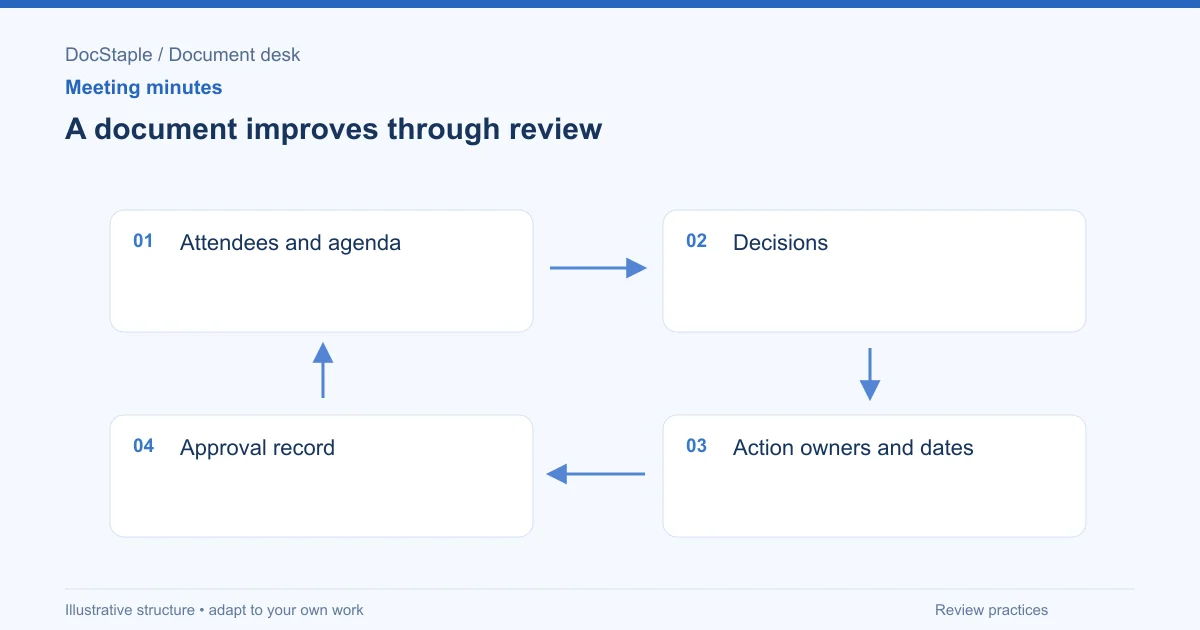
Meeting minutes are often treated as admin afterthoughts. In client delivery work, they are much more useful than that. Good minutes preserve what was decided, who owns the next action, what evidence was considered and whether the record was approved.
This article uses a consulting scenario: a weekly steering meeting for a strategy review. The consulting team is presenting discovery themes, the client sponsor is choosing which options move into analysis, and several actions are assigned. The best practices below are about business meeting records, not public-body legal compliance. If your meeting is governed by board rules, public meeting laws or a regulated process, follow the applicable jurisdiction-specific requirements.
Treat Minutes As A Decision Record
The first best practice is mental: minutes are not a transcript. They are a structured record of action.
The City of Orlando's meeting guidance says minutes are a record of action taken or assignments made and that it is not necessary to record all conversations (City of Orlando Effective Meetings). That guidance is written for neighborhood association meetings, not consulting steering committees, but the principle is useful: do not bury decisions under every spoken comment.
Weak entry
The team discussed customer interviews. There was concern about the sample and whether more interviews were needed. Several people commented on operations involvement.
Stronger entry
Agenda item: Discovery interview coverage.
Decision: Sponsor approved adding two operations interviews before options analysis.
Reason: Current interview set includes sales and onboarding, but not the team that handles first-use escalations.
Action: Consulting lead to schedule two operations interviews by [date]. Owner: [name].
The stronger entry lets a future reader see the issue, the decision, the reason and the owner. It also avoids naming every speaker unless the speaker's role matters.
Record Attendees, Agenda And Boundaries
The top of the minutes should answer basic record questions:
- Meeting title.
- Date, time and location or video platform.
- Chair or sponsor.
- Minute taker.
- Attendees and apologies.
- Agenda or purpose.
- Circulation limits, if confidential.
For a consulting meeting, add project identifiers:
Project: Strategy review of customer onboarding
Meeting purpose: Steering review of discovery themes and approval of analysis priorities
Document references: Discovery summary v0.3 dated [date]; interview list v0.2 dated [date]
Version references matter. If the minutes say "the discovery summary", nobody can tell later whether the team discussed the same draft that was revised after the meeting.
Avoid copying sensitive client information into minutes when a document reference will do. Minutes can say "see risk log item R-04" instead of reproducing a detailed complaint or confidential customer example.
Separate Decisions From Discussion
Minutes become hard to use when proposals, comments and decisions all look the same. Use labels.
Discussion: Client sponsor asked whether small-business customers should remain in scope. Consulting lead explained that the approved project brief limits the review to enterprise onboarding.
Decision: Sponsor confirmed small-business onboarding remains excluded from this phase.
Action: No action. Exclusion to remain in project brief and final report assumptions.
This is also where you prevent "soft decisions" from sneaking in. If someone says "we should probably do that", ask in the meeting whether that is a decision or a proposal for later approval.
The DC Office of Advisory Neighborhood Commissions describes meeting minutes as an official record that documents key issues, decisions, action items and responsibilities (DC OANC Meeting Minutes). Your private consulting meeting is not an ANC meeting, but the categories are still the useful ones: issues, decisions, action items and responsibilities.
Make Action Items Checkable
Every action item needs one accountable owner and one due date. "Team to follow up" is not an action item. It is a place where work disappears.
Use this structure:
| Action | Owner | Due date | Evidence of completion |
|---|---|---|---|
| Schedule two operations interviews | [Name] | [Date] | Calendar invites sent |
| Confirm whether churn data can be shared | [Name] | [Date] | Sponsor email confirmation |
| Update risk log for missing data | [Name] | [Date] | Risk log item R-07 added |
Add evidence of completion when the action matters. It makes the next meeting faster because people can check the record rather than debate whether something was "basically done."
If an action is blocked, update it in the next minutes:
Action update: A-04 remains open. Operations interviews could not be scheduled because [reason]. Sponsor to nominate alternate participants by [date].
Do not silently delete old actions. Close them, carry them forward or replace them with a new decision.
Preserve Approval And Corrections
Minutes are drafts until the agreed reviewer approves them. State the review route:
Draft minutes circulated to attendees on [date]. Corrections due by [date]. Approval by [chair or sponsor] recorded on [date]. Corrections after approval require a revised version number.
The City of Orlando guidance says approved minutes should be marked approved with the date (City of Orlando Effective Meetings). For consulting work, you can adapt that into a simple approval table:
| Version | Date | Reviewer | Status | Notes |
|---|---|---|---|---|
| v0.1 | [date] | Attendees | Draft | Corrections requested |
| v1.0 | [date] | Sponsor | Approved | Stored in project folder |
Approval does not mean everyone loved the meeting. It means the record is accepted as the record.
Avoid The Common Failure Modes
Minutes usually fail in predictable ways:
- They record discussion but not decisions.
- They name departments instead of owners.
- They miss due dates.
- They hide objections that affect the decision.
- They include confidential detail unnecessarily.
- They do not identify the document versions discussed.
- They never record approval.
Here is a better sample entry for a contested item:
Agenda item: Whether to include billing handoff in the onboarding review.
Decision: Sponsor approved including billing handoff as a dependency, not as a separate process review.
Unresolved concern: Finance lead stated that billing errors may require separate analysis. Sponsor deferred that decision until final recommendations.
Action: Consulting lead to add billing handoff as dependency D-03 in the project brief. Owner: [name]. Due: [date].
This is concise, but it does not pretend the concern disappeared.
One more failure mode is treating minutes as a place to argue the case after the meeting. If a decision was made, record the decision and the material condition attached to it. Do not improve the reasoning after the fact. A clean record might say:
Decision: Sponsor approved limiting the final analysis to enterprise onboarding.
Condition: The final report must note that small-business onboarding was outside scope and was not tested.
Dissent or concern: Sales lead stated that some enterprise customers begin in the small-business queue. Sponsor asked that this be listed as a limitation.
That wording is useful because it keeps the decision intact while preserving the limitation. It does not turn the minutes into a debate transcript. It also gives the report writer a clear instruction for the final assumptions section.
For recurring meetings, keep an action log across minutes rather than relying on memory. Number each action, carry open actions forward, and close them with a date. If an action changes materially, create a new action and refer to the old one. That habit makes the approval record easier to audit because a reader can follow the life of a decision from meeting to meeting.
Start From An Editable Structure
The consulting meeting minutes template is an editable Word file with sections for meeting details, attendees, agenda discussion, decisions, actions, approval circulation and review. It gives you a repeatable structure, but the value still comes from writing clear decisions, named owners and accurate approval records.
Last updated: September 26, 2026
Frequently Asked Questions
Related Articles
Change Request Best Practices for Client Delivery
Change request best practices for documenting the reason, scope impact, schedule and cost implications, and authorization before changed work starts.
Change Request Checklist for Reviewing Scope, Schedule and Cost
A change request checklist for consulting projects covering reason for change, scope impact, schedule and cost implications, and authorization.
Change Request Examples: Scope, Schedule, Cost and Authorization
Practical change request examples for consulting projects, with annotated language for the reason, scope impact, schedule, cost, decision and authorization.
Handover Document Best Practices for Client Delivery
Handover document best practices for completed work, outstanding actions, access, operating instructions, acceptance, and ownership.
Handover Document Checklist: Completed Work, Open Actions and Ownership
A practical handover document checklist for consulting work, with review gates for completed work, outstanding actions, access, operating notes and acceptance.
Handover Document Examples for Consulting Work
Handover document examples for consulting teams, covering completed work, outstanding actions, access and operating instructions, and acceptance and ownership.