Meeting Minutes Checklist for Decisions, Actions and Approval Records
A meeting minutes checklist for consulting teams covering attendees and agenda, decisions, action owners and dates, and approval records.
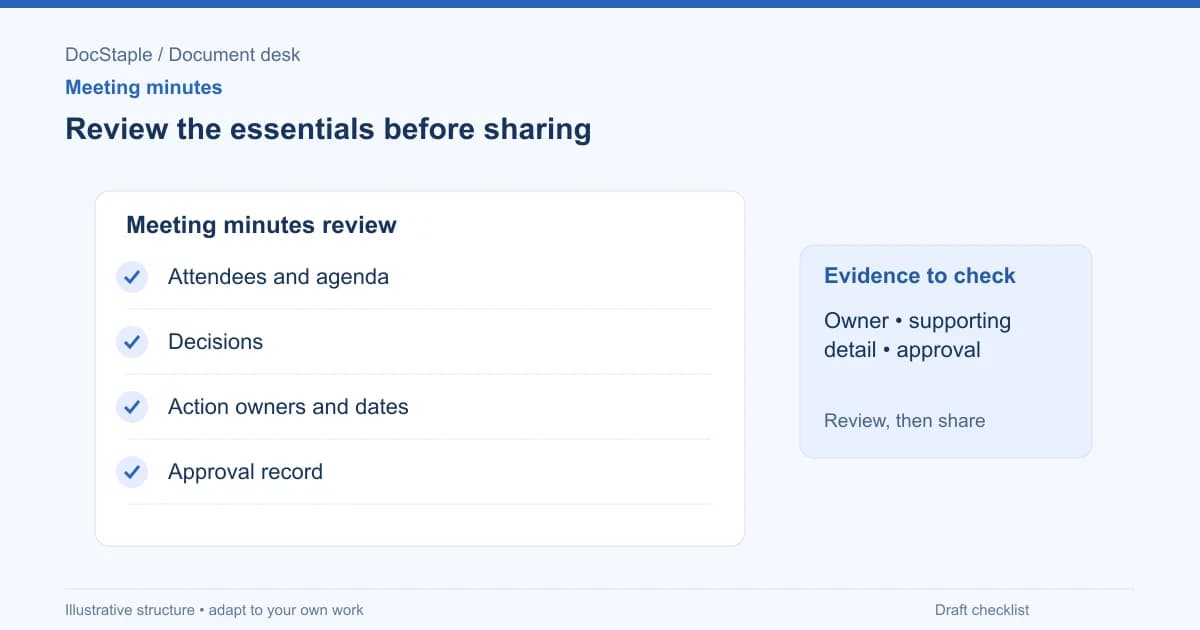
Meeting minutes are not a diary. They are a decision record. A useful checklist helps the note-taker capture what was decided, who owns the next action and how the record was approved.
This example uses a consulting project: a strategy review engagement has reached the recommendation stage, and the client sponsor is meeting with the engagement lead and subject matter experts to decide which options move forward. The meeting is not a formal public body meeting, but official guidance on records is still useful. NARA says documentation for formal meetings should include participant names and titles, agenda, distributed materials, summary of significant matters, decisions reached, actions decided, actions to be taken and assignments of responsibility NARA recordkeeping guide.
Attendees and agenda
Start with the basics because they authenticate the record.
Checklist fields:
- meeting title, date, time and location or call platform
- chair or facilitator
- attendees, roles and organizations
- apologies or absent required reviewers
- agenda items and papers reviewed
- declared conflicts or circulation limits
Draft language:
Meeting: Recommendation review for [project]. Date: [date]. Chair: [client sponsor]. Attendees: [names and roles]. Papers: recommendations report v[version], options table v[version], decision log extract dated [date].
Annotation: referencing versions is better than copying sensitive material into the minutes. It lets a later reader find the evidence without turning minutes into a data dump.
Decisions
Separate discussion from decision. A paragraph that says people "discussed implementation" is not enough.
Decision wording:
Decision 1: The sponsor approved Option B for further planning, subject to finance confirming the cost range by [date]. Option A was not selected because it requires system changes outside the current budget window.
Annotation: the decision states what happened, the condition and the reason that matters. It does not try to capture every sentence spoken.
GOV.UK's Charity Commission governance framework says board decisions are taken by resolution and recorded in the minutes, and describes a secretary role that includes circulating accurate minutes and following up action points GOV.UK governance framework. Your consulting meeting may not be a charity board, but the same habit is sound: decisions and actions should be visible and followable.
Action owners and dates
Every action needs one owner and a date. Avoid "team to follow up" because no one owns it.
| Action | Owner | Due date | Evidence of completion |
|---|---|---|---|
| Confirm finance range for Option B | [Finance lead] | [date] | Comment in decision log |
| Revise recommendations report | [Engagement lead] | [date] | Report v[next] issued |
| Confirm implementation workshop attendees | [Sponsor] | [date] | Attendee list |
If an action depends on another action, say so. If the due date is unknown, assign an owner to confirm the date rather than leaving it blank.
Approval record
Minutes become useful when people know whether they are draft, corrected or approved.
Draft approval block:
Draft minutes circulated to [names] on [date]. Corrections due by [date]. Approved by [chair/sponsor] on [date]. Approved version stored in [project record location].
Do not treat silence as approval unless that is the agreed process. For sensitive matters, record distribution restrictions and where the official copy sits. NARA also explains that records of decisions and commitments made orally or electronically should be documented and retained in appropriate recordkeeping systems NARA recordkeeping guide.
Checklist for the note-taker
Before you close the document, scan for these failure signs:
- discussion but no decision
- decision but no authority
- action but no owner
- owner but no due date
- due date but no completion evidence
- reference to a report but no version
- sensitive information copied when a reference would do
- draft minutes with no approval route
For consulting teams, meeting minutes often become the bridge between the recommendation report and the next scope decision. Keep them plain, factual and short enough that people will actually review them.
Worked example: discussion, decision or new scope?
In the recommendation review, the sponsor says, "Option B is probably the right direction, but I want finance to confirm the cost range and I want two extra stakeholder workshops before we lock it." That single comment creates three possible minute entries.
Weak entry:
Option B was discussed. Team to arrange workshops.
This is too thin. It hides the condition on the decision, creates a group-owned action and may imply the extra workshops are already authorized.
Overstated entry:
Option B was approved and two stakeholder workshops were added to the project scope.
This goes too far if finance has not confirmed the cost range and the SOW did not include workshops. The minutes would be turning a preference into approval.
Better entry:
Decision: Sponsor selected Option B as the preferred recommendation for planning, subject to finance confirming the cost range by [date]. No scope change was approved in this meeting. Sponsor asked [engagement lead] to prepare a change request for two stakeholder workshops by [date]. Until that request is approved, the recommendations report remains the current deliverable.
Why this follows from the evidence: the minutes separate three things that happened in the room. The sponsor expressed a preferred direction, set a dependency for that direction and requested analysis of extra work. Only the first two belong in the decision record. The workshops belong in a change request because they add activity not in the baseline.
If the sponsor later says the minutes are too cautious, the correction should identify what was actually authorized. For example:
Correction accepted: sponsor confirms finance approval was received during the meeting and Option B is approved for the report. Correction not accepted: workshops remain subject to separate change request because fee and timing were not agreed.
That wording keeps the minutes useful without making them combative. The note-taker is not blocking progress; they are preserving the difference between agreement in principle and authority to start new work.
There is a second useful line to add when the room agrees on direction but not detail:
Open point: finance confirmation will determine whether Option B is presented as the sole recommendation or as one of two viable options. [Finance lead] to provide cost range by [date]. [Engagement lead] to update the recommendation table after that response.
That line matters because it gives the next meeting a starting point. Without it, the team may arrive with a polished Option B story while finance believes the choice is still open. The minutes are not predicting the outcome; they are naming the hinge that controls the outcome.
If the discussion included sensitive objections, avoid turning the minutes into a transcript of who criticized whom. Use the evidence record instead:
Operations raised handoff delay as the main concern, referring to interview themes in findings matrix v[version]. Finance raised affordability, pending cost range.
This phrasing preserves the basis for the decision without copying interview detail or making the record more personal than necessary. It also helps the team decide where each follow-up belongs: finance data in the decision log, workshop scope in a change request and final recommendation wording in the report.
For recurring review meetings, carry this same decision forward until it closes. The next set of minutes should not say only "Option B discussed again." It should say whether finance confirmed the cost range, whether the change request was raised and whether the preferred recommendation changed. That continuity is what turns minutes into a reliable project record.
Start from an editable Word draft
Use the consulting meeting minutes template to capture decisions, actions, source versions and open items from the review meeting without writing a transcript.
Last updated: September 26, 2026
Frequently Asked Questions
Related Articles
Change Request Best Practices for Client Delivery
Change request best practices for documenting the reason, scope impact, schedule and cost implications, and authorization before changed work starts.
Change Request Checklist for Reviewing Scope, Schedule and Cost
A change request checklist for consulting projects covering reason for change, scope impact, schedule and cost implications, and authorization.
Change Request Examples: Scope, Schedule, Cost and Authorization
Practical change request examples for consulting projects, with annotated language for the reason, scope impact, schedule, cost, decision and authorization.
Handover Document Best Practices for Client Delivery
Handover document best practices for completed work, outstanding actions, access, operating instructions, acceptance, and ownership.
Handover Document Checklist: Completed Work, Open Actions and Ownership
A practical handover document checklist for consulting work, with review gates for completed work, outstanding actions, access, operating notes and acceptance.
Handover Document Examples for Consulting Work
Handover document examples for consulting teams, covering completed work, outstanding actions, access and operating instructions, and acceptance and ownership.