Onboarding Checklist Best Practices for Consulting Teams
Onboarding checklist best practices for consulting teams, with guidance on pre-arrival setup, access, orientation, role training and completion evidence.
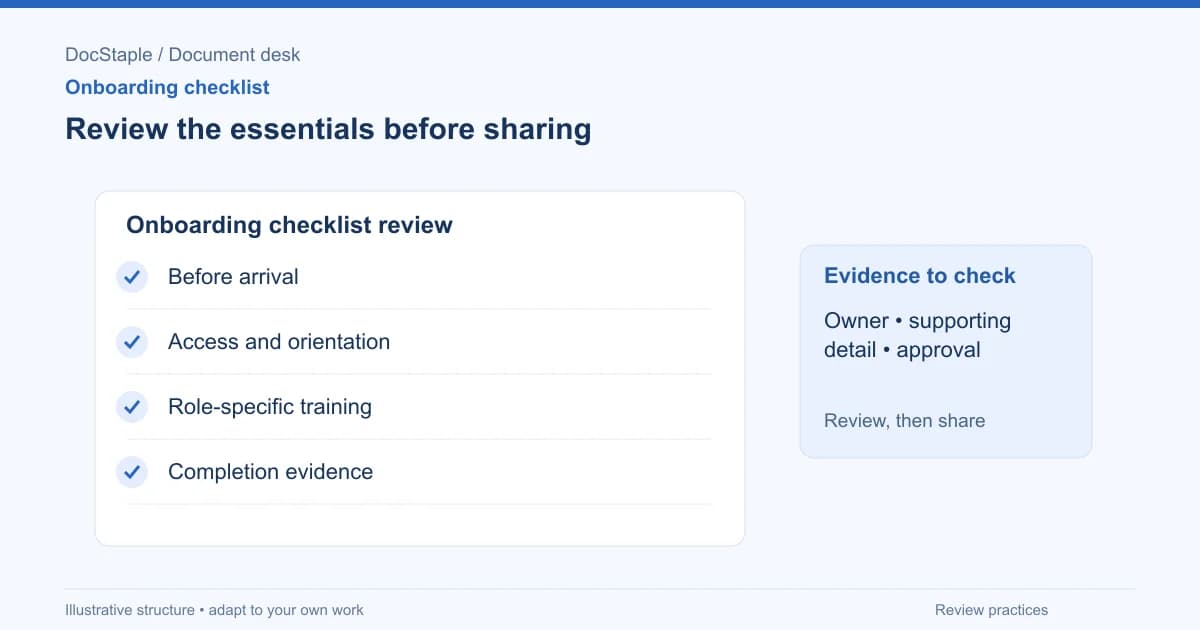
Onboarding checklist best practices matter because onboarding fails in small, practical ways: the account exists but the project folder does not, the new person attends orientation but cannot describe the first assignment, or training is marked complete without evidence that the person can apply it.
This article uses a consulting scenario: a boutique consulting firm is onboarding an experienced manager who will take over a distressed process-improvement engagement. The manager needs rapid context, access to client material, clarity on authority and proof that handover is complete. A generic new-hire checklist will miss the risk. The checklist must reflect the role and the engagement.
Use Readiness As The Organizing Principle
The best checklist design starts with readiness, not administration. Ask: what must be true before this person can work without creating confusion, rework or unacceptable risk?
For the incoming consulting manager, readiness means:
- Company access is active.
- Project material is available in the approved workspace.
- Client-contact rules are understood.
- Current project risks and commitments are reviewed.
- The outgoing lead transfers decisions, open issues and next deadlines.
- The practice lead signs off that the manager can own the next client meeting.
That readiness definition gives each checklist section a purpose. It also stops the team from treating onboarding as complete because HR tasks are finished.
The U.S. Office of Personnel Management's onboarding model describes onboarding as staged activity that can continue through first-week and later milestones, not just a first-day event (OPM onboarding model). That guidance is federal employment material, but the staged approach fits consulting handovers well.
Make Before-Arrival Work Specific
Before-arrival tasks should remove predictable friction. They should also prepare the manager's context, not just their equipment.
Worked example: incoming engagement manager
| Task | Owner | Due | Evidence |
|---|---|---|---|
| Prepare laptop and core accounts | IT | Before day 1 | Asset and account tickets closed |
| Grant role-based project workspace access | Engagement coordinator | Before day 1 | Permission record |
| Send engagement briefing pack | Outgoing lead | Before day 1 | Link sent and acknowledged |
| Schedule handover meeting | Practice lead | Before day 2 | Calendar invite accepted |
| List open client commitments | Outgoing lead | Before day 2 | Commitment log updated |
Annotation: The checklist includes project-specific context before the first meeting. A manager taking over a distressed engagement needs the commitment log as much as the laptop.
Avoid inherited tasks that do not apply. If the manager is transferring internally, some HR orientation steps may be irrelevant. Replace them with project transition items that affect client delivery.
Treat Access As A Controlled Gate
Access best practice means "right access at the right time with a record." Consulting teams often handle client documents, interview notes, commercial information and internal quality reviews. A checklist should separate these permission types.
Use a decision table:
| Access request | Grant now? | Reason |
|---|---|---|
| Project delivery folder | Yes | Needed to review workpapers and deadlines |
| Client contract and pricing folder | Only if role requires | May exceed delivery need |
| Prior personnel notes | No, unless approved | Not needed for project handover |
| Client meeting channel | Yes | Needed for communication continuity |
This table forces a permission decision instead of copying the outgoing manager's full access by default.
OSHA says U.S. employers must provide safety training in language and vocabulary employees can understand (OSHA employer responsibilities). Apply the same standard to access orientation: if the manager does not understand the boundary, the access control has not done its job.
Connect Orientation To Immediate Decisions
Orientation should prepare the person for decisions they will make soon. For a distressed engagement, the incoming manager may need to lead a client meeting within days. The checklist should prioritize decision context.
Useful orientation items:
| Orientation item | Why it matters | Evidence |
|---|---|---|
| Sponsor expectations | Prevents mixed messages | Handover note reviewed |
| Current scope boundaries | Stops accidental expansion | Brief and change log reviewed |
| Open risks | Helps manager plan escalation | Risk list updated |
| Team responsibilities | Clarifies internal authority | Role table confirmed |
| Next client meeting objective | Focuses preparation | Agenda approved |
Decision analysis: full history or decision summary?
Do not force the incoming manager to read every old note before taking action. Give them a decision summary first: current objective, open commitments, disputed facts and next approval. Archive history remains available, but onboarding should support immediate control of the engagement.
This is where consulting onboarding differs from general orientation. The goal is not only belonging; it is continuity of judgment.
Require Role-Specific Practice
Best-practice onboarding checks whether the person can perform the role's critical tasks. For an experienced manager, that may sound unnecessary, but a new client context still requires practice.
For this manager:
| Role-specific item | Standard | Evidence |
|---|---|---|
| Review current project brief | Can state objective, scope and decision owner | Practice lead discussion |
| Inspect evidence log | Can identify unsupported findings | Annotated review note |
| Prepare client meeting plan | Agenda aligns with sponsor decision | Agenda approved |
| Confirm escalation route | Knows who approves scope changes | Decision-owner note |
Worked example: evidence-log review
The incoming manager reviews three draft findings and marks each as supported, partially supported or unsupported. The practice lead checks the markings before the manager leads the next client review.
This task is not remedial. It confirms that the new manager applies the firm's evidence standard to the specific engagement.
OSHA education and training guidance notes that additional training can be needed when facilities, equipment, processes, materials or work organization changes, or when a worker receives a new task (OSHA education and training). For consulting managers, the "new task" may be a troubled client workstream with different evidence, scope and communication risks.
Record Completion Without Overbuilding The Process
Completion evidence should help the firm answer a practical question: can this person own the work now, and what remains open?
Use this completion language:
Onboarding for the engagement is complete when access is active, project context has been reviewed, open commitments are transferred, role-specific practice is complete, the next client meeting plan is approved and remaining actions have owners and dates.
Then record the proof:
| Completion item | Evidence |
|---|---|
| Access active | Permission record or ticket |
| Context reviewed | Handover checklist signed by incoming manager |
| Commitments transferred | Commitment log owner changed |
| Practice completed | Evidence-log review note |
| Client meeting ready | Agenda approved by practice lead |
Do not hide open items to make onboarding look complete. If one item remains, list it:
Open action: finance-access request pending. Owner: engagement coordinator. Due: [date]. Workaround: outgoing lead provides approved budget summary until access is resolved.
That note supports continuity better than a falsely clean checklist.
Keep The Checklist Alive After Day One
The final best practice is to revisit the checklist after the first live work cycle. For a consulting manager, that might mean after the first client meeting or first status report.
Ask:
- Did any missing access delay work?
- Did the manager understand scope boundaries?
- Did role-specific practice reveal a training gap?
- Did the client receive consistent messages during transition?
- Are open actions still owned?
Update the checklist before the next similar onboarding. Best practices become real when the document learns from the last handover.
Start from an editable checklist: The consulting onboarding checklist template includes editable Word sections for before the start date, initial orientation, supervised practice, readiness and ongoing support. Use it as a starting document for role-specific onboarding, then tailor the owners, access gates and completion evidence to the engagement.
Last updated: September 26, 2026
Frequently Asked Questions
Related Articles
Change Request Best Practices for Client Delivery
Change request best practices for documenting the reason, scope impact, schedule and cost implications, and authorization before changed work starts.
Change Request Checklist for Reviewing Scope, Schedule and Cost
A change request checklist for consulting projects covering reason for change, scope impact, schedule and cost implications, and authorization.
Change Request Examples: Scope, Schedule, Cost and Authorization
Practical change request examples for consulting projects, with annotated language for the reason, scope impact, schedule, cost, decision and authorization.
Handover Document Best Practices for Client Delivery
Handover document best practices for completed work, outstanding actions, access, operating instructions, acceptance, and ownership.
Handover Document Checklist: Completed Work, Open Actions and Ownership
A practical handover document checklist for consulting work, with review gates for completed work, outstanding actions, access, operating notes and acceptance.
Handover Document Examples for Consulting Work
Handover document examples for consulting teams, covering completed work, outstanding actions, access and operating instructions, and acceptance and ownership.