Onboarding Checklist Checklist: Review Gates Before You Use It
An onboarding checklist checklist for reviewing before-arrival tasks, access, orientation, role-specific training and completion evidence.
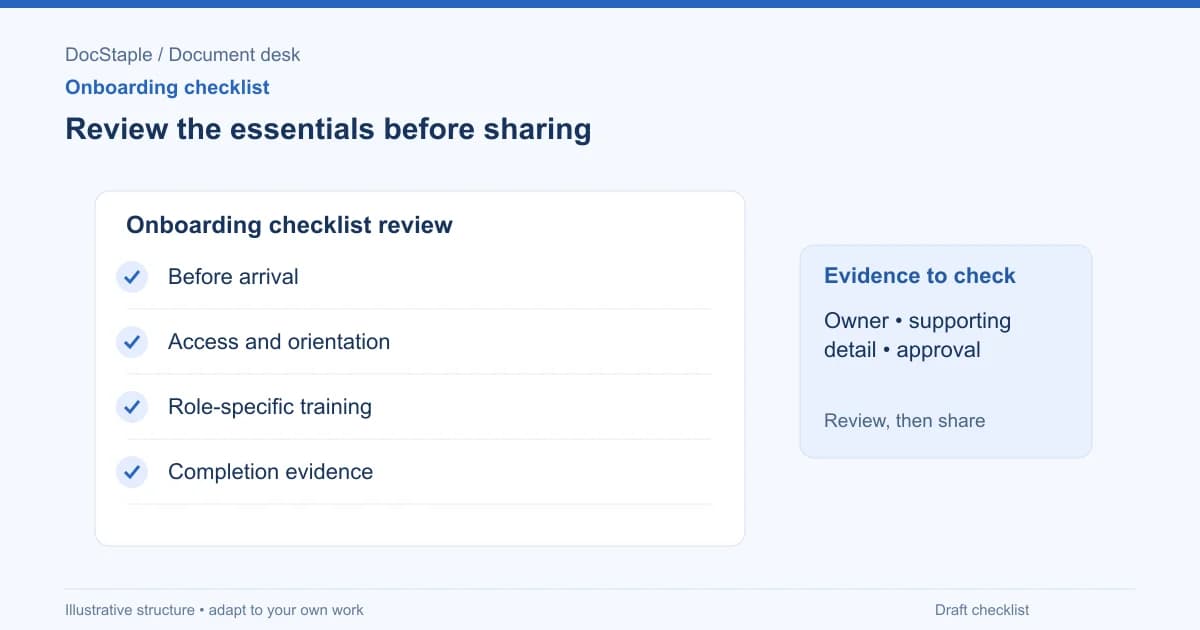
An onboarding checklist checklist helps you inspect the checklist before a new employee, contractor or project participant depends on it. The point is simple: a checklist can look complete while still missing owners, evidence, access gates or role-specific training.
This article uses a consulting scenario. A firm is preparing to onboard three contract analysts for a six-week market-entry research engagement. They will receive limited system access, work with interview summaries and produce draft analysis for a manager. The onboarding checklist must be tight enough for a short engagement and careful enough for client information.
Check 1: Before-Arrival Tasks Are Real
Start by testing whether the before-arrival section would help a person on day one. Many checklists include vague tasks such as "prepare access" or "send welcome information." A review checklist should force those lines to become specific.
Use these review questions:
| Review item | Pass standard |
|---|---|
| Start date confirmed | Date, location and reporting contact are recorded |
| Equipment prepared | Device or remote environment is assigned and tracked |
| Accounts requested | Each system has a named request owner |
| First-week schedule sent | Calendar invites or agenda exist |
| Buddy or support contact assigned | Person knows who answers practical questions |
Worked example: contract analyst setup
Weak line:
Set up analyst access before start.
Revised line:
IT requests limited document-system access, research database login and collaboration-channel access by [date]. The engagement coordinator records ticket numbers and confirms the analyst can log in before the kickoff call.
Annotation: The revised line names systems, owner, timing and evidence. It also fits a contractor scenario where access may differ from employee access.
The U.S. Office of Personnel Management's sample onboarding checklist includes actions such as confirming the start date, preparing the workspace and introducing a buddy or mentor (OPM sample supervisor checklist). That source applies to federal onboarding, but the review pattern is useful anywhere: confirm the basics before the person arrives.
Check 2: Access Matches The Role
Access review should ask whether each permission supports the role. More access than needed creates avoidable risk. Less access than needed creates day-one blockage.
For the contract analysts, the checklist should distinguish three access levels:
| Access area | Need | Review decision |
|---|---|---|
| Research folder | Required for assigned source files | Grant limited folder access |
| Client contract folder | Not needed for analysis | Do not grant |
| Interview summaries | Needed after confidentiality onboarding | Gate behind acknowledgment |
| Finance system | Not related to role | Exclude |
Decision analysis: shared folder or separate workspace?
If analysts only need prepared source packs, create a separate workspace with approved materials. If they need live project documents, grant role-based project access and record who approved it. The checklist should not leave that decision to an informal message thread.
OSHA's employer-responsibility page says U.S. employers must provide safety training in language and vocabulary workers can understand (OSHA employer responsibilities). For access and orientation, use the same clarity principle: a person should understand what they may access, what they may share and where to ask before handling work materials.
Check 3: Orientation Explains The Work
Orientation should not read like a company directory. For short consulting engagements, the new person needs to know the engagement goal, roles, first assignment, communication route and escalation path.
Review the checklist for these items:
- Engagement purpose in one paragraph.
- Team roles and who approves work.
- First task and due date.
- Client-contact rules.
- Document naming and storage instructions.
- Escalation route for unclear facts or access issues.
Sample orientation language:
During the kickoff, the engagement manager explains the market-entry research question, shows the analyst where approved source packs are stored, confirms that analysts do not contact client stakeholders directly and assigns the first research summary due by [date].
Annotation: This tells the analyst how to behave, not just where to click. It also protects the client relationship by naming the communication boundary.
If your review finds only general company orientation, add an engagement-specific section. A person can understand benefits, holidays and expenses and still be lost on the client work they were hired to support.
Check 4: Role-Specific Training Has A Standard
A checklist item that says "complete training" does not tell a manager whether the person can do the work. The review checklist should require a standard and evidence for each critical skill.
For the research analysts:
| Skill | Standard | Evidence |
|---|---|---|
| Source note quality | Separates source fact, inference and open question | Sample note reviewed |
| Citation method | Links each claim to approved source material | First summary checked |
| Confidentiality handling | Stores files only in approved workspace | Acknowledgment and spot check |
| Escalation | Flags unsupported claims before drafting | Manager review note |
Worked example: source note training
Weak line:
Analyst reviews research method.
Better line:
Analyst prepares one sample source note using the approved format. Manager checks whether the note separates direct source fact, analyst inference and follow-up question before assigning live research.
OSHA's education and training guidance says training helps workers understand hazards and controls, and additional training may be needed when a worker receives a new task that could increase hazards (OSHA education and training). In consulting research, the practical hazard may be unsupported claims or mishandled client information. The checklist should train the actual task, not only the employment category.
Check 5: Completion Evidence Is Fileable
Completion evidence should prove the onboarding work happened without turning the checklist into a dumping ground. Ask whether each evidence item has a storage location and a retention owner.
Good evidence examples for this scenario:
| Evidence | Stored by | Notes |
|---|---|---|
| Closed access tickets | IT | Shows permissions granted |
| Confidentiality acknowledgment | People operations or project admin | Use approved record system |
| Reviewed sample note | Engagement manager | Store in project onboarding folder |
| Readiness sign-off | Engagement manager | Include open follow-up items |
Avoid evidence lines that depend on memory:
Manager confirmed everything looked good.
Use a clearer record:
Manager reviewed sample source note on [date], confirmed no critical gaps and assigned first live research task. Open action: analyst to review citation examples by [date].
This supports continuity if the manager changes or the analyst later moves to another engagement.
Check 6: The Checklist Can Survive A Busy Week
The final review is practical. Ask whether the checklist still works when the manager is traveling, IT is busy and the new person starts during a client deadline.
Test these failure points:
- Each task has one owner, not a department name.
- Due dates line up with the start date.
- Critical access has a backup approver.
- Training evidence can be reviewed quickly.
- Open items have a follow-up owner.
- The checklist does not include irrelevant inherited tasks.
For the contract analyst group, you might assign the engagement coordinator as checklist owner, IT as access owner, the manager as training reviewer and people operations as employment-record owner. That division keeps the checklist from landing entirely on one person who cannot complete every item.
Start From An Editable Checklist
The consulting onboarding checklist template gives you editable Word sections for before the start date, initial orientation, supervised practice, readiness and ongoing support. Use it as the checklist under review, then apply the gates above before assigning it to a real hire, contractor or project participant.
Last updated: September 26, 2026
Frequently Asked Questions
Related Articles
Change Request Best Practices for Client Delivery
Change request best practices for documenting the reason, scope impact, schedule and cost implications, and authorization before changed work starts.
Change Request Checklist for Reviewing Scope, Schedule and Cost
A change request checklist for consulting projects covering reason for change, scope impact, schedule and cost implications, and authorization.
Change Request Examples: Scope, Schedule, Cost and Authorization
Practical change request examples for consulting projects, with annotated language for the reason, scope impact, schedule, cost, decision and authorization.
Handover Document Best Practices for Client Delivery
Handover document best practices for completed work, outstanding actions, access, operating instructions, acceptance, and ownership.
Handover Document Checklist: Completed Work, Open Actions and Ownership
A practical handover document checklist for consulting work, with review gates for completed work, outstanding actions, access, operating notes and acceptance.
Handover Document Examples for Consulting Work
Handover document examples for consulting teams, covering completed work, outstanding actions, access and operating instructions, and acceptance and ownership.