Project Brief Checklist
Use this project brief checklist to review business context, success criteria, dependencies, decision owners and approval readiness.
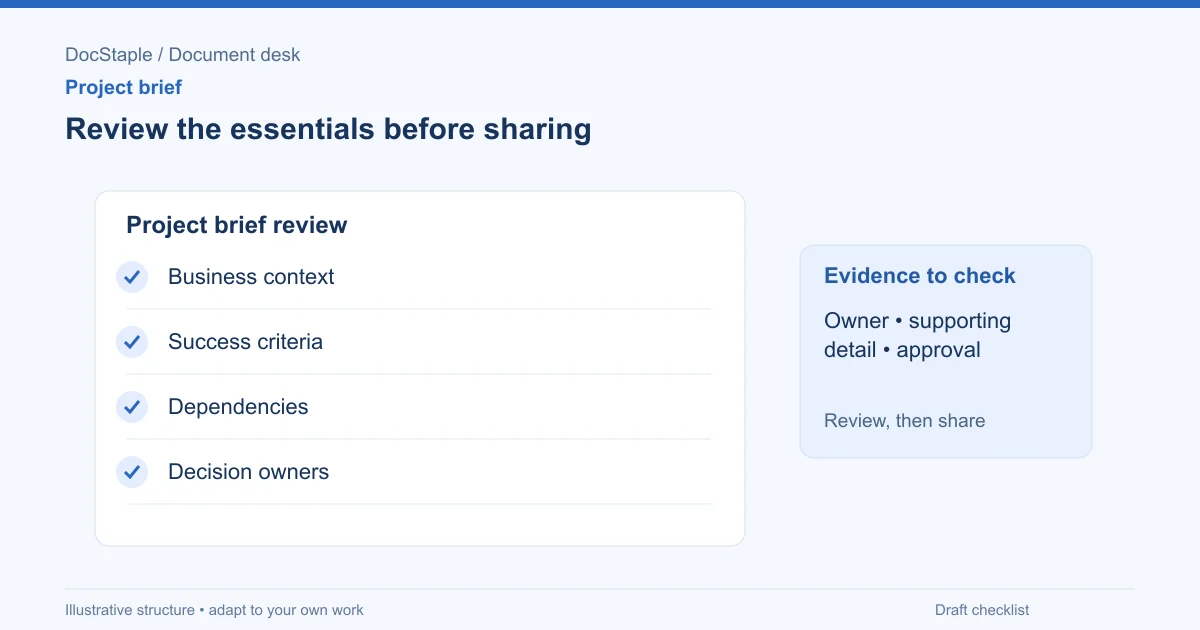
A project brief checklist helps you decide whether the brief is ready to guide delivery. It should test whether the business context, success criteria, dependencies and decision owners are clear enough for a team to act on. A brief that sounds polished but hides the real decision can send a project in the wrong direction.
The scenario here is a consulting team preparing a project brief for a customer support workflow review at a software company. The sponsor wants faster triage and fewer escalations, but the team has not yet agreed which workflows, teams or metrics are in scope. The checklist turns that uncertainty into review questions.
Check 1: Business context explains the decision
A project brief should explain why the work matters now. It does not need a long history, but it should connect the project to a business problem and a decision.
Review questions:
- What problem is the organization trying to solve?
- Who experiences the problem?
- What decision will the brief authorize?
- What evidence supports the problem statement?
- What is outside the immediate decision?
Worked example:
Draft: "Support workflows need improvement."
Checklist finding: too vague. It does not say whether the problem is customer wait time, internal rework, poor routing, missing knowledge articles or unclear escalation authority.
Improved language:
The project addresses inconsistent triage for enterprise support tickets. Support managers report that tickets move between Tier 1, Tier 2 and account teams without a shared routing standard. The brief authorizes discovery and workflow mapping for enterprise ticket intake, not a full support tooling replacement.
Annotation: the revised version names the user group, problem behavior, authorized next step and exclusion. It gives the project team a boundary.
Check 2: Success criteria are observable
Success criteria should let the sponsor decide whether the project achieved its intended outcome. They should not be slogans.
Weak criteria:
Improve support quality and collaboration.
Stronger criteria:
Success means the sponsor approves a documented future-state triage workflow, role responsibilities for escalations, decision rules for enterprise ticket routing and an implementation decision log.
This is observable. The sponsor can review those outputs even before operational metrics change.
In US federal service contracting, performance-based guidance emphasizes required results and measurable performance standards (FAR Subpart 37.6). A consulting project brief is not a government contract, but the same drafting habit helps: define what the work must make assessable.
Decision analysis: should the success criterion be "reduce escalation time by 20 percent"? Only if the project controls the measurement period, baseline and implementation. If this brief only authorizes discovery, then success should focus on an approved workflow recommendation and the evidence needed for a later implementation decision.
Better staged wording:
Discovery-stage success means the sponsor can approve, revise or reject a future-state workflow based on documented current-state evidence. Operational performance targets will be confirmed in the implementation plan if that stage is approved.
That prevents a discovery brief from pretending to deliver implementation results.
Check 3: Scope and exclusions match the decision
Scope in a project brief is about focus. It tells the team where to spend attention and where not to wander.
Checklist questions:
- Which workflows, locations, teams or systems are included?
- Which deliverables will be produced?
- Which related work is excluded?
- Does each exclusion prevent a likely misunderstanding?
- Do assumptions have owners?
Worked scope example:
Included: enterprise ticket intake, Tier 1 routing, Tier 2 escalation handoff, account-team exception handling and current knowledge-base use.
Excluded: software procurement, pricing of new tools, staffing redesign, customer-facing policy changes and implementation of workflow changes.
This scope fits the stated decision. It allows process discovery without turning the brief into a technology selection project.
Failure mode: the brief says "support workflow review" and includes no exclusions. A product leader assumes the team will recommend a new support platform. The sponsor expects only a triage map. The team spends interviews on the wrong issue.
Add a boundary sentence:
Recommendations may identify tooling constraints, but the project will not select, procure or configure software unless a separate implementation stage is approved.
That single sentence saves meetings.
Check 4: Dependencies are named and owned
Dependencies are where many project briefs become too optimistic. If the team needs data exports, interview access, system diagrams or sponsor decisions, name them.
Dependency checklist:
- Required records
- Required people
- System access
- Decision deadlines
- Related projects
- Constraints such as holidays, release freezes or client blackout periods
Sample dependency table:
| Dependency | Owner | Needed by | Risk if late |
|---|---|---|---|
| Ticket category export | Support operations manager | Week 1 | Workflow map may rely only on interviews |
| Enterprise account interview list | Sponsor | Week 1 | Sample may miss key escalation paths |
| Current escalation policy | Tier 2 lead | Week 2 | Future-state rules may be incomplete |
Worked decision example: the support operations manager cannot provide ticket exports because of data restrictions. The brief should not simply proceed as if nothing changed.
Possible update:
If ticket exports cannot be provided, the team will use anonymized category summaries and manager walkthroughs. The brief will label findings based on substitute evidence and identify where validation is still required.
That protects the quality of the later recommendation.
Check 5: Decision owners are distinct from contributors
A project brief should separate people who provide input from people who approve decisions. Many briefs fail because every stakeholder is listed equally.
Review questions:
- Who sponsors the project?
- Who approves the brief?
- Who can change scope?
- Who provides subject-matter input?
- Who accepts deliverables?
- Who must be informed but cannot approve changes?
Sample language:
The VP of Customer Operations is the sponsor and approves the brief, scope changes and final recommendation package. Support managers, Tier 2 leads and account directors provide input. Product operations is consulted for system constraints but does not approve project scope.
In US procurement language, a statement of objectives includes purpose, scope or mission, period and place of performance, background, performance objectives and operating constraints (FAR Subpart 37.6). For a private project brief, those same categories are a useful reminder that authority and constraints belong in the document, not only in conversations.
Failure mode: the project team accepts a major new request from a contributor because the brief never identified the sponsor. The brief should make polite refusal possible.
Check 6: Approval readiness includes evidence and file hygiene
Before approval, inspect the brief as a record. It should show what evidence supports the business context and what remains uncertain.
Approval checklist:
- Problem statement cites actual records, interviews or sponsor input.
- Success criteria match the approved stage.
- Dependencies have owners and dates.
- Decision owner is named.
- Exclusions are specific.
- Risks and assumptions are visible.
- Draft comments are resolved.
- Final version is stored with date and owner.
Microsoft explains that Word users can review tracked changes and accept or reject them from the Review tab (Microsoft Support: Track changes in Word). Use that workflow before circulating an approved brief, because unresolved markup can confuse which scope is final.
Approval wording:
The sponsor approves this project brief for discovery and workflow recommendation only. Implementation, software procurement and staffing changes require a separate approval record.
That sentence is short and powerful. It authorizes the next step without pretending the whole transformation has been approved.
For an editable starting point, the consulting project brief template includes sections for problem and intended outcome, scope and constraints, stakeholders, success criteria and authorization. Use the checklist to make sure the completed brief can guide delivery decisions, not merely introduce them.
Last updated: September 26, 2026
Frequently Asked Questions
Related Articles
Change Request Best Practices for Client Delivery
Change request best practices for documenting the reason, scope impact, schedule and cost implications, and authorization before changed work starts.
Change Request Checklist for Reviewing Scope, Schedule and Cost
A change request checklist for consulting projects covering reason for change, scope impact, schedule and cost implications, and authorization.
Change Request Examples: Scope, Schedule, Cost and Authorization
Practical change request examples for consulting projects, with annotated language for the reason, scope impact, schedule, cost, decision and authorization.
Handover Document Best Practices for Client Delivery
Handover document best practices for completed work, outstanding actions, access, operating instructions, acceptance, and ownership.
Handover Document Checklist: Completed Work, Open Actions and Ownership
A practical handover document checklist for consulting work, with review gates for completed work, outstanding actions, access, operating notes and acceptance.
Handover Document Examples for Consulting Work
Handover document examples for consulting teams, covering completed work, outstanding actions, access and operating instructions, and acceptance and ownership.