Project Brief Examples: Context, Success Criteria and Decision Owners
Project brief examples for a consulting strategy review, with annotated language for business context, success criteria, dependencies and decision owners.
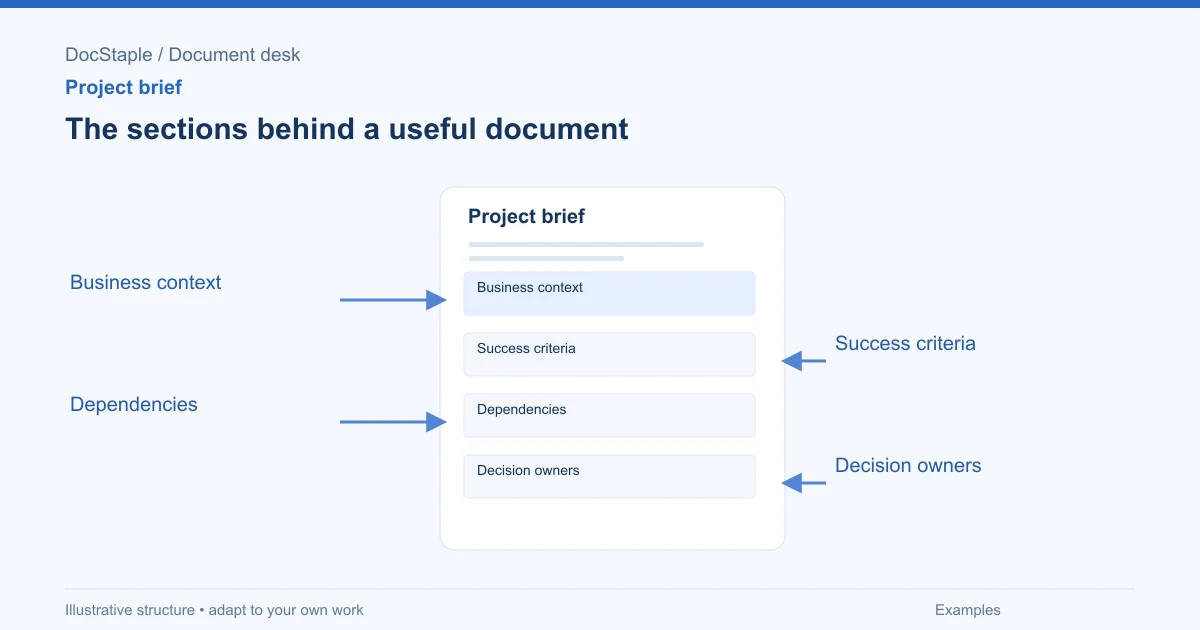
Project brief examples are easy to skim and hard to use if they only show polished final copy. A useful example exposes the choices behind the wording: what evidence belongs in the business context, how success will be judged and who can make the call when the team gets stuck.
This article uses a fictional scenario: a consulting team is preparing a project brief for a nonprofit's donor-operations review. The sponsor wants a recommendation on whether to centralize donation processing across three regional offices. The brief is written before discovery begins, so it must be specific enough to authorize work without pretending the answer is already known.
Example 1: Business context that leads to a decision
A project brief should not start with project enthusiasm. It should start with the decision the organization needs to make.
Weak draft
This project will improve donor operations and support future growth.
That line may be true, but it is not useful. It does not say what is happening now, who is affected or what decision the sponsor faces.
Stronger draft
Business context. [Client] processes donations through three regional offices. The sponsor reports inconsistent month-end reconciliation timing, duplicate donor records and different local practices for exception handling. Leadership must decide by [date] whether donation processing should remain regional, move to a central team or follow a hybrid model.
Annotation: The paragraph separates reported facts from the decision. If the team has not verified the issues yet, the phrase "the sponsor reports" is more honest than writing them as findings.
Public procurement guidance often uses the same discipline. FAR Part 7 says acquisition planners should ensure that the statement of work is closely aligned with performance outcomes and cost estimates (Acquisition.GOV, FAR Part 7). A private consulting brief is not a federal acquisition plan, but the principle is useful: context should point toward an outcome, not float as background.
Example 2: Success criteria that can be checked
Success criteria should define what evidence will make the next decision possible. They are not the same as benefits.
Weak draft
The project will be successful if the client is happy with the recommendations.
Happiness is not a review standard. It can also pressure the consultant to soften an uncomfortable finding.
Stronger draft
Success criteria. The project is ready for sponsor approval when the recommendations report compares the regional, central and hybrid models against the agreed criteria; identifies operational, staffing and data-quality implications; states the evidence used; and records unresolved assumptions. The sponsor approves the report for leadership review or requests one consolidated revision.
Annotation: This describes a usable output. It does not promise that centralization will save money or that leadership will accept the recommendation.
For services ordered under certain federal schedules, FAR 8.405-2 says statements of work include a deliverable schedule and applicable performance standards when relevant (Acquisition.GOV, FAR 8.405-2). For a project brief, translate that into "what will exist, by when and by what standard will it be reviewed?"
Example 3: Dependencies that deserve names
Dependencies are often written as vague risks: "client availability may affect timing." That does not help anyone manage the work.
Stronger draft
Dependencies. The discovery timetable depends on [Client] providing: access to the three regional operations leads by [date]; donation-volume exports for the last [number] months; current exception-handling procedures; and a nominated data contact who can explain field definitions. If these inputs are not available by [date], the delivery lead will propose a revised schedule before interviews begin.
Annotation: The dependency list names documents, people and dates. It also states what happens when the dependency fails.
Do not overload the brief with every small task. Use it to capture dependencies that affect the decision, the timetable or the quality of evidence. If a dependency is merely convenient, put it in the workplan. If it can delay the recommendation, it belongs in the brief.
Example 4: Decision owners who can approve or stop work
Decision ownership is not the same as stakeholder interest. A subject matter expert may provide essential input without having authority to approve scope or change the project.
Example language
Decision owners. [Sponsor name] is accountable for approving the project brief, resolving priority conflicts and accepting the final recommendations report for leadership review. [Operations lead] validates current-state process descriptions. [Finance lead] validates cost assumptions. [Consulting delivery lead] decides whether evidence is sufficient to support a recommendation and escalates unresolved assumptions to the sponsor.
Annotation: The paragraph gives each person a different job. It avoids a committee where everyone comments and no one decides.
Add a decision log starter:
| Decision | Owner | Due | Evidence needed | Status |
|---|---|---|---|---|
| Confirm operating models to compare | Sponsor | [date] | Current-state interviews complete | Open |
| Approve criteria for recommendation | Sponsor | [date] | Draft criteria reviewed by finance and operations | Open |
| Decide whether leadership pack is ready | Sponsor | [date] | Final recommendations report | Open |
The Oregon Department of Transportation's Statement of Work Writing Guide recommends an SOW review discussion to cover consultant tasks, deliverables, delivery schedule and items provided by the agency, and says expectations promised by either party must be captured in the contract (ODOT SOW Writing Guide). For a project brief, use the same habit: if a meeting decides something important, write the owner and decision into the brief or an attached log.
Example 5: Scope boundaries that prevent accidental expansion
A project brief can be short and still stop drift. The key is to say what the project will not decide.
Example language
Scope boundaries. The project covers donation processing workflow, exception handling, data handoff points and staffing implications for the three regional offices. It does not include software selection, system configuration, donor communications strategy, employment-law advice or implementation management. Any request to add those topics requires sponsor approval and a revised brief.
Annotation: These exclusions are specific to the scenario. A generic "anything not listed is excluded" may be legally useful in some documents, but operational teams need to see the likely misunderstandings spelled out.
Use boundaries when there is a tempting adjacent topic. Here, software selection and donor communications are close enough to the review that stakeholders may expect them unless the brief says otherwise.
Approval check before the brief is used
Before sharing the brief as the working record, test it with the sponsor and the delivery lead.
- Context: Does the opening identify the current problem and the decision date?
- Success criteria: Could a reviewer tell whether the recommendations report is ready?
- Dependencies: Are required data, access and client contacts named with dates?
- Decision owners: Does each approval have one accountable owner?
- Scope boundaries: Are tempting adjacent requests excluded or routed through change approval?
- Evidence: Does the brief say which records or interviews will support the recommendation?
- Version control: Is the approved brief saved where the team can find it?
Start from an editable brief
The consulting project brief template gives you an editable Word structure for problem and intended outcome, scope and constraints, stakeholders and delivery plan, success criteria and authorization, plus review and approval prompts. Use it to turn a promising idea into a decision-ready record, then update it when the decision, scope or owners change.
Sources: FAR Part 7, Acquisition.GOV, FAR 8.405-2, Acquisition.GOV, Statement of Work Writing Guide, Oregon Department of Transportation
Last updated: September 26, 2026
Frequently Asked Questions
Related Articles
Change Request Best Practices for Client Delivery
Change request best practices for documenting the reason, scope impact, schedule and cost implications, and authorization before changed work starts.
Change Request Checklist for Reviewing Scope, Schedule and Cost
A change request checklist for consulting projects covering reason for change, scope impact, schedule and cost implications, and authorization.
Change Request Examples: Scope, Schedule, Cost and Authorization
Practical change request examples for consulting projects, with annotated language for the reason, scope impact, schedule, cost, decision and authorization.
Handover Document Best Practices for Client Delivery
Handover document best practices for completed work, outstanding actions, access, operating instructions, acceptance, and ownership.
Handover Document Checklist: Completed Work, Open Actions and Ownership
A practical handover document checklist for consulting work, with review gates for completed work, outstanding actions, access, operating notes and acceptance.
Handover Document Examples for Consulting Work
Handover document examples for consulting teams, covering completed work, outstanding actions, access and operating instructions, and acceptance and ownership.