Project Status Report Best Practices for Milestones, Risks and Decisions
Project status report best practices for milestone progress, decisions needed, risks, blockers and next reporting period commitments.
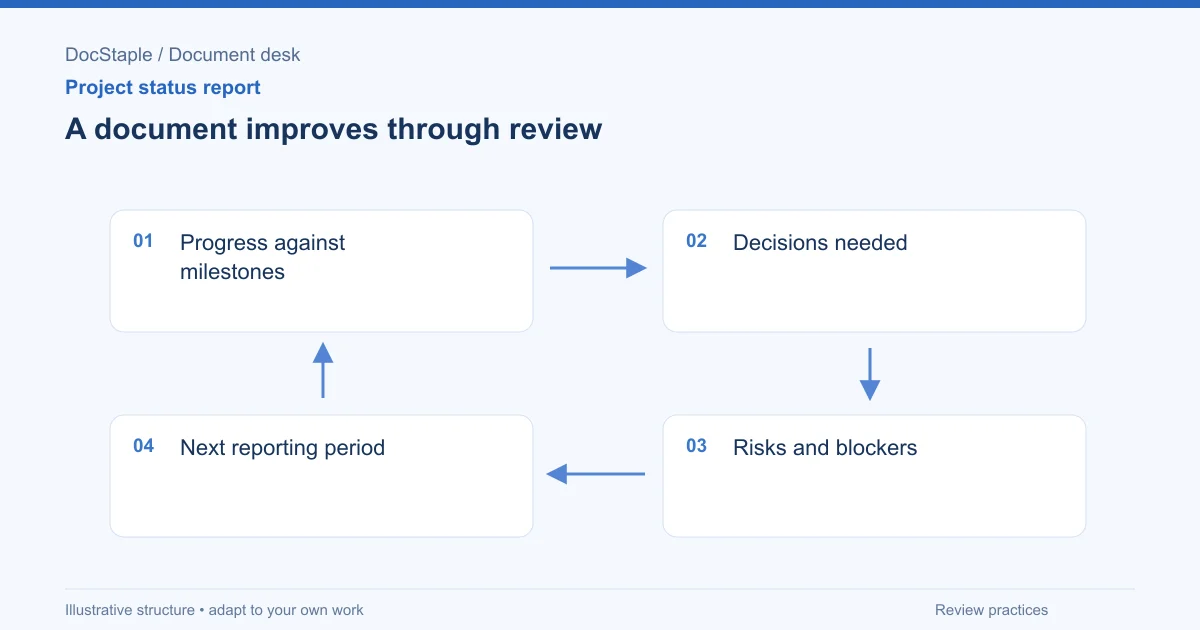
A project status report should help a sponsor act. If the report lists activity without decisions, hides blockers behind colors or repeats last week's risks unchanged, it becomes noise.
This article uses a consulting project as the main example: a strategy review is moving from discovery into recommendations. The client sponsor wants to know whether milestones are on track, which decisions are needed, what risks could affect the report and what the next period will produce.
Lead With The Management Message
Best practice starts with a short statement that a sponsor can understand before reading the tables.
Weak version
Status: Amber. Interviews done. Analysis ongoing. Risks remain.
Better version
Overall status: Needs attention. Discovery interviews are complete, but the customer data file is missing first-use timestamps. Qualitative analysis can continue; quantitative validation depends on a corrected file by [date].
Why it works: The better version explains the milestone, the blocker, the work that can continue and the decision point. It does not ask the reader to decode a color.
The California Project Management Framework says monitoring and controlling uses current metrics and status reports against plans to identify potential issues or risks early (California PMF monitoring and controlling). That is public-sector guidance, but the reporting purpose is broadly useful: surface variance early enough for action.
If your report uses red, amber and green, write the rule beside the status. For example, amber can mean "baseline still achievable with sponsor action by [date]." Red can mean "baseline no longer achievable without an approved change." Without a rule, color becomes a mood indicator.
Report Progress Against Milestones, Not Motion
Activity is not the same as progress. "Held meetings" matters only if those meetings complete a milestone or reveal a material issue.
Worked example: discovery milestone
| Milestone | Baseline | Current status | Evidence | Management note |
|---|---|---|---|---|
| Complete stakeholder interviews | [date] | Complete | Interview tracker v3 | No schedule impact |
| Receive customer data file | [date] | Partially complete | Data receipt note | Missing timestamp field |
| Draft recommendations outline | [date] | At risk | Delivery plan v4 | Depends on data correction |
Sample narrative
Stakeholder discovery is complete against the agreed interview list. The customer data file was received on [date], but it is missing the first-use timestamp needed for the onboarding comparison. The team can draft qualitative recommendations while the client data lead corrects the file.
Decision analysis: Should the report include percent complete? Only use percentages if the project has a defined measurement basis. "Analysis 70% complete" is weak unless the sponsor knows what counts as the remaining 30%. In many consulting reports, milestone status and evidence references are clearer.
Another failure mode is reporting effort as progress:
The team spent 42 hours on analysis this week.
That may matter for billing, but it does not tell the sponsor whether the recommendation is closer to approval. Translate effort into a milestone statement:
Analysis hours were used to code interview themes and test them against the customer data file. Two themes are supported; one remains limited because the timestamp field is missing.
Make Decisions Needed Visible
Decisions should not be buried inside risk commentary. A sponsor should be able to scan one section and see what they must decide.
Worked example: sponsor decision table
| Decision needed | Owner | Needed by | Impact if delayed |
|---|---|---|---|
| Approve two additional operations interviews | Client sponsor | [date] | Recommendations may exclude operations evidence |
| Confirm whether pricing analysis is in scope | Client sponsor | [date] | Draft report will omit pricing recommendations |
| Accept revised workshop agenda | Steering group chair | [date] | Workshop may not produce final decision |
Draft language
Decision required by [date]: approve or reject two additional operations interviews. If no decision is received, the final report will state that operations evidence was not gathered and the related recommendation is limited.
Why it works: The wording gives the sponsor a choice and explains consequence without threat. It avoids vague escalation language like "client to advise."
For U.S. federal contracts, FAR 42.1106 says production progress reporting should be limited to information essential to government needs and should use contractor management-system data where possible (FAR 42.1106). Your private consulting project may not be governed by FAR, but the discipline is useful: report what the recipient needs for action.
Separate Risks, Blockers And Changes
Status reports fail when they throw every problem into one "risks" section. Separate the type of issue so the response is obvious.
| Type | Meaning | Example |
|---|---|---|
| Risk | Possible future event | Sponsor workshop may move because executives are unavailable |
| Blocker | Current obstacle | Corrected customer data file has not been received |
| Change | Approved or proposed baseline adjustment | Pricing analysis requested outside original scope |
Draft risk language
Risk: Final recommendations may lack operations validation if additional interviews are not approved by [date]. Trigger: no sponsor approval by [date]. Response: engagement lead will mark related recommendation as limited or remove it from final draft.
Draft blocker language
Blocker: Customer data file is missing first-use timestamp for [period]. Owner: client data lead. Action: provide corrected file by [date]. Impact: quantitative comparison cannot be completed until resolved.
Why it works: The risk has a trigger and response. The blocker has an owner and current impact. Neither is padded with general concern.
Commit To The Next Reporting Period
A useful report closes with what will happen next. This section should be specific enough that next week's report can check it.
Next-period commitments
| Commitment | Owner | Due | Dependency |
|---|---|---|---|
| Complete qualitative recommendations outline | Consulting manager | [date] | None |
| Receive corrected customer data | Client data lead | [date] | Data export access |
| Hold sponsor decision meeting | Client sponsor | [date] | Agenda approval |
| Update risk and decision log | Engagement lead | [date] | Current decisions |
Sample language
Next period, the team will complete the qualitative recommendations outline, receive or close the corrected data dependency and hold the sponsor decision meeting. If the corrected data is not received by [date], the report will move quantitative validation to a limitation note.
Decision analysis: Avoid promising recovery that depends entirely on someone else. Phrase commitments with conditions when the team does not control the dependency.
Keep Evidence Close But Not Heavy
Best practice is traceability, not attachment overload. A sponsor does not need every interview note attached to the status report, but the report should identify where important claims came from.
Use a small evidence table:
| Status claim | Supporting record |
|---|---|
| Interviews complete | Interview tracker v3 |
| Data incomplete | Data receipt note [date] |
| Workshop at risk | Calendar response summary |
| Scope question open | Decision log item D-04 |
This matters when the status changes. If the report moves from "on track" to "needs attention," the sponsor should see the trigger.
Keep evidence references short. A status report can say "Interview tracker v3" or "decision log D-04" without attaching the underlying file. The point is to make the claim traceable, not to turn every weekly update into a records bundle.
The Federal Acquisition Regulation describes surveillance as government review and analysis of performance plans, schedules, controls and actual performance under them (FAR 42.1101). A client-delivery status report should follow the same reporting instinct: compare actual work with the plan and explain variance.
Before sending, read the report once as the sponsor. If the sponsor cannot tell what to decide, what is late and what will happen next, the report needs revision even if every table is filled in. Completed fields are not the same as useful status.
For recurring reports, carry unresolved decisions forward with their original due date so delay remains visible.
Start From An Editable Reporting Structure
The consulting project status report template is an editable Word file with sections for period and overall assessment, progress and milestones, risks, issues, decisions and next commitments. Use it as a practical structure, then adapt the evidence, owners, cadence and decision route to your project governance.
Last updated: September 26, 2026
Frequently Asked Questions
Related Articles
Change Request Best Practices for Client Delivery
Change request best practices for documenting the reason, scope impact, schedule and cost implications, and authorization before changed work starts.
Change Request Checklist for Reviewing Scope, Schedule and Cost
A change request checklist for consulting projects covering reason for change, scope impact, schedule and cost implications, and authorization.
Change Request Examples: Scope, Schedule, Cost and Authorization
Practical change request examples for consulting projects, with annotated language for the reason, scope impact, schedule, cost, decision and authorization.
Handover Document Best Practices for Client Delivery
Handover document best practices for completed work, outstanding actions, access, operating instructions, acceptance, and ownership.
Handover Document Checklist: Completed Work, Open Actions and Ownership
A practical handover document checklist for consulting work, with review gates for completed work, outstanding actions, access, operating notes and acceptance.
Handover Document Examples for Consulting Work
Handover document examples for consulting teams, covering completed work, outstanding actions, access and operating instructions, and acceptance and ownership.