Capability Statement Best Practices for Consulting Firms
Capability statement best practices for consulting firms, with fixes for vague competencies, weak past performance, generic differentiators and stale credentials.
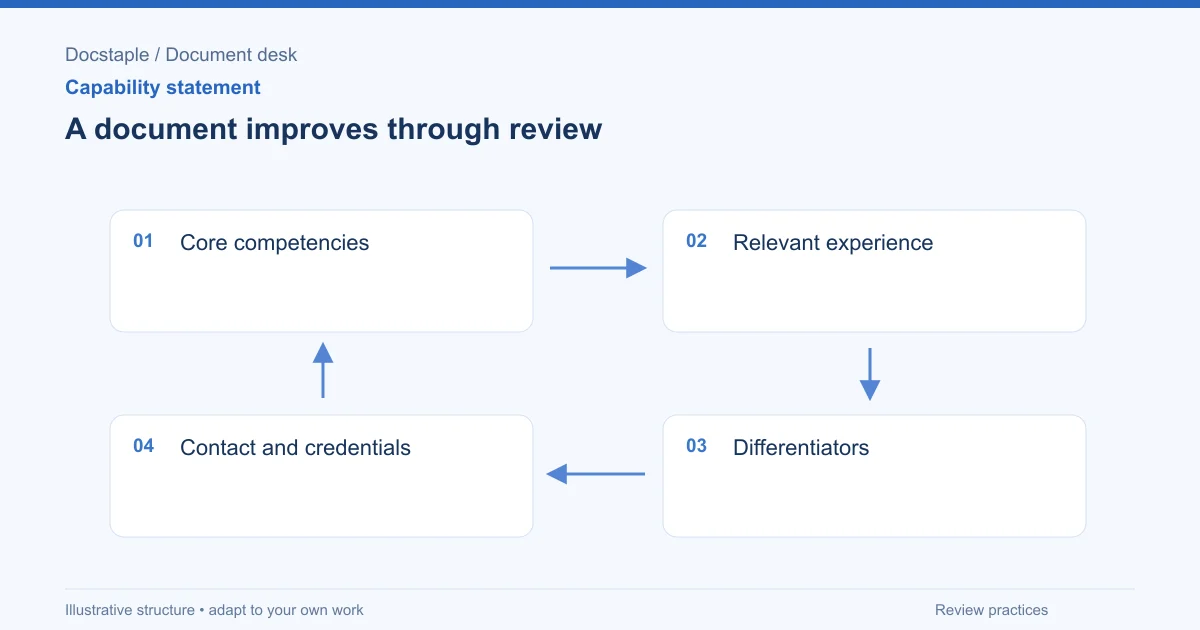
Capability statement best practices are less about decoration and more about buyer confidence. A clean layout helps, but the substance has to answer the buyer's real questions: can this firm do the work, has it done similar work, what makes it different and who can I contact?
This article uses a consulting scenario. A small advisory firm wants to approach a federal program office and a prime contractor about service-design and operating-model review work. The firm has good experience, but its first draft reads like a general brochure.
The fixes below focus on failure modes: unfocused competencies, vague past performance, copy-paste differentiators, overstuffed identifiers and weak next steps. For United States federal outreach, official guidance from HHS lists items such as core capabilities, major services, certifications, clients, codes and contact information as important capability-statement content (HHS guidance).
Best Practice 1: Make The Statement Opportunity-Specific
The first best practice is to stop treating the capability statement as a company autobiography. The document should be assembled for a buyer, a service lane and a conversation.
Weak opening:
[Firm name] is a full-service management consulting firm providing strategic solutions to public, private and nonprofit clients.
Better opening:
[Firm name] supports public-sector program teams with service-design reviews, operating-model assessment and sponsor-ready recommendations for delivery improvement.
The better version is narrower. That is the point. It gives up some breadth so the reader can identify fit quickly.
Commerce's small-business specialist guidance tells businesses to compare opportunities to their core competencies and develop a concise one-page overview that highlights competencies and differentiating performance elements (Commerce PDF). For a consulting firm, that means the top of the page should not list every advisory category the partners have ever sold.
Decision analysis: prime contractor outreach
If the target is a prime contractor building a team for a service-center modernization bid, the opening should emphasize subcontractor fit:
[Firm name] provides discovery interviews, service-blueprint workshops and findings reports for public-service modernization teams. We support primes that need a focused consulting partner for user-facing process review and sponsor briefing materials.
This differs from an agency-facing version because the reader's risk is different. The prime wants to know where the firm fits into a team and what work package it can own. The best practice is to adapt emphasis without changing facts.
Best Practice 2: Turn Core Competencies Into Work Packages
Core competencies should read like things the buyer can buy, evaluate or assign. A section that says "strategy, innovation, operations and transformation" asks the reader to do too much translation.
Use work-package language:
- Service-design discovery interviews.
- Current-state process and handoff mapping.
- Operating-model options analysis.
- Recommendations report with assumptions and risks.
- Sponsor briefing and decision log.
Each item could become a task in a statement of work. That makes the capability statement more useful during market research, teaming discussions or vendor engagement.
Avoid mixing service categories with personality claims. "Responsive senior experts" is not a competency. If senior involvement matters, state the delivery control: "named principal attends kickoff, sponsor interviews and final briefing."
Best Practice 3: Prove Relevant Experience Without Inflating It
Past performance and relevant experience should be concrete enough for a buyer to trust, but careful enough to respect confidentiality and evidence limits.
Weak experience:
Delivered transformational results for government, nonprofit and enterprise clients.
Better experience:
Public-service intake review, client name withheld. Role: discovery interview planning, current-state handoff map and recommendations report. Deliverables accepted by project sponsor on [date]. Evidence: approved report and acceptance email retained internally.
The stronger language avoids inflated outcomes. It tells the reader what happened and what proof exists.
Decision analysis: no federal past performance yet
A consulting firm may have commercial or nonprofit work but no federal prime contract history. Do not pretend otherwise. Use adjacent evidence honestly:
Relevant commercial experience: operating-model review for a regional member-services organization. Scope included [number] stakeholder interviews, service pathway mapping and decision options for leadership. Relevance to federal program office: similar intake complexity, multi-role handoffs and sponsor decision needs.
This is useful because it explains transferability. It does not call the work federal past performance. If the buyer requires federal past performance, this may not be enough, but overclaiming will create a worse problem.
The FTC's small-business advertising guidance says advertisers need a reasonable basis for objective claims (FTC FAQ). Apply that discipline here. "Delivered report accepted by sponsor" is easier to support than "reduced delays by 40%" unless the project records prove the number and attribution.
Best Practice 4: Write Differentiators A Buyer Can Test
Differentiators should be operationally meaningful. The worst versions sound positive but uncheckable: trusted, agile, collaborative, innovative, client-first.
Better differentiators for the consulting scenario:
Each recommendation traces to interview themes, reviewed documents or named assumptions.
The engagement lead attends sponsor interviews instead of delegating all discovery to junior staff.
Final reports separate decisions requested from background findings, so sponsors can act without rereading the whole analysis.
These lines are strong because the buyer can test them. They also address common consulting concerns: unsupported recommendations, unclear senior involvement and reports that do not lead to decisions.
Keep differentiators distinct from experience. A past project proves relevance. A differentiator explains the firm's way of working. If one line does both, split it so the reader can scan.
Do not borrow authority from a partner or employee without precision. If a partner owns a certification, name the partner role. If a credential belongs to one staff member, avoid wording that makes it sound like a company certification.
Best Practice 5: Keep Credentials And Codes Lean
Credentials, codes and company data help buyers route and verify the firm. They become a problem when the section looks like a junk drawer.
For a United States federal audience, include only current and relevant items such as legal name, UEI, CAGE, NAICS codes, socioeconomic certifications if applicable, business size status where relevant, website and contact details. SAM.gov explains that entities need an active registration to apply directly for federal awards as prime awardees, and that a Unique Entity ID by itself does not provide that ability (SAM.gov registration).
Best practice: copy identifiers from official records, then reduce the list to those related to the service lane. Ten unrelated NAICS codes can make the firm look unfocused. A short list tied to the buyer's requirement is usually more credible.
For non-US buyers or private-sector prospects, replace federal codes with the evidence that actually matters: supplier registration, insurance certificates, professional memberships, security reviews, approved vendor status or regional licenses. State the jurisdiction when requirements vary.
Best Practice 6: End With A Specific Business Action
A capability statement should not end with "contact us for more information." The reader should know what to do next and who owns the response.
Weak ending:
Please contact us to learn more about our services.
Better ending:
For a scoped service-design review proposal, contact [name], [role], at [email] or [phone]. We can provide a two-page approach note for [target program or bid] by [reasonable response period].
This ending converts the document from a passive profile into a next-step tool. It also avoids promising instant turnaround unless the firm can meet it.
Use one primary contact. Multiple contacts make the buyer choose the route. If business development and delivery both need visibility, make one person the lead and list the other only when the buyer asks for technical follow-up.
Put The Practices Into A Reusable Draft
The best version is not the one with the most words. It is the one where each section earns its space. The opening frames the opportunity. Core competencies map to work packages. Experience proves relevance. Differentiators reduce buyer risk. Credentials are current. The contact block tells the reader what to do.
Keep a master capability statement with approved facts, then create targeted copies for agencies, primes, nonprofit buyers or commercial prospects. Label each copy with the intended audience and review date so stale identifiers and old claims do not keep circulating.
The consulting capability statement template provides editable Word sections for organization and capabilities, relevant experience, resources and differentiators, business details and approval notes. Use it as a structure, then apply these best practices to make the content specific to the buyer.
Last updated: September 26, 2026
Frequently Asked Questions
Related Articles
Capability Statement Checklist for Buyer-Ready Consulting Drafts
A capability statement checklist for consulting firms, with review gates for core competencies, relevant experience, differentiators, credentials and contact details.
Capability Statement Examples: Four Sections Written Weak and Then Strong
Capability statement examples for a fictional consulting firm: core competencies, relevant experience, differentiators, and contact and credentials, each shown as weak and stronger draft wording with a review checklist.
Engagement Letter Best Practices
Best practices for engagement letters, including scope control, responsibility wording, limitation language and approval records.
Engagement Letter Checklist
Use this engagement letter checklist to review purpose, parties, responsibilities, limitations, approval and signature readiness.
Engagement Letter Examples: Purpose, Scope Limits and Signatures
Engagement letter examples for consulting work, with annotated wording for parties, responsibilities, scope limitations, approval and signatures.
How to Write a Construction Capability Statement: Experience, Credentials and Proof
How to write a construction capability statement for subcontracting and buyer review, with draft language for competencies, relevant projects, differentiators, credentials and approval checks.