How to Write a Construction Capability Statement: Experience, Credentials and Proof
How to write a construction capability statement for subcontracting and buyer review, with draft language for competencies, relevant projects, differentiators, credentials and approval checks.
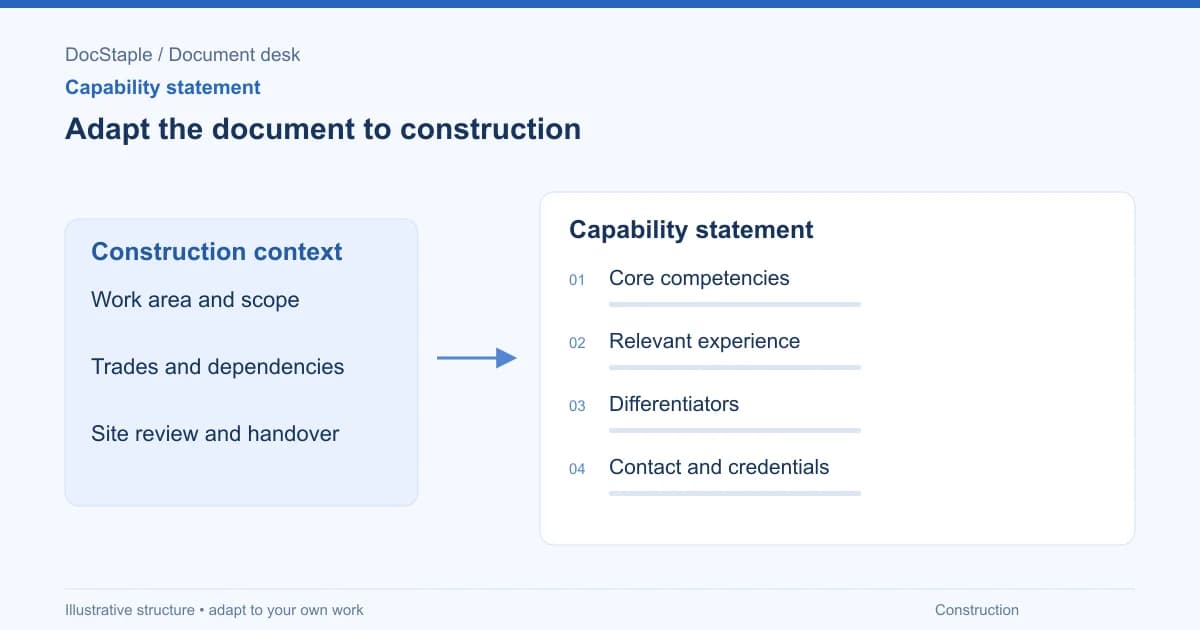
A construction capability statement is a fast credibility test. A general contractor, public buyer or owner's representative wants to see what work you actually perform, where you have done similar work, what makes you different and who to contact. If the document reads like a generic brochure, it fails that test.
This guide uses a fictional scenario: a small construction firm wants to win commercial fit-out and closeout support work from general contractors. The statement needs to show fit-out capability, relevant project evidence, current credentials and a clear next step. Do not invent licenses, safety records, certifications or project outcomes. Requirements and terminology vary by jurisdiction and procurement process.
Focus Core Competencies On The Work You Want
Core competencies should match the buyer's need. Do not list every trade, service and aspiration.
Weak draft
We provide construction, project management, maintenance, repairs, fit-outs, renovations, site services, consulting and general support.
Stronger draft
Core competencies
- Commercial interior fit-out support for occupied and partially occupied buildings.
- Closeout coordination, punch-list tracking and site completion packs.
- Trade coordination for partitions, finishes and minor works packages.
- Defect logging with location, responsible trade, target date and closeout evidence.
The U.S. Department of Veterans Affairs capability statement packet says core competencies should relate the business's expertise to the specific needs of the agency and should not include everything the firm can do (VA OSDBU Capabilities Statement Packet). That applies just as well to a subcontractor handout. If the buyer is looking for fit-out support, lead with fit-out support.
Select Relevant Project Experience
Construction buyers need evidence. "Experienced team" is weak unless the statement points to relevant projects or verified capacity.
Relevant experience
Office fit-out closeout, [city] - Supported punch-list tracking and completion records for a [size or project type] office fit-out. Coordinated open items with site manager and trade leads.
Retail refresh programme - Completed minor works and closeout documentation across [number if verified] locations under phased access conditions.
Occupied-building works - Delivered small works packages with access restrictions, tenant coordination and daily site clean-down requirements.
Use client names only when you have permission. If you cannot name the client, describe the project type and your role. Do not imply you were the prime contractor if you were a subcontractor.
The VA packet recommends listing past customers for similar work and leaving reference contact details off a general handout when sending it as initial outreach or leaving it at conferences (VA OSDBU Capabilities Statement Packet). For construction, a practical version is: keep a reference list ready, but do not publish private contacts unless they agreed.
Write Differentiators That A Site Manager Cares About
Differentiators should explain why the buyer would choose you over another qualified firm.
Weak draft
We deliver quality work safely and on time.
That is an expectation, not a differentiator.
Stronger draft
Differentiators
- Closeout records organized by room, drawing reference, responsible trade and evidence status.
- Experience working around tenant access windows and building-management rules.
- Single closeout contact for site manager communication and weekly issue summaries.
- Current document-control habit: work is checked against approved drawing revisions before closeout items are marked complete.
These statements describe behavior a site manager can value. They also create claims you must be able to support. If your team does not actually use drawing revision checks, do not include that bullet.
Include Credentials, Codes And Contact Details
Construction capability statements often need more operational detail than consulting statements.
Consider including:
- Legal business name.
- Service area.
- Trade categories or services.
- License numbers, if required and current in the jurisdiction.
- Insurance statement, reviewed for accuracy.
- Safety or quality credentials only if current and verifiable.
- Procurement identifiers such as UEI, CAGE, NAICS or local vendor numbers where relevant.
- Primary contact name, phone and email.
The Washington Office of Minority and Women's Business Enterprises describes capability statement elements for federal contexts as company data, core competencies, experience and contact information, while state and local contexts may add differentiators and past performance (Washington OMWBE). That guidance is not construction-specific legal advice, but it is a helpful scan order.
Add an internal verification note before sending:
Checked on [date]: license [number], insurance statement, safety credential, project descriptions, contact details and permission to use project photos.
Show Draft Language And Approval Checks
Here is a compact sample opening:
[Company] provides commercial fit-out support, closeout coordination and minor works services for general contractors and owners' representatives in [service area]. We help site teams turn approved drawings, punch-list items and trade actions into a clear completion record.
Annotated:
- "Provides" is direct.
- "Commercial fit-out support" names the target work.
- "Approved drawings, punch-list items and trade actions" uses site evidence, not marketing language.
- "Completion record" connects the work to the buyer's closeout problem.
Approval check:
- Are core competencies matched to the opportunity?
- Are project examples permission-safe and accurate?
- Are photos approved for use?
- Are license, insurance and certification references current?
- Does the statement avoid "best", "leading" and other unsupported claims?
- Is one contact person clearly named?
- Does the statement invite a specific next step, such as requesting a scoped proposal?
Add a project-proof table when the buyer needs more evidence:
| Project type | Your role | Evidence you can share | Permission status |
|---|---|---|---|
| Commercial office fit-out | Closeout coordination | Completion pack description, anonymized punch-list process | Client name withheld |
| Retail refresh | Minor works support | Before-and-after photos, if approved | Permission pending |
| Occupied-building works | Access-controlled works | Method summary and contact reference on request | Reference available |
This table keeps the statement honest. It separates what you did from what you can show. It also prevents a designer or estimator from adding photos, logos or client names that have not been approved.
If you target public work, adapt identifiers carefully. NAICS codes, UEI, CAGE codes, state vendor IDs and local certifications are not decorative. They should be current and relevant to the buyer. If a certification expired, remove it. If the business is licensed in one state but the opportunity is in another, do not let the statement imply authority to perform work where you are not authorized.
Use restrained wording around safety. Instead of unsupported claims like "best safety record", write something verifiable:
Safety documentation, insurance certificates and project-specific method information are available for review during prequalification, subject to the requirements of the opportunity and applicable law.
That is more credible than a claim you cannot prove on the page.
Tailor For General Contractors, Owners And Public Buyers
A construction capability statement should change depending on who reads it.
For a general contractor, emphasize how you make site coordination easier: access windows, trade communication, closeout evidence and responsiveness to the site manager. For an owner or owner's representative, emphasize business outcomes: readiness for occupancy, documented completion, fewer unresolved handover items and clear escalation routes. For a public buyer, emphasize current registrations, relevant codes, past performance and compliance with the exact submission instructions.
Do not send the same version to all three if the opportunity matters. The core facts stay the same, but the order should change. A general contractor may care first about whether you can mobilize and coordinate. A public buyer may first check whether your identifiers, certifications and relevant experience match the procurement.
Before sending a tailored version, save it with the buyer name and date. That makes it easier to prove what was sent and prevents old capability statements from circulating with expired credentials.
Start From An Editable Structure
The construction capability statement template is an editable Word file with sections for organization and capabilities, relevant experience, resources, differentiators, business details, contact information and approval. It is a starting structure, not proof of capability or approval by any buyer.
Last updated: September 26, 2026
Frequently Asked Questions
Related Articles
Capability Statement Best Practices for Consulting Firms
Capability statement best practices for consulting firms, with fixes for vague competencies, weak past performance, generic differentiators and stale credentials.
Capability Statement Checklist for Buyer-Ready Consulting Drafts
A capability statement checklist for consulting firms, with review gates for core competencies, relevant experience, differentiators, credentials and contact details.
Capability Statement Examples: Four Sections Written Weak and Then Strong
Capability statement examples for a fictional consulting firm: core competencies, relevant experience, differentiators, and contact and credentials, each shown as weak and stronger draft wording with a review checklist.
Engagement Letter Best Practices
Best practices for engagement letters, including scope control, responsibility wording, limitation language and approval records.
Engagement Letter Checklist
Use this engagement letter checklist to review purpose, parties, responsibilities, limitations, approval and signature readiness.
Engagement Letter Examples: Purpose, Scope Limits and Signatures
Engagement letter examples for consulting work, with annotated wording for parties, responsibilities, scope limitations, approval and signatures.