Capability Statement Checklist for Buyer-Ready Consulting Drafts
A capability statement checklist for consulting firms, with review gates for core competencies, relevant experience, differentiators, credentials and contact details.
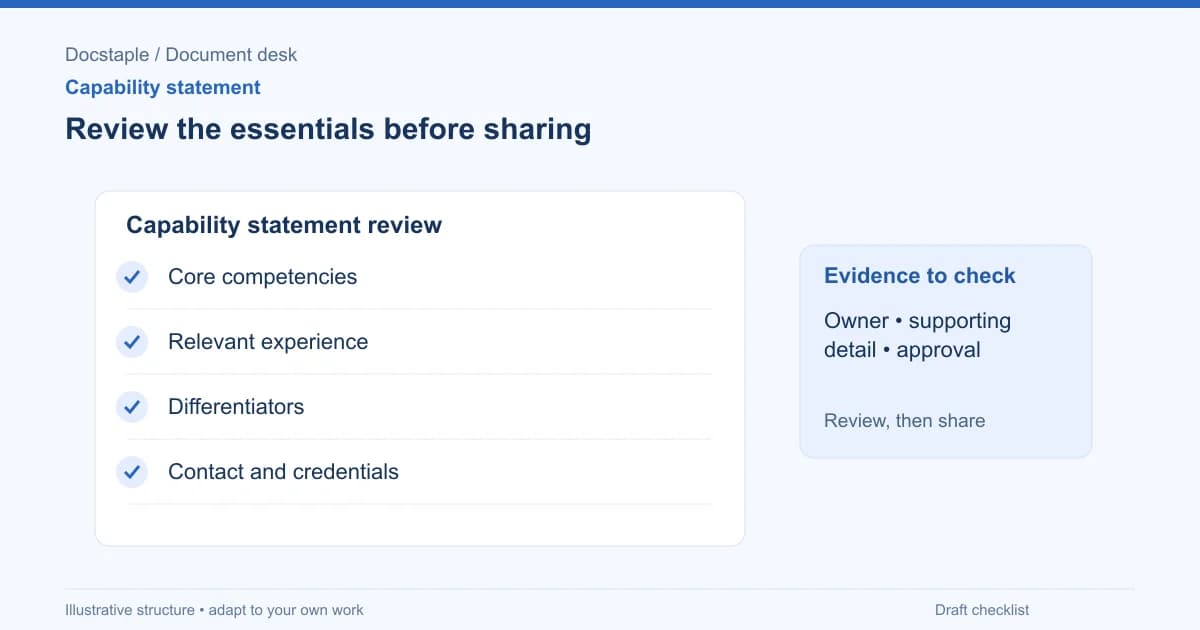
A capability statement checklist is useful because the document is short, but the risk of vagueness is high. One polished page can still fail if the first line is too broad, the experience is not relevant, the differentiators sound like slogans or the contact details are out of date.
This checklist is written for a consulting firm preparing a capability statement for operating strategy and service-improvement work. The same review logic can fit other business services, but the evidence, buyer language and identifiers should change with the opportunity.
For United States federal outreach, several official sources describe capability statements as concise summaries of core capabilities, services, certifications, clients, codes and contact details. HHS lists those content areas in its guidance on how to write a good capability statement. Commerce also tells businesses to develop a concise one-page overview that highlights competencies and performance elements that differentiate the business in its small-business specialist guidance (Commerce small business specialist PDF).
Start With The Buyer And Opportunity
Before checking sentences, check the target. A capability statement sent to a state transportation agency, a nonprofit foundation and a prime contractor should not read exactly the same.
Use this first gate:
- Name the buyer type and opportunity lane.
- Identify the service you want to be considered for.
- Confirm which jurisdiction or procurement context controls any identifiers.
- Remove services that are true but irrelevant to this version.
Worked decision analysis: state agency intake review
Suppose a consulting firm wants to approach a state health agency about intake-process review. The firm's master statement says it provides strategy, operations, facilitation, training, analytics, change management and executive coaching. That is not false, but it is too wide for the target.
The checklist should force a narrower opening:
[Firm name] helps public-service teams review intake workflows, interview stakeholders, map current handoffs and prepare sponsor-ready recommendations for service improvement decisions.
The annotation is the important part. "Public-service teams" matches the buyer. "Review intake workflows" names the lane. "Sponsor-ready recommendations" signals the deliverable. Training and executive coaching may stay in the firm's service menu, but they should not lead this statement unless the opportunity calls for them.
Check Core Competencies For Scope Fit
Core competencies should be the work a buyer can actually ask you to perform. They are not values, personality traits or every line from your website.
Review each competency with three questions:
- Could this become a proposal task or deliverable?
- Is it relevant to the buyer's likely need?
- Can the firm show that it has delivered it before?
Annotated sample language
Core competencies: stakeholder interview planning; current-state workflow review; service handoff mapping; options analysis; recommendations reports; executive sponsor briefings.
This works because each item is a consulting activity or output. A buyer can understand what the firm would do. It is also easier to price and scope later than "transformation advisory" or "operational excellence."
Delete competencies that only exist to look bigger. If the page lists twelve unrelated services, the reader may struggle to identify the real offer. For a United States federal audience, HHS includes core capabilities and major services among the items to include in a capability statement, but that does not mean every service belongs in every version (HHS capability statement guidance).
Test Relevant Experience Against Evidence
Relevant experience should prove that the firm can perform the work in front of the buyer. It should not simply name impressive clients.
Use this checklist:
- Is the example similar to the target work?
- Does it state the firm's actual role?
- Are the client name and details approved for use?
- Is the outcome supported by a record or approved language?
- Does the example avoid confidential operational details?
Worked decision analysis: confidential nonprofit project
A weak entry says:
Helped a leading nonprofit transform operations and improve service delivery.
The problem is not only style. "Leading" is unsupported, "transform" is unclear and the claimed improvement may be confidential or impossible to evidence.
A stronger checklist-passing entry says:
Regional nonprofit, name withheld under confidentiality terms. Scope: intake review, stakeholder interviews and recommendations report for leadership. Period: [month year to month year]. Evidence available internally: signed statement of work, interview plan, final report acceptance email.
This version gives the buyer useful information without exposing the client. It also separates external wording from internal proof. The capability statement does not need to attach the acceptance email, but the writer should know it exists before making the claim.
For marketing claims in the United States, the FTC says advertising should be truthful and supported by evidence (FTC advertising FAQ for small business). Treat capability-statement outcomes the same way. If you cannot support a result, describe the deliverable instead.
Separate Differentiators From Slogans
A differentiator should explain why this firm is a better fit for the buyer's problem. "Trusted," "innovative," "responsive" and "best-in-class" rarely survive review because a competitor can say the same thing.
Use this gate:
- Is the differentiator specific to how the firm works?
- Can the firm prove it during delivery?
- Does it matter to the buyer's risk or decision?
- Is it separate from a credential, unless the credential is current and named?
Annotated sample language
Differentiators: the engagement lead attends all sponsor interviews; every recommendation references the interview theme or document that supports it; final reports separate confirmed decisions from assumptions requiring sponsor review.
The language is not flashy, but it tells a buyer how delivery will feel. It also connects to consulting risk. Strategy-review projects often fail when findings cannot be traced back to evidence or when assumptions become invisible. These differentiators are operational controls, not adjectives.
If a partner provides part of the capability, the statement should say so. "Cybersecurity assessment capability through [partner name], responsible for technical control review" is clearer than implying the consulting firm owns every credential.
Verify Contact, Credentials And Identifiers
The final block is small, but it is where many drafts decay. Old phone numbers, retired certifications and copied registration codes undermine trust quickly.
Check:
- Legal name and DBA, if used.
- Website and primary contact.
- Email and phone number.
- Service area or office location.
- Current certifications, licenses or memberships.
- Procurement identifiers that apply to the target buyer.
- One clear next step.
Sample business-details block
Legal name: [registered legal name]
Primary contact: [name], [role], [email], [phone]
Service area: [states, regions or remote coverage]
Relevant identifiers: [UEI, CAGE, NAICS or local supplier ID, if applicable]
Next step: request a scoped proposal for [specific service lane].
For United States federal contracting, SAM.gov explains that entities need an active registration to apply for federal awards as a prime awardee, and that a Unique Entity ID alone is not the same as being able to apply directly for awards (SAM.gov entity registration). That distinction matters. Do not present an identifier as broader eligibility than it actually provides.
If the statement is for a non-US buyer, replace this gate with the registry, supplier number or certification system used in that jurisdiction. The checklist should verify the buyer's required evidence, not force US labels into the wrong context.
Finish With A Send-Ready Review
The last pass should be practical, not ceremonial. Read the statement as if you are a busy buyer deciding whether to keep the firm in a shortlist.
Confirm that the first third of the page answers three questions: what the firm does, who it helps and why the evidence is relevant. Then scan the rest for unsupported adjectives, stale identifiers, unexplained acronyms and client details that need permission.
Do not use the same version for every opportunity. Keep a master with approved facts, then create buyer-specific versions by reordering verified evidence. The facts stay stable; the emphasis changes.
The consulting capability statement template gives you editable Word sections for organization and capabilities, relevant experience, resources and differentiators, business details and review notes. Use it to build the draft, then run this checklist before sending.
Last updated: September 26, 2026
Frequently Asked Questions
Related Articles
Capability Statement Best Practices for Consulting Firms
Capability statement best practices for consulting firms, with fixes for vague competencies, weak past performance, generic differentiators and stale credentials.
Capability Statement Examples: Four Sections Written Weak and Then Strong
Capability statement examples for a fictional consulting firm: core competencies, relevant experience, differentiators, and contact and credentials, each shown as weak and stronger draft wording with a review checklist.
Engagement Letter Best Practices
Best practices for engagement letters, including scope control, responsibility wording, limitation language and approval records.
Engagement Letter Checklist
Use this engagement letter checklist to review purpose, parties, responsibilities, limitations, approval and signature readiness.
Engagement Letter Examples: Purpose, Scope Limits and Signatures
Engagement letter examples for consulting work, with annotated wording for parties, responsibilities, scope limitations, approval and signatures.
How to Write a Construction Capability Statement: Experience, Credentials and Proof
How to write a construction capability statement for subcontracting and buyer review, with draft language for competencies, relevant projects, differentiators, credentials and approval checks.