Engagement Letter Checklist
Use this engagement letter checklist to review purpose, parties, responsibilities, limitations, approval and signature readiness.
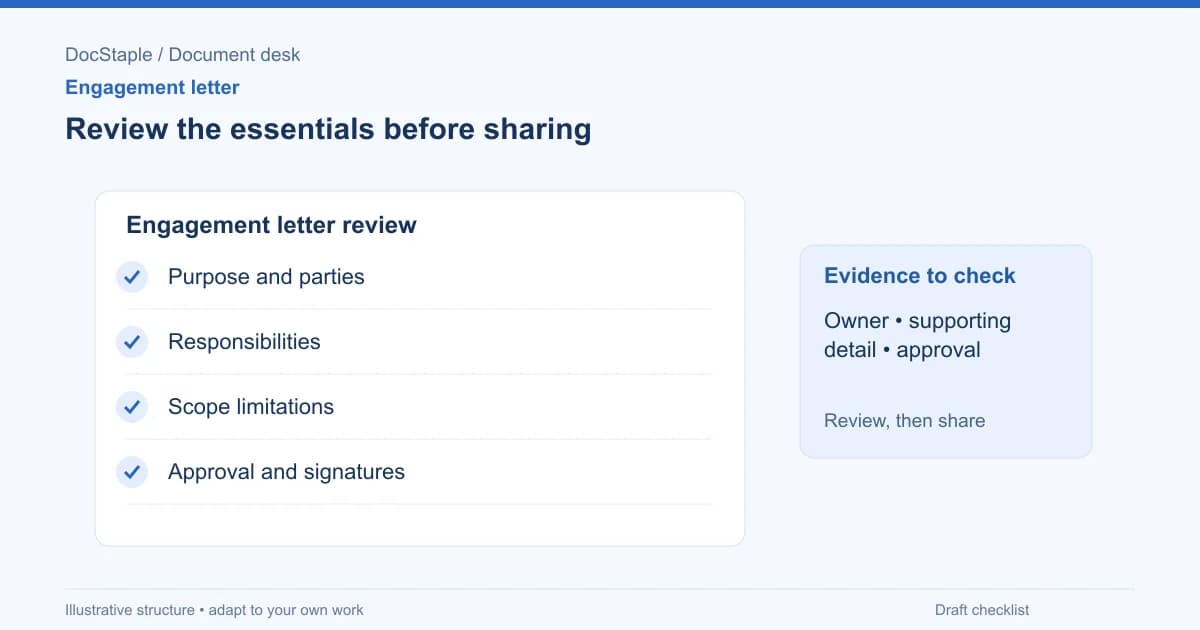
An engagement letter checklist is useful only if it tests the document before it becomes the project record. It should not ask, "Does the letter have a scope section?" It should ask whether the scope is specific enough to stop a delivery argument.
Use the checklist below for a consulting engagement letter before it goes to a client. The scenario is a data governance assessment for a midsize healthcare administration vendor. The consultant will review current document-handling routines and prepare a recommendations memo. The point of the checklist is to catch uncertainty before signature.
Check 1: Purpose and parties are exact
The first review gate is identity. Confirm the full legal names, trading names if used, addresses if required by your format, and the person authorized to instruct each side.
Review questions:
- Does the letter name the client entity, not only the client contact?
- Does it identify the provider entity issuing the letter?
- Does it state the assignment purpose in business language?
- Does it name the person authorized to approve changes?
Worked review example:
Draft: "This letter confirms our work with Apex."
Checklist finding: fail. "Apex" could mean Apex Health Admin LLC, Apex Benefits Services Inc. or a department nickname. It also says nothing about the decision the work supports.
Improved wording:
This letter confirms the engagement between Calder Consulting Ltd. and Apex Health Admin LLC for a data governance assessment supporting Apex's decision on whether to revise document access routines for client onboarding records.
That version gives the file reviewer a real starting point. The engagement is not "help with governance"; it is tied to a decision and a document population.
Check 2: Responsibilities show both sides of the work
Engagement letters often over-describe the consultant's output and under-describe the client's inputs. That is risky because consulting work usually depends on access, records, reviewers and decisions.
For the Apex scenario, the checklist should test three responsibility types:
- Provider activities
- Client inputs
- Shared review points
Annotated sample:
Calder will interview up to eight process owners, review current onboarding record-handling instructions and prepare a recommendations memo. Apex will provide current access matrices, sample onboarding file indexes and reviewer availability. Apex will consolidate draft comments through the project sponsor.
Why this passes: there is a named work pattern, a defined evidence set and a single comment route. It avoids a familiar problem where six reviewers send conflicting comments after the draft is already late.
Decision analysis: if Apex cannot provide sample files because they contain restricted information, the letter should say what substitute evidence will be used. A checklist should flag that before signature.
Possible fix:
If sample files cannot be shared, Apex will provide redacted file indexes and a walkthrough with the records manager. Calder's recommendations will be limited to the evidence made available.
That limitation belongs in the letter, not in a later apology email.
Check 3: Scope has deliverables, exclusions and acceptance
Scope needs three layers: included work, excluded work and acceptance. A checklist that checks only deliverables leaves two-thirds of the problem unreviewed.
In US federal service contracting, performance-based guidance uses performance work statements, measurable standards and assessment methods for performance-based contracts (FAR Subpart 37.6). Your private engagement letter is not a FAR contract unless it is actually in that system, but the review idea is practical: say what result will be assessed and how.
Checklist questions:
- Is each deliverable named?
- Does the letter say what each deliverable contains?
- Are exclusions written in concrete terms?
- Is acceptance tied to an authorized reviewer?
- Are draft comments handled by one consolidated route?
Worked review example:
Draft: "Deliverable: governance memo."
Checklist finding: incomplete. The phrase does not tell the client whether the memo includes policy drafting, system configuration, legal analysis or implementation planning.
Better:
Deliverable: recommendations memo describing current document-access gaps observed from supplied records, practical improvement options, implementation considerations and open decisions for Apex's sponsor. The memo will not include legal advice, system configuration or revised policy text unless added by written approval.
That wording narrows the deliverable and reduces false expectations.
Check 4: Limitations are visible, not hidden
Limitations should be easy to find. If they are scattered through a proposal, footer and attachment, readers may miss them. Put material limitations near the scope or reliance section.
Review for:
- Reliance on client-supplied information
- No audit, certification or assurance unless expressly included
- No legal, tax, safety or regulated advice unless approved and qualified
- Distribution limits if the output is for a defined audience
- Assumptions that affect timing
For Apex, a strong limitation might say:
Calder will rely on records and explanations provided by Apex. Calder will note apparent inconsistencies discovered during the review, but the engagement does not include independent verification, legal advice or certification of compliance with healthcare privacy laws.
Jurisdiction matters. If a letter discusses a legal requirement, say which jurisdiction applies and obtain appropriate review. Do not imply that a consulting template decides compliance for a regulated organization.
Checklist failure mode: the draft says "standard limitations apply" without attaching or identifying them. A reviewer cannot approve a limitation they cannot see.
Check 5: Fees, timing and changes are controlled
Fees and schedule usually fail because they are separated from assumptions. A checklist should connect the number to the facts behind it.
Review questions:
- Is the fee basis clear?
- Does the schedule depend on client input dates?
- Are expenses, taxes or third-party costs addressed if relevant?
- Who can approve additional work?
- How will approved changes be recorded?
In US federal contracting, the FAR treats modifications as written contract actions and explains when change orders and supplemental agreements are used (FAR Part 43). Private consulting teams do not need federal forms for ordinary commercial work, but they should still document scope changes clearly.
Sample change control:
Additional interviews, policy drafting, system configuration support or work outside the stated deliverables requires written approval by Apex's project sponsor and Calder's engagement lead before the work begins. Approved changes must state the added work, fee effect and timing effect.
Worked decision example: Apex asks for two extra departments to be reviewed. The checklist should push the drafter to decide whether that is a small addition within the cap or a change. If the original scope said "up to eight process owners," the ninth and tenth interviews need approval or an explicit reserve.
Check 6: Signature readiness includes the Word file
The final checklist is not only substantive. It is also documentary. A letter can have sound wording and still be unready because markup, comments or old placeholders remain.
Microsoft notes that hiding changes does not remove markup; tracked changes need to be accepted or rejected to remove them from the document (Microsoft Support: Track changes in Word). That is a practical risk for engagement letters because comments may contain negotiation positions or names of alternatives.
Signature readiness checklist:
- All bracketed fields completed or removed.
- Attachments listed by exact title and date.
- Version number or date appears in the footer or file name.
- Tracked changes are resolved.
- Comments are deleted or intentionally retained.
- Signature blocks include name, title, organization and date.
- The signed copy and editable master are stored separately.
Also check the file name against the signature date. A common records problem is a final PDF named "v3 clean" while the signed letter shows a later revision date. Use a naming pattern that makes the issued version obvious to someone who was not in the negotiation.
Final approval language:
By signing, each party confirms that the person signing is authorized to approve the engagement described in this letter and that the attached schedules listed above form part of the engagement record.
For a reusable review structure, the consulting engagement letter template includes editable purpose, responsibility, limitation and approval sections. Use the checklist to test the completed draft, not to excuse vague wording.
Last updated: September 26, 2026
Frequently Asked Questions
Related Articles
Capability Statement Best Practices for Consulting Firms
Capability statement best practices for consulting firms, with fixes for vague competencies, weak past performance, generic differentiators and stale credentials.
Capability Statement Checklist for Buyer-Ready Consulting Drafts
A capability statement checklist for consulting firms, with review gates for core competencies, relevant experience, differentiators, credentials and contact details.
Capability Statement Examples: Four Sections Written Weak and Then Strong
Capability statement examples for a fictional consulting firm: core competencies, relevant experience, differentiators, and contact and credentials, each shown as weak and stronger draft wording with a review checklist.
Engagement Letter Best Practices
Best practices for engagement letters, including scope control, responsibility wording, limitation language and approval records.
Engagement Letter Examples: Purpose, Scope Limits and Signatures
Engagement letter examples for consulting work, with annotated wording for parties, responsibilities, scope limitations, approval and signatures.
How to Write a Construction Capability Statement: Experience, Credentials and Proof
How to write a construction capability statement for subcontracting and buyer review, with draft language for competencies, relevant projects, differentiators, credentials and approval checks.