Capability Statement Examples: Four Sections Written Weak and Then Strong
Capability statement examples for a fictional consulting firm: core competencies, relevant experience, differentiators, and contact and credentials, each shown as weak and stronger draft wording with a review checklist.
A capability statement is a short document that tells a buyer what your organization does, what it has done, and how to verify and contact you. Because buyers may skim it before deciding whether to ask for more, weak wording costs you the reader quickly. The wording problems are usually the same ones: adjectives with no evidence, a client list nobody approved, and identifiers that do not match official records.
This article works through one fictional example and shows four sections twice, first as a weak draft and then as a stronger one. The firm is Harbor Lane Advisory, an invented nine-person consultancy that reviews operating strategy for mid-sized public and nonprofit organizations. Every name, number and project is made up for illustration. Bracketed items are fields you would replace with verified facts.
What a capability statement needs to do
Buyers rarely read a capability statement closely, and that shapes the drafting. The US General Services Administration's Office of Evaluation Sciences studied small manufacturers' marketing materials. It reported that of 4,546 capabilities statements taken from the Small Business Administration's system, roughly half were over two pages and only a third described past performance on the first page, and that federal buyers it interviewed emphasized the importance of past performance.
Be careful with what that study does and does not show. It looked at small manufacturers and federal buyers, and its email test of a standardized template found no statistically significant difference in click rates between original and redesigned statements. So treat it as a reason to put evidence early and keep the page easy to scan, not as proof that any layout wins contracts.
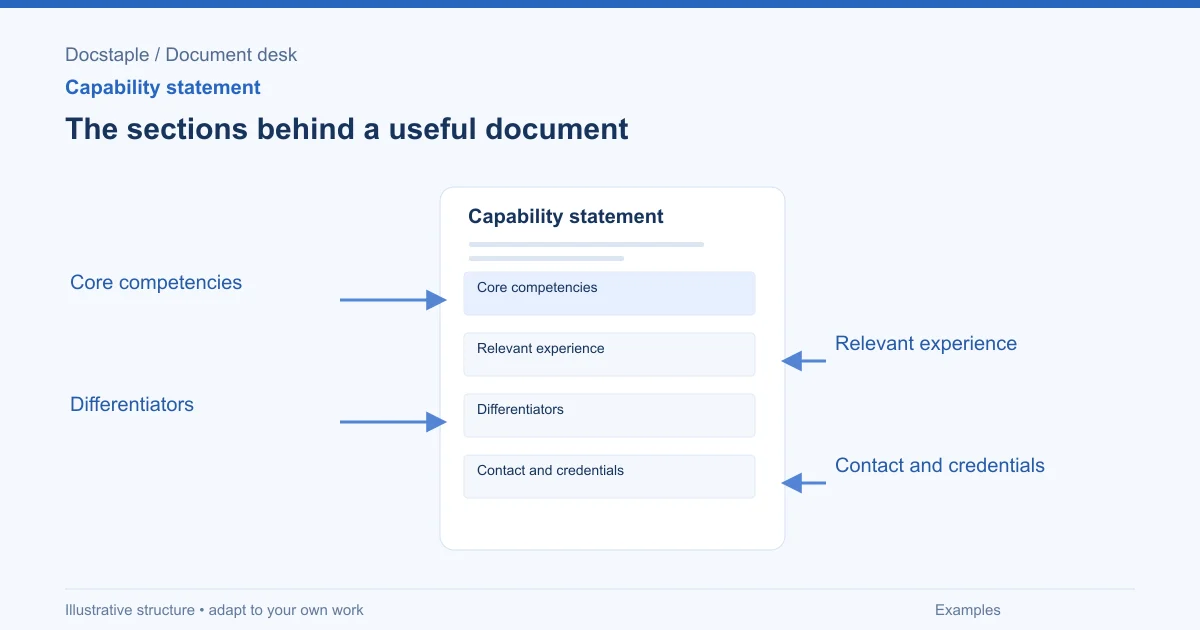
The four sections below follow the brief for this article: core competencies, relevant experience, differentiators, and contact and credentials.
Example 1: Core competencies
Core competencies tell the buyer what you can be asked to do. A weak version describes an attitude.
Weak draft
Harbor Lane Advisory is a results-driven, full-service consultancy committed to excellence and innovative solutions for every client.
Nothing here can be checked, and a buyer cannot tell which requests to send you.
Stronger draft
Core competencies
- Operating strategy reviews for organizations with [range] staff, delivered as a written report with options and a recommendation
- Stakeholder interviews and current-state process mapping
- Facilitated planning workshops for leadership teams
- Recommendations presentations to boards or executive committees
The stronger version names services in the vocabulary a buyer would use to search or write a request. It also states a size range, which helps a buyer rule you in or out. If you serve government buyers, matching your wording to the categories in your registration keeps the statement consistent with your official record. Each line should describe something you have delivered, not something you hope to.
Example 2: Relevant experience
Experience is where a reader looks for proof. A weak version lists names and adjectives.
Weak draft
We have worked with numerous leading organizations and achieved outstanding results across many sectors.
Stronger draft
Relevant experience
Client (as approved) Scope Period Verified outcome [Regional nonprofit, name used with permission] Strategy review with discovery interviews and a recommendations report [Month year to month year] Report delivered to the board on [date]; [one outcome the client has confirmed] [Public agency, or "a state agency" if the name is confidential] Current-state process review [Period] [Outcome, or "Deliverables accepted by the project sponsor"]
Notice the last column. It records an outcome the client has confirmed, not a result the consultant claims credit for. If a client asked you to keep its name private, describe it generically. If you want to quote a testimonial, get the words and the attribution approved in writing first.
The rule behind that caution comes from the US Federal Trade Commission's guidance for small businesses. It says advertising must be truthful and non-deceptive and that advertisers must have evidence to back up their claims, and it defines a reasonable basis as objective evidence that supports the claim. A capability statement is a marketing document, so the same discipline applies to "increased efficiency by [number]%" style figures. If the client cannot confirm a number, leave it out.
Example 3: Differentiators
Differentiators should be things a competitor could not honestly copy and paste. A weak version claims uniqueness with no basis.
Weak draft
Our unique approach and unmatched expertise set us apart from every other firm.
Stronger draft
What is different about how we work
- Every engagement is led by a named principal who attends all stakeholder interviews.
- Each recommendation in the report cites the interview notes or documents it rests on, so the client can trace it.
- Reports are delivered as editable Word documents, along with a short briefing for the sponsor.
- [Certification or credential, only if current and verifiable, with the issuing body named]
Every line here is a practice you can prove or a credential you can show. If you rely on a partner, say so and describe what the partner does. Do not let the reader assume a partner's certification or experience is your own. Delete anything you would struggle to evidence if the buyer asked.
Example 4: Contact and credentials
This section lets the buyer verify who you are and act. A weak version buries or omits the details.
Weak draft
For more information, please get in touch. Registered and certified.
Stronger draft
Business details Legal name: [as it appears on your registration] Location and service area: [city and region served] Contact: [named person], [role], [email], [phone] Registration identifiers: [only those that apply and are current] Next step: Request a scoped proposal by contacting [named person]. We will respond within [period you can meet].
If you sell to US federal buyers, the identifiers usually come from SAM.gov. That site says that if you want to apply for federal awards as a prime awardee, you need a registration, and that a Unique Entity ID alone does not let you apply directly for awards. So do not present an identifier as if it were the same as being registered, and copy each value from your record exactly.
This advice is specific to the United States. Buyers in other countries, and some state or local buyers, use different registers and identifiers. If you are unsure what your target buyer expects, read the request or ask them.
Also avoid the temptation to fill space with "certified" or "licensed" without naming the body. The reader should be able to look each one up.
Review a capability statement before it goes out
Whether the draft comes from this article, a colleague or an older version, check it against evidence:
- Purpose: Does the first section say what you do and who you do it for, in plain terms?
- Evidence: Does each claim map to a project record, a document or a credential you can produce?
- Permission: Have you approved every client name, quote and outcome with the client, or generalized it?
- Placement: Does your strongest relevant experience appear near the top, not after a page of adjectives?
- Consistency: Do names, identifiers, codes and dates match the official records they come from?
- Length and fit: Does it fit the limit the buyer set, or a length you can defend?
- Leftovers: Have all names, figures and claims from the example you started with been replaced?
- Next step: Is there one named person and one specific action for the reader?
- Approval: Has the person authorized to speak for the organization signed it off, and is the approved copy saved?
Give the finished version to someone who was not involved in writing it. If they cannot tell what you would do for them from the first third of the page, revise the top.
Turn the examples into your own draft
If you would rather not rebuild the layout each time, the consulting capability statement template is an editable Word file with sections for organization and capabilities, relevant experience and results, resources and differentiators, business details and next step, and an approval record. It is a starting draft: you supply the facts, and it does not guarantee that a statement is accurate, compliant or acceptable to any particular buyer.
Sources: GSA Office of Evaluation Sciences: small manufacturers' marketing materials, FTC Advertising FAQ's: A Guide for Small Business, SAM.gov entity registration
Last updated: September 26, 2026
Frequently Asked Questions
Related Articles
Capability Statement Best Practices for Consulting Firms
Capability statement best practices for consulting firms, with fixes for vague competencies, weak past performance, generic differentiators and stale credentials.
Capability Statement Checklist for Buyer-Ready Consulting Drafts
A capability statement checklist for consulting firms, with review gates for core competencies, relevant experience, differentiators, credentials and contact details.
Engagement Letter Best Practices
Best practices for engagement letters, including scope control, responsibility wording, limitation language and approval records.
Engagement Letter Checklist
Use this engagement letter checklist to review purpose, parties, responsibilities, limitations, approval and signature readiness.
Engagement Letter Examples: Purpose, Scope Limits and Signatures
Engagement letter examples for consulting work, with annotated wording for parties, responsibilities, scope limitations, approval and signatures.
How to Write a Construction Capability Statement: Experience, Credentials and Proof
How to write a construction capability statement for subcontracting and buyer review, with draft language for competencies, relevant projects, differentiators, credentials and approval checks.