Engagement Letter Best Practices
Best practices for engagement letters, including scope control, responsibility wording, limitation language and approval records.
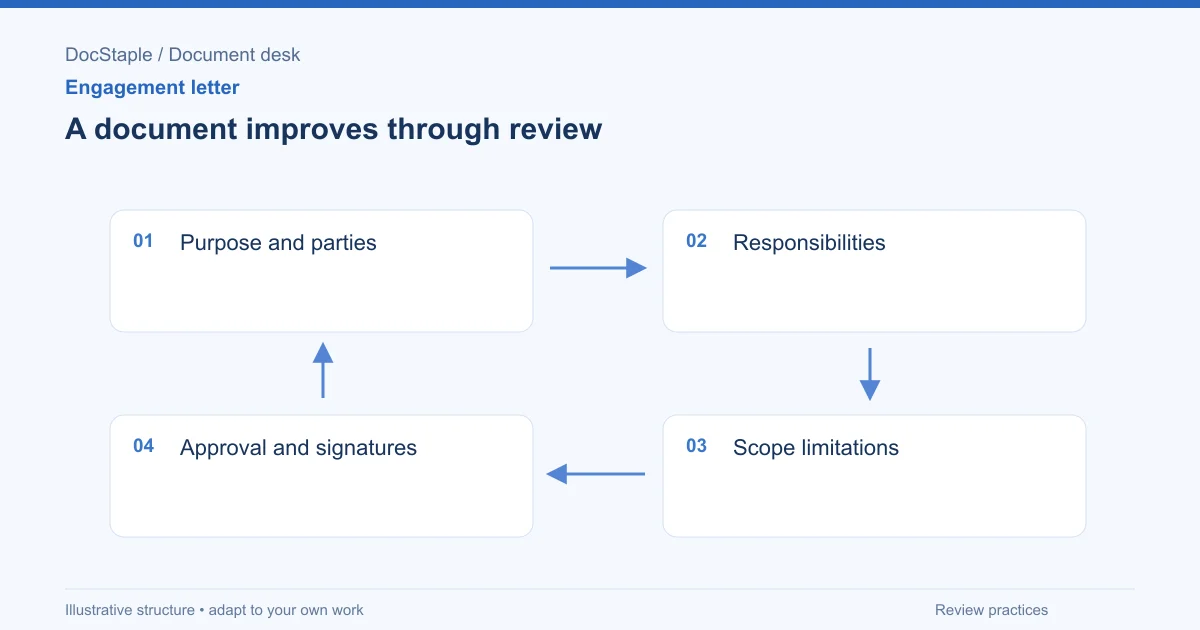
Engagement letter best practices are not about making the letter heavier. They are about making it more useful when the first difficult question appears. Who can approve a change? Was implementation included? Did the client promise access to the records? Can the report be shared outside the sponsor group?
The examples here use a consulting firm advising a nonprofit on a donor operations review. The client wants a recommendations report, but the conversations quickly touch technology, staffing and privacy. A good engagement letter keeps those adjacent topics from quietly becoming unpriced commitments.
Best practice 1: Write the assignment as a decision record
An engagement letter should say why the work exists. When it names the decision being supported, scope choices become easier.
Weak:
We will review donor operations and provide advice.
Stronger:
The engagement will support Harbor House Foundation's decision on whether to redesign donor intake, acknowledgment and reporting routines before the next annual campaign.
This changes the document. The consultant is not promising to transform the entire fundraising function. The assignment supports a defined management decision.
Worked example: the development director asks for board training slides. If the letter's purpose is donor operations redesign, training slides may be related but separate. The engagement lead can propose a change rather than stretching the recommendations report into a training package.
Best practice wording:
The intended audience is Harbor House's executive sponsor and operations steering group. Distribution outside that audience requires sponsor approval and may require additional review if the material is repurposed.
That sentence protects the context of the advice. A report drafted for internal decision-making may not suit public release, funder reporting or legal review.
Best practice 2: Pair every provider duty with a client dependency
Consulting letters often say what the consultant will do but not what the client must provide. That creates delivery friction. Best practice is to pair duties and dependencies in the same section.
Example:
Alder Strategy will conduct up to ten interviews, review donor intake procedures, inspect supplied reporting templates and prepare a recommendations report. Harbor House will provide current procedure documents, sample reporting templates, interview access and one consolidated set of draft comments.
This phrasing makes the dependency visible. It also makes delay conversations less personal. If comments arrive from five reviewers separately, the letter already says the sponsor should consolidate them.
Decision analysis: should the letter require "all relevant documents" or name the records? Name the records when you can. "All relevant documents" sounds broad and may invite disputes about whether missing documents were requested. "Current donor intake procedure, acknowledgment email templates and monthly reporting template" is reviewable.
If records are uncertain, use a discovery clause:
If discovery identifies additional records needed to complete the review, Alder will request them in writing and state whether missing records affect the report's limitations or timing.
That handles uncertainty without pretending the scope is complete on day one.
Best practice 3: Make scope measurable enough to review
The scope should let both parties determine whether work was delivered. In US federal service contracting, performance-based service contracts use a performance work statement, measurable performance standards and assessment methods (FAR Subpart 37.6). A nonprofit consulting letter is usually not a federal procurement document, but measurable drafting still helps.
Better scope fields:
- Workstream
- Included activities
- Deliverable
- Acceptance reviewer
- Explicit exclusions
For Harbor House:
| Workstream | Included | Output |
|---|---|---|
| Donor intake review | Interviews and document review | Findings summary |
| Reporting routine review | Template inspection and process mapping | Recommendations report |
Then define the acceptance moment:
Harbor House's executive sponsor will review the draft report for factual corrections and acceptance. Acceptance does not require agreement with every recommendation; it confirms that the agreed deliverable has been provided for the stated purpose.
That last sentence is useful. Consulting recommendations may be debated. Acceptance should not depend on the client liking every recommendation unless the parties intentionally make that the standard.
Best practice 4: Put exclusions where readers cannot miss them
Exclusions should sit next to scope, not in fine print. Adjacent work is the main risk: software selection, policy drafting, staff training, implementation support, assurance, legal advice or tax advice.
Sample exclusion block:
This engagement excludes software procurement, implementation management, legal advice, tax advice, audit or assurance procedures, and drafting of policies for external publication. Those services require separate written approval.
Failure mode: the letter says "recommendations report" and the client assumes recommendations include implementation roadmaps, software vendor scoring and policy edits. The consultant assumes it means findings and options. The difference is expensive.
Worked fix: add a "not included unless added" sentence after the deliverable table.
Recommendations may identify areas where policy, software or staffing changes should be considered. The engagement does not include selecting vendors, negotiating software contracts or managing implementation.
That is precise and still client-friendly. It does not sound defensive; it explains the boundary.
Best practice 5: Treat change control as a normal workflow
Change control should not sound like a threat. It is how both sides protect budget, timing and decision quality.
Best practice language:
Either party may request a scope change. The request must describe the added or revised work, reason for the change, effect on fee, effect on timetable and any new assumptions. No additional work begins until both parties approve the change in writing.
In US federal contracting, formal modification rules distinguish written change orders, supplemental agreements and administrative changes (FAR Part 43). Commercial consulting engagements will use simpler tools, but they still benefit from naming the changed work and approval authority.
Decision analysis: if a sponsor asks for an extra presentation to the board, should the consultant require a change? The answer depends on the original scope. If the scope included one executive presentation, a board presentation adds audience, preparation risk and possibly different messaging. Best practice is to approve it as a change, even if the fee effect is zero.
Possible no-fee change record:
Approved change: Alder will present the existing recommendations report to the board program committee on [date]. No new analysis is included. Fee effect: none. Timing effect: final report issue moves from [date] to [date].
That small record prevents confusion later.
One more best practice: keep change approvals with the signed letter, not only in email threads. A later project reviewer should be able to reconstruct the current scope without searching inboxes, chat messages and meeting notes.
Best practice 6: Finish with clean approval evidence
The final signed letter should be boring in the best way. Names are correct, attachments are listed, tracked changes are gone and the authority is clear.
Microsoft explains that Word's Reviewing Pane can show remaining tracked changes and comments, and changes must be accepted or rejected rather than merely hidden (Microsoft Support: Track changes in Word). Use that before issuing any engagement letter.
Approval evidence should include:
- Final Word or PDF version.
- Signature page with name, title and date.
- Attachment list.
- Change approvals issued after signature.
- Record of who received the signed copy.
Sample signature wording:
The individuals signing below confirm they are authorized to approve this engagement for their respective organizations and that the attachments listed in this letter are incorporated into the engagement record.
Do not add a broad legal promise you do not understand. If your organization requires governing law, limitation of liability, confidentiality or dispute terms, use approved wording for the relevant jurisdiction.
For a structured starting point, the consulting engagement letter template includes editable sections for purpose, responsibilities, scope limits, fee timing and authorization. The best practice is to turn those sections into a clear record of this engagement, not a generic form with names inserted.
Last updated: September 26, 2026
Frequently Asked Questions
Related Articles
Capability Statement Best Practices for Consulting Firms
Capability statement best practices for consulting firms, with fixes for vague competencies, weak past performance, generic differentiators and stale credentials.
Capability Statement Checklist for Buyer-Ready Consulting Drafts
A capability statement checklist for consulting firms, with review gates for core competencies, relevant experience, differentiators, credentials and contact details.
Capability Statement Examples: Four Sections Written Weak and Then Strong
Capability statement examples for a fictional consulting firm: core competencies, relevant experience, differentiators, and contact and credentials, each shown as weak and stronger draft wording with a review checklist.
Engagement Letter Checklist
Use this engagement letter checklist to review purpose, parties, responsibilities, limitations, approval and signature readiness.
Engagement Letter Examples: Purpose, Scope Limits and Signatures
Engagement letter examples for consulting work, with annotated wording for parties, responsibilities, scope limitations, approval and signatures.
How to Write a Construction Capability Statement: Experience, Credentials and Proof
How to write a construction capability statement for subcontracting and buyer review, with draft language for competencies, relevant projects, differentiators, credentials and approval checks.