Confidentiality Agreement Checklist for Consulting Engagements
A practical confidentiality agreement checklist covering confidential information, permitted use, exceptions, legal review and signatures for consulting work.
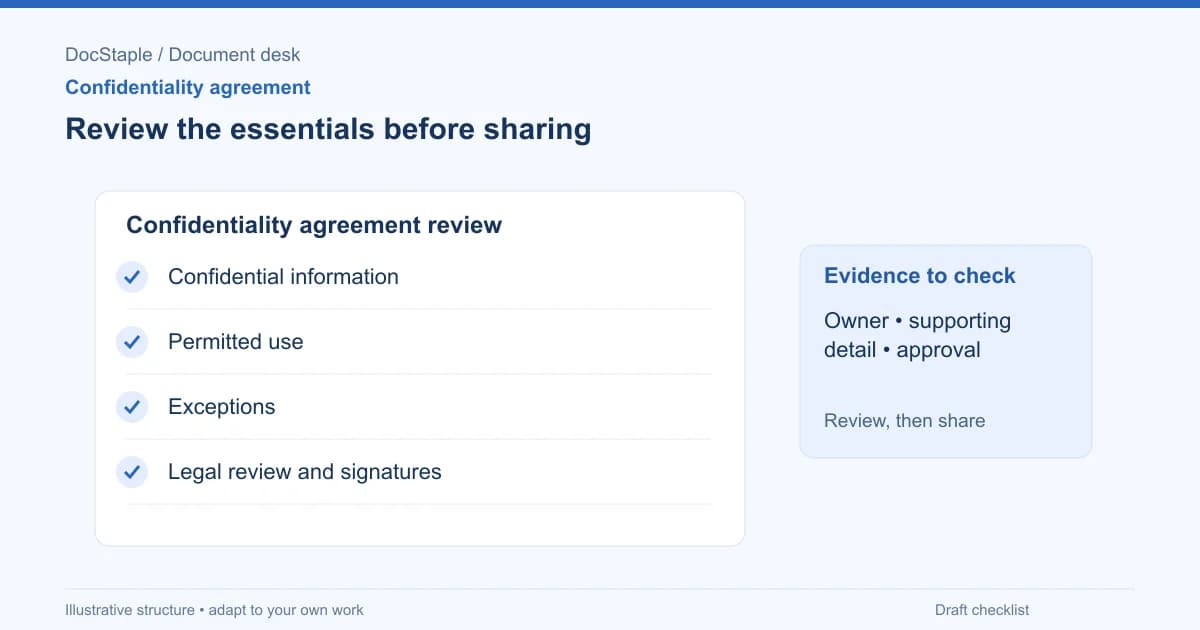
A confidentiality agreement checklist helps you catch gaps before sensitive information starts moving. It is not a substitute for legal review, but it can make that review cleaner by forcing practical questions into the open: what information is covered, who may use it, what exceptions apply, and who is authorized to sign.
Use this guide for a consulting scenario. A client is sharing customer interviews, pricing analysis, draft strategy materials and employee feedback with an outside consulting team. The consultants need the information to produce a recommendations report. One subcontractor will help with data analysis, and both parties want a signed agreement before the discovery phase begins.
Confirm the parties and purpose
Start with the basics. The agreement should identify the disclosing party, receiving party and business purpose. If both parties will share sensitive information, say whether the agreement is mutual. If only one side shares confidential information, do not accidentally create obligations that do not match the deal.
Purpose matters because it limits use. "For any business discussion" is too broad for most consulting work. "To evaluate and perform the strategy review described in statement of work SOW-24-03" is more useful.
Checklist:
- Are the legal names of the parties correct?
- Is the project or purpose specific enough to limit use?
- Does the agreement cover affiliates, advisers or subcontractors only if intended?
- Does the agreement match the statement of work and data handling promises?
Draft language:
The receiving party may use Confidential Information solely to evaluate, prepare and perform the strategy review described in [SOW reference] and for no other purpose.
Review criterion: a project manager should be able to explain why each party needs the information and where the authority to share it comes from.
Define confidential information without creating confusion
The definition is the heart of the checklist. The FTC advises businesses to know what personal information they hold, where it is stored and who has access to it when assessing data security FTC. The same discipline helps confidentiality drafting: inventory the real information before writing the clause.
For this consulting scenario, confidential information might include interview notes, customer lists, non-public revenue data, product roadmaps, pricing models, system screenshots and draft recommendations. If personal data is involved, the confidentiality agreement may sit beside a data processing or data sharing arrangement, not replace it.
The UK ICO says data sharing agreements can include retention and deletion rules, security arrangements, breach procedures, staff training responsibilities and termination procedures for return or deletion of shared data ICO. That is UK data protection guidance, not a universal NDA rule, but it is a useful reminder that "confidential" often needs operational detail.
Checklist:
- Does the definition cover oral, written, electronic and observed information if needed?
- Are examples relevant to this engagement?
- Does the agreement explain whether unmarked information can still be confidential?
- Does it separate confidential business information from regulated personal data?
- Are trade secrets handled carefully where applicable?
Draft language:
Confidential Information includes non-public information disclosed in connection with the Purpose, whether disclosed in writing, orally, visually or electronically, including customer data extracts, interview notes, pricing analysis and draft recommendations.
Review criterion: test five real documents against the definition. If the team disagrees about whether they are covered, revise the wording.
Limit permitted use and authorized access
A confidentiality agreement should not only say "keep it secret." It should say who may see the information and what they may do with it. This is especially important in consulting, where analysts, subcontractors, specialist advisers and client-side reviewers may all touch the same material.
Checklist:
- Is the permitted use tied to the specific engagement?
- Are authorized recipients listed or clearly described?
- Must subcontractors sign written confidentiality obligations before access?
- Are storage, copying and transmission limits realistic?
- Does the agreement include a process for reporting unauthorized disclosure?
Practical example:
The consultant may disclose Confidential Information only to personnel and approved subcontractors who need access for the Purpose and who are bound by written obligations protecting the information at least as strongly as this agreement.
Do not promise controls the team cannot perform. If the consulting firm uses a managed document workspace, name the approved workspace. If files may be exported for analysis, define when that is permitted and how copies are deleted or reconciled.
Review criterion: compare the agreement to the actual workflow. If the analyst needs a data room export, the agreement should either permit it with controls or prohibit it clearly enough that the workflow changes.
Check exceptions and lawful disclosures
Exceptions prevent the agreement from overreaching. They also reduce disputes by acknowledging information that should not be treated as protected.
Common exceptions include information the receiving party can show was already lawfully known, becomes public through no breach, is received lawfully from someone else without a duty of confidence, or is independently developed without using confidential information. Required disclosures may also be permitted when a court, regulator or law requires disclosure, often with notice where legally allowed.
Be careful with reporting restrictions. In the United States, the SEC explains that Rule 21F-17(a) prohibits actions that impede a person from communicating directly with SEC staff about possible securities law violations, including enforcing or threatening to enforce a confidentiality agreement for those communications SEC. The US Defend Trade Secrets Act also includes immunity language for certain confidential disclosures to government officials or attorneys to report or investigate suspected legal violations, and its notice provision can apply to contractor and consultant agreements 18 U.S.C. 1833.
Checklist:
- Are exclusions specific and evidence-based?
- Does required-disclosure wording avoid impossible notice promises?
- Does the agreement avoid blocking lawful reports to regulators?
- Has counsel reviewed any trade secret notice wording for the relevant jurisdiction?
- Does the duration match the information and law that applies?
Draft language:
Nothing in this agreement prevents a person from making disclosures protected by applicable law, including lawful reports to a government agency or regulator.
Review criterion: a lawyer should confirm the exception wording before signature, especially if employees, contractors, securities issues, personal data or trade secrets are involved.
Verify return, deletion and retention promises
Return and deletion clauses look simple but can be operationally messy. Backups, audit records, legal holds and professional record-keeping duties may prevent total deletion. A realistic clause distinguishes active project files from retained archival copies.
Checklist:
- When does return or deletion happen?
- Who requests it and who confirms completion?
- Are backups, legal holds and required records handled accurately?
- Does the clause say whether retained copies remain subject to confidentiality?
- Is there an evidence record showing what was returned, deleted or retained?
Draft language:
Within [number] days after the Purpose ends or on written request, the receiving party will return or delete Confidential Information in its active project files, except for copies it is required to retain by law, professional obligation, litigation hold or routine backup process. Retained copies remain subject to this agreement.
Review criterion: ask the person who administers the document system whether the promise can actually be fulfilled.
Confirm legal review and signatures
The final checklist step is execution. A good confidentiality agreement can still fail as a record if the wrong entity signs, the signed copy contains comments, or each party signs a different version.
Checklist:
- Has a qualified legal reviewer checked governing law, remedies and statutory notices?
- Are the parties' names and addresses correct?
- Are signers authorized for their organizations?
- Is the final version free of comments and tracked changes?
- Is the executed agreement stored where the project team can find it?
- Are related documents consistent, including the proposal, statement of work and data processing terms?
Draft signature record:
Version signed: [file name and date]. Legal review: [reviewer and date]. Signed for [Client]: [name, title, date]. Signed for [Consultant]: [name, title, date].
For a structured starting point, the consulting confidentiality agreement template includes editable sections for parties, purpose and information, permitted use and disclosure, exceptions, duration, return, review and execution. Treat it as a drafting aid, not a guarantee that the agreement is enforceable or compliant.
Final review criterion: the checklist is complete only when the business workflow, legal wording and signature record all describe the same arrangement.
Last updated: September 26, 2026
Frequently Asked Questions
Related Articles
Audit Checklist Best Practices
Best practices for audit checklists, including scope, evidence, findings, actions, closure review, failure modes and sample wording.
Audit Checklist Checklist: Review Your Audit Form Before You Use It
A practical audit checklist checklist with decision gates for scope, evidence, findings, actions and closure review.
Audit Checklist Examples: Scope, Evidence, Findings and Closure
Audit checklist examples for consulting work, covering audit scope, evidence to inspect, findings and actions, closure review and practical draft wording.
Business Continuity Plan Best Practices for Consulting Teams
Business continuity plan best practices for consulting teams, including critical services, recovery priorities, communications, exercises and review criteria.
Business Continuity Plan Checklist for Consulting Teams
A practical business continuity plan checklist for consulting work, covering critical services, recovery priorities, communications, exercises and review criteria.
Business Continuity Plan Examples: Consulting Scenarios and Recovery Priorities
Business continuity plan examples for consulting teams, with critical services, recovery priorities, communications, exercises and review criteria.