Employee Handbook Best Practices for Consulting Firms
Employee handbook best practices for consulting firms, covering working arrangements, conduct and reporting, leave placeholders and local policy review.
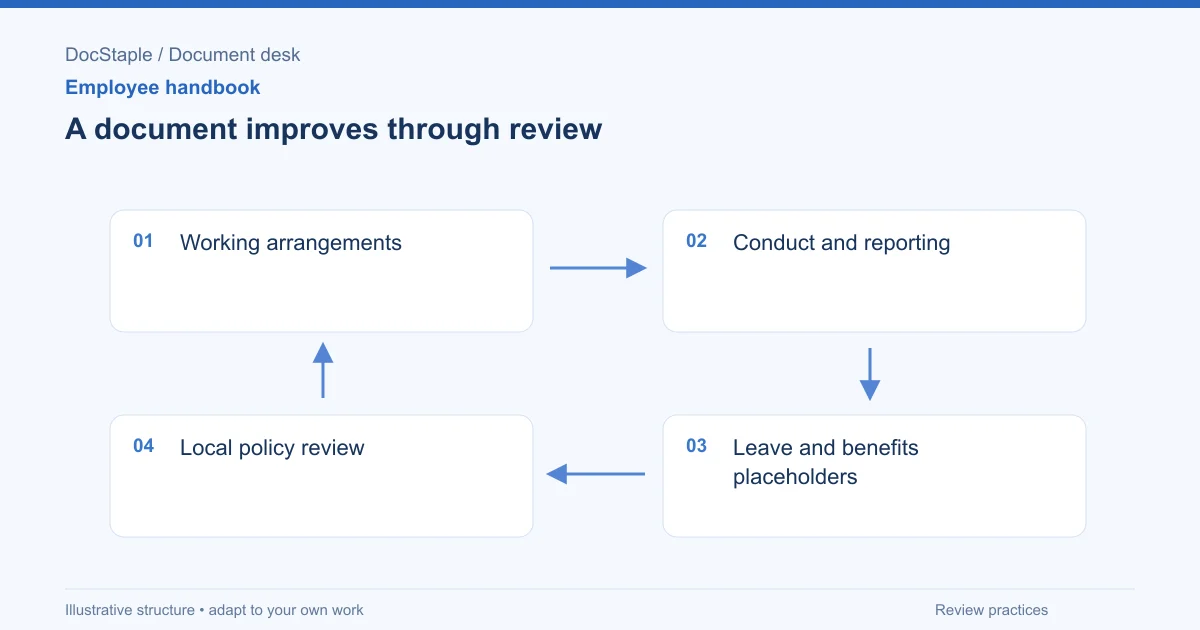
Employee handbook best practices are mostly about avoiding two extremes. A handbook that is too vague does not help employees make decisions. A handbook that is too detailed can lock the organization into promises it did not mean to make or cannot administer consistently. The best handbooks are clear, current and operationally honest.
Consider a consulting firm that has grown from ten people to forty. The early handbook says "we work flexibly" and "talk to your manager with concerns." That worked when everyone knew the founders. Now consultants work across remote offices, client sites and subcontractor-supported engagements. The firm needs policies that are still human, but much more explicit.
Make working arrangements specific enough to follow
Consulting work moves between home offices, client sites, workshops and travel. A best-practice handbook does not pretend the whole workforce sits in one office from 9 to 5 unless that is true. It explains how availability, scheduling, client commitments, time recording, travel and remote work decisions are handled.
Good working-arrangement wording should answer:
- where employees may work;
- how availability is set for client and internal commitments;
- how absence or lateness is reported;
- who approves travel, remote work exceptions or schedule changes;
- what client-site rules employees must follow.
Draft language:
Employees may work from approved locations that support confidentiality, reliable communication and client commitments. Employees must keep their calendars current, attend agreed meetings, follow client-site rules and notify their manager and People Operations if they cannot meet a scheduled commitment.
The tradeoff is flexibility versus predictability. Too much flexibility without decision rules creates inconsistent treatment. Too much rigidity can make consulting delivery harder. A good handbook names the decision maker and the criteria rather than trying to list every possible schedule.
Review criterion: choose three common events, such as illness before a workshop, a client-site visit and a remote-work request. The handbook should tell the employee what to do and who decides.
Build conduct and reporting routes for real situations
Conduct sections should not be motivational wallpaper. They should state expectations and reporting routes. The EEOC's US harassment guidance says employees should report harassment to management at an early stage to prevent escalation EEOC. EEOC promising practices also refer to multiple accessible reporting avenues and prompt, impartial and thorough investigations EEOC promising practices. Those are US federal resources, and local law may require more.
In consulting, concerns may involve colleagues, managers, clients or third parties. The handbook should make clear that employees can report concerns arising during client delivery, travel, virtual collaboration and work events.
Best practices:
- provide more than one reporting route;
- include a route outside the direct management chain;
- explain confidentiality as "to the extent possible," not absolute secrecy;
- prohibit retaliation in language reviewed for the jurisdiction;
- describe what happens after a report at a high level.
Draft language:
Employees may report policy concerns to their manager, People Operations or [alternate contact]. Reports involving client-site conduct, project travel or virtual collaboration should be raised through the same routes. The company will review concerns promptly and will share information only as needed to conduct a fair review, take action or meet legal obligations.
Review criterion: an employee who is uncomfortable reporting to their manager should still have a clear path.
Treat leave and benefits as verified content
Leave and benefits should be handled with discipline. In the United States, the Department of Labor describes FMLA as providing eligible employees of covered employers with job-protected leave for qualifying family and medical reasons and continuation of group health benefits on the same terms as if the employee had not taken leave DOL Fact Sheet 28. DOL also states that the FMLA general notice must be included in employee handbooks or other written benefit guidance when such materials exist DOL FMLA FAQ. Those statements do not replace state law, local law or plan documents.
Best practice is to draft leave and benefits sections from source material:
- statutes and required notices;
- benefit plan documents;
- employment contracts or offer letters;
- approved local policies;
- HR administration procedures.
Use placeholders until review is complete:
[Local leave summary to be inserted after HR and legal review. Include eligibility, request process, notice requirements, pay status and source document.]
This may look unfinished, but it is safer than publishing a confident paragraph that contradicts a plan document. The handbook should also state what controls if there is a conflict, subject to legal review.
Review criterion: every benefit or leave statement should have a named source and owner.
Avoid promises the organization cannot keep
Handbooks often create risk through casual absolutes: "all concerns are confidential," "discipline will follow these steps," "remote work is always available," or "benefits never change." These statements may sound reassuring but can be inaccurate.
Replace absolutes with controlled commitments:
- "confidential to the extent possible and permitted by law";
- "the company may use corrective action appropriate to the circumstances";
- "remote work arrangements require approval and must support role requirements";
- "benefits are governed by applicable plan documents and may change according to those documents and law."
For a consulting firm, be careful with client-site language. The employer may not control every client environment, but it can tell employees how to report issues, when to stop work, and who coordinates with the client.
Scenario example:
If an employee believes a client-site condition creates a safety, harassment, confidentiality or security concern, the employee should remove themselves from immediate danger where possible, notify their manager or People Operations, and follow any emergency or client-site reporting process that applies.
Review criterion: scan the handbook for "always," "never," "guarantee," "must" and "will." Keep strong words where they are accurate and required; revise them where they overpromise.
Keep local policy review visible
An employee handbook is not a one-time writing project. It is a controlled policy document. Best practice is to show local review and version control without making the handbook feel like a legal filing.
Create a review table:
- document owner;
- jurisdictions covered;
- legal reviewer or review method;
- approval date;
- next review trigger;
- summary of local appendices.
Local review is especially important when the handbook covers multiple US states, countries or categories of workers. Wage and hour rules, leave rights, required notices, privacy rules, safety duties and termination practices can vary significantly. Do not describe a generic handbook as compliant everywhere.
Draft language:
This handbook is reviewed for the locations listed in Appendix A. Employees working in a location with a local appendix should read that appendix together with the main handbook.
Review criterion: if a manager cannot tell which handbook version applies to an employee, the rollout is not ready.
Roll it out like an operating document
A handbook rollout should do more than email a PDF. Managers need to understand the policies they administer. Employees need a place to ask questions. HR needs acknowledgment records and a process for updates.
Rollout steps:
- Remove drafting comments and placeholders.
- Confirm local appendices and required notices.
- Brief managers on the sections they administer.
- Distribute the current version through the approved system.
- Collect acknowledgment records without asking employees to waive rights.
- Track questions and fix unclear sections.
Draft acknowledgment:
I acknowledge that I received access to the current employee handbook and understand that I should ask People Operations about any policy I do not understand.
For a structured drafting base, the consulting employee handbook template provides editable sections for employment context, working arrangements, conduct, safety, confidentiality, reporting, development, acknowledgment and approval. It is a starting draft; employment policies need review for the organization and jurisdiction.
The practical test is simple: when employees and managers face a common decision, the handbook should reduce confusion instead of creating a new round of interpretation.
Last updated: September 26, 2026
Frequently Asked Questions
Related Articles
Audit Checklist Best Practices
Best practices for audit checklists, including scope, evidence, findings, actions, closure review, failure modes and sample wording.
Audit Checklist Checklist: Review Your Audit Form Before You Use It
A practical audit checklist checklist with decision gates for scope, evidence, findings, actions and closure review.
Audit Checklist Examples: Scope, Evidence, Findings and Closure
Audit checklist examples for consulting work, covering audit scope, evidence to inspect, findings and actions, closure review and practical draft wording.
Business Continuity Plan Best Practices for Consulting Teams
Business continuity plan best practices for consulting teams, including critical services, recovery priorities, communications, exercises and review criteria.
Business Continuity Plan Checklist for Consulting Teams
A practical business continuity plan checklist for consulting work, covering critical services, recovery priorities, communications, exercises and review criteria.
Business Continuity Plan Examples: Consulting Scenarios and Recovery Priorities
Business continuity plan examples for consulting teams, with critical services, recovery priorities, communications, exercises and review criteria.