Employee Handbook Checklist for U.S. Consulting Employers
A practical employee handbook checklist covering working arrangements, conduct and reporting, leave and benefits placeholders, and local policy review.
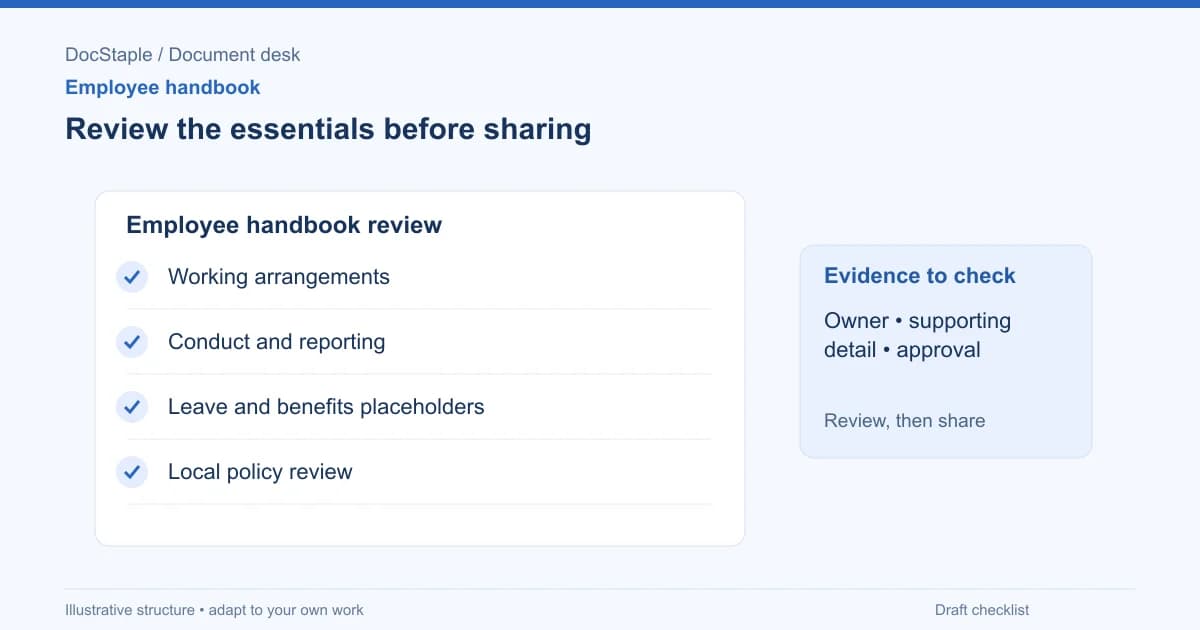
An employee handbook checklist helps you catch gaps before a policy document reaches staff. It should not tempt you to paste in promises the business cannot support. A useful handbook explains how people work, what conduct is expected, where concerns are reported, where leave and benefits information lives, and who has reviewed the document for the jurisdictions involved.
This checklist uses a U.S. consulting employer as the example: a firm with office-based and hybrid consultants, client-site work, confidential client information, and a handbook rollout for current employees. U.S. federal requirements are only part of the picture. State and local law, employer size, industry, contracts and employee classification can change what belongs in the handbook.
Working arrangements
Start with how work actually happens. For consulting, the handbook may need to cover office days, remote work, client-site attendance, travel approval, time recording, equipment, expenses and availability expectations. Avoid turning flexible practices into rigid promises unless leadership intends that.
Draft language:
Working arrangements may include office, remote and client-site work depending on role, project requirements and manager approval. Employees must follow the current scheduling, time recording, travel and client-site procedures that apply to their assignment. Changes to working arrangements should be confirmed by the employee's manager and recorded through the approved HR process.
Checklist questions:
- Does the handbook distinguish normal workplace rules from project-specific client requirements?
- Does it explain who approves schedule changes?
- Does it avoid promising remote work where the role or client site may require presence?
- Does it explain equipment care and return?
- Does it route accommodation or adjustment requests to the right HR process?
Review criteria: working-arrangement language should be accurate, flexible enough for real consulting delivery, and consistent with offer letters, contracts, wage and hour rules, and local requirements.
For consulting teams, also check client-site language against actual engagement documents. If the firm promises a client that consultants will follow a specific security process, the handbook should not contradict that promise. If client-site rules change by project, the handbook should explain where employees receive current instructions instead of trying to list every client rule in one permanent document.
Conduct and reporting
Conduct sections should be clear without trying to list every possible behavior. They typically cover respectful workplace expectations, conflicts of interest, confidentiality, use of systems, client interaction, anti-harassment reporting and non-retaliation.
For U.S. employers, the EEOC says employers can help prevent harassment by establishing an effective complaint or grievance process, training managers and employees, and taking immediate and appropriate action when an employee complains (EEOC harassment). That does not mean one paragraph guarantees compliance; it means reporting routes and response responsibilities should be real.
Draft language:
Employees may report workplace conduct concerns to their manager, any senior manager, Human Resources, or the designated reporting contact. Employees do not need to report a concern to the person involved in the concern. The company prohibits retaliation for good-faith reporting or participation in a workplace investigation. Reports will be reviewed through the applicable company process.
Checklist questions:
- Are there multiple reporting routes?
- Does the handbook avoid requiring employees to report only to their direct manager?
- Does it explain confidentiality limits in investigations?
- Does it separate client confidentiality from employee reporting rights?
- Does it match the employer's actual investigation process?
Review criteria: conduct language should tell employees where to go, tell managers what to do with a report, and avoid promises such as "complete confidentiality" if the employer may need to investigate.
Add a manager-facing check as well. A handbook that tells employees to report concerns is incomplete if managers do not know how to escalate them. The checklist should confirm that supervisors understand where to send harassment, safety, payroll, leave, confidentiality and client-conduct concerns. That operational handoff matters as much as the handbook wording.
Leave and benefits placeholders
Leave and benefits are high-risk areas for outdated handbook text. Use placeholders until HR and legal reviewers confirm the exact wording.
For a U.S. employer covered by the Family and Medical Leave Act that has any FMLA-eligible employees, the Department of Labor says the employer must provide the general notice in its employee handbook or other written leave and benefit materials. If neither exists, it must give the general notice to each new employee upon hire (DOL Fact Sheet 28D). Eligibility, individual notices, paid leave substitution and state leave rules require separate review.
Draft placeholder:
[Insert current leave policy reviewed by HR and legal counsel. Confirm federal, state and local requirements, eligibility, notice procedures, paid leave coordination, benefits continuation and return-to-work requirements before publication.]
Benefits placeholder:
[Insert benefits summary or reference to the official benefits plan documents. If there is a conflict between this handbook and the plan documents, the reviewed plan documents control to the extent permitted by applicable law.]
Checklist questions:
- Are paid time off, holidays, sick leave and family leave accurate for each location?
- Are benefits summaries aligned with plan documents?
- Are eligibility rules current?
- Does the handbook avoid unsupported promises?
- Are required notices included or referenced where applicable?
Review criteria: no leave or benefits section should be issued from memory. Confirm the source document, reviewer and date.
Confidentiality, safety and client work
Consulting handbooks should explain information handling in plain language. Employees may handle client records, interview notes, pricing, strategy documents or personal data. The handbook should point to approved procedures rather than trying to replace them.
Draft language:
Employees must protect confidential company and client information and use approved storage, sharing and disposal methods. Suspected loss, unauthorized disclosure or misdirected sharing of confidential information must be reported promptly to the designated contact so the company can assess contractual, privacy and client communication obligations.
Add client-site rules:
When working at a client site, employees must follow company policies and applicable client-site rules. If a client instruction conflicts with company policy, law or professional obligations, the employee should pause and contact their manager or the designated escalation contact.
Review criteria: confidentiality language should not prevent lawful reporting of workplace concerns. Safety and client-site sections should route hazards and conflicts to a real contact.
Local policy review and acknowledgment
The final checklist item is local review. Do not treat a handbook as one-size-fits-all if employees work in multiple states or countries. Review at least:
- At-will or contract language.
- Wage and hour rules.
- Leave laws.
- Expense reimbursement.
- Anti-harassment and discrimination provisions.
- Privacy and monitoring notices.
- Safety reporting.
- Required postings or notices.
- Acknowledgment wording.
Draft acknowledgment:
I acknowledge receipt of the employee handbook dated 26 September 2026. I understand that I am responsible for reading it and asking questions about policies that affect my work. This acknowledgment does not waive rights that cannot be waived under applicable law.
Have counsel review whether acknowledgment wording could affect contract status in the relevant jurisdiction.
Operational review criteria:
- The handbook matches actual practice.
- U.S. federal references are checked, and state/local review is complete.
- Leave and benefits text has owner approval.
- Reporting routes are usable.
- Client confidentiality and employee reporting rights are not confused.
- Acknowledgment language is reviewed before distribution.
Distribution also needs a record. Decide whether employees receive the handbook through HR software, email, an intranet or a printed packet, and keep an acknowledgment record tied to the issued version. If a policy is later changed, record whether employees received the update or the full revised handbook.
The consulting employee handbook template provides an editable Word structure for employment context, working arrangements, conduct, safety, confidentiality, reporting, development, acknowledgment and approval. Use it as a drafting framework, then complete local review before issuing.
Last updated: September 26, 2026
Frequently Asked Questions
Related Articles
Audit Checklist Best Practices
Best practices for audit checklists, including scope, evidence, findings, actions, closure review, failure modes and sample wording.
Audit Checklist Checklist: Review Your Audit Form Before You Use It
A practical audit checklist checklist with decision gates for scope, evidence, findings, actions and closure review.
Audit Checklist Examples: Scope, Evidence, Findings and Closure
Audit checklist examples for consulting work, covering audit scope, evidence to inspect, findings and actions, closure review and practical draft wording.
Business Continuity Plan Best Practices for Consulting Teams
Business continuity plan best practices for consulting teams, including critical services, recovery priorities, communications, exercises and review criteria.
Business Continuity Plan Checklist for Consulting Teams
A practical business continuity plan checklist for consulting work, covering critical services, recovery priorities, communications, exercises and review criteria.
Business Continuity Plan Examples: Consulting Scenarios and Recovery Priorities
Business continuity plan examples for consulting teams, with critical services, recovery priorities, communications, exercises and review criteria.