Employee Handbook Examples: Draft Wording for Working Arrangements, Conduct and Leave
Employee handbook examples for a small consulting firm, with draft wording for working arrangements, conduct and reporting, leave and benefits placeholders, and a local policy review step, plus a checklist for review before you issue it.
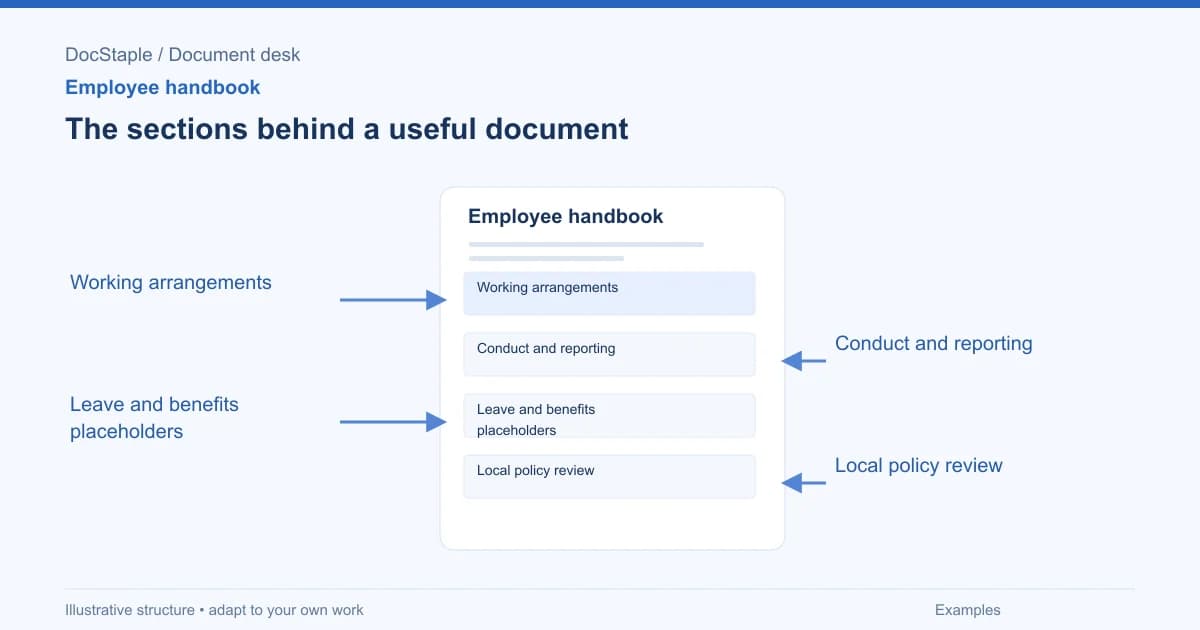
An employee handbook is where a workplace writes down how it actually runs: when people work, how they are expected to behave, where to take a concern and who to ask about leave. Examples are useful because the difficult part is rarely the headings. It is choosing wording that is specific enough to help and careful enough not to promise things you have not verified.
This guide uses a fictional consulting firm to show draft wording for four areas: working arrangements, conduct and reporting, leave and benefits placeholders, and local policy review. Everything in brackets is a placeholder. Employment requirements vary by country and often by state or region, so this article focuses on the United States and flags where you should check your own location.
The scenario used throughout. A consulting firm with about 40 people is preparing its first proper handbook. Most staff work on client sites or from home, a few work from a small office, and the firm expects to open a second location next year. Until now, expectations have lived in emails and onboarding conversations, which means different managers answer the same question differently.
The firm's goal is narrow: one document a new consultant can read in an evening and a manager can point to when a question comes up. A handbook that tries to restate every law becomes long, stale and hard to trust.
Start with scope: who the handbook covers
Before any policy wording, say who the document is for and what it is not. This is the section people skip, and it is what prevents arguments later about whether a rule applies to contractors, part-time staff or a second office.
Draft wording:
This handbook applies to [employee groups] working for [organisation name] in [locations]. It does not apply to [independent contractors / clients' staff / other groups]. Where a written agreement, benefit plan document or local law gives you different terms, those terms apply instead, and your people manager or [HR contact] can explain which.
This handbook is reviewed at least [frequency] and may change. The current version is kept at [location]. Version [number], effective [date].
The handbook says where other documents take priority, and carries a version number and date so anyone can tell whether their copy is current.
Scope check: Could a part-time employee, a contractor and a new hire in the second office each tell from this paragraph whether it applies to them?
Working arrangements
This section covers schedules, attendance, absence reporting, remote and client-site work, and use of company systems. Describe the practice the firm actually follows, and avoid promising flexibility you may need to withdraw.
Draft wording:
Working hours. Your expected working pattern is set out in your offer or agreement. Client-site schedules are agreed with your engagement lead in advance where possible.
Absence. If you cannot attend work, tell [name or role] by [time] using [method]. Give as much notice as you can, and tell us the expected return date if you know it.
Remote and client-site work. You may be asked to work from [home / client site / office] depending on the engagement. Working from a location other than your usual one needs [approval by role]. Client information must be handled in line with [confidentiality policy] wherever you work.
Company systems. [Systems] are provided for business use. Read [acceptable use policy] for what is permitted and how we monitor systems, if we do.
Some parts of this section touch legal requirements. For example, the US Department of Labor's Fact Sheet 21 on FLSA recordkeeping says every covered employer must keep certain records for each non-exempt worker, and that payroll records must be preserved for at least three years. If your handbook says how employees record time, write it to match the records you actually keep and how your payroll works, rather than inventing a process to fill a paragraph.
If your firm monitors systems, say so plainly, and resolve what your location requires you to tell people before publication.
Working arrangements check: Does every sentence describe something the firm really does, with a named person or method for each request or notification?
Conduct and reporting
Conduct sections work best when they describe behaviour and the route for raising a concern, and stay away from vague catch-all phrases. The reporting route matters as much as the rule itself. A rule about respectful behaviour means little if nobody knows who to tell.
Draft wording:
Expected conduct. We expect everyone to treat colleagues, clients and suppliers with respect, to be honest in their work and records, and to protect confidential information belonging to [organisation] and its clients.
Raising a concern. If you see or experience behaviour you think breaks this handbook, or a safety or confidentiality problem, you can tell [named role 1], [named role 2] or [alternative contact outside the reporting line]. You do not need to raise it with your own manager first.
What happens next. [Named role] will acknowledge your report within [time] and explain the next steps. We will share information only with people who need it to look into the concern or act on it.
Retaliation. We do not tolerate retaliation against anyone who raises a concern in good faith or takes part in looking into one.
Give at least two reporting contacts, with one outside the normal reporting line. Only promise acknowledgment times you can meet. And avoid disciplinary consequences you have not agreed: "Breaches may lead to action under [disciplinary procedure]" is safer than a fixed list of penalties.
Be careful with broad rules about confidentiality, social media or discussing pay and conditions. Wording such as "do not discuss company matters" is the type of sentence to have reviewed by employment counsel for your location before publishing.
Safety and incident reporting also belong here. If you already have an incident process, link to it rather than duplicating it; the incident report examples article shows how such a record is structured.
Conduct check: Can an employee find at least two named contacts, understand what will happen after they report, and see that retaliation is addressed?
Leave and benefits placeholders
This is the section most likely to go wrong, because it is tempting to copy figures from another handbook. Leave and benefits can be shaped by legislation, contracts, insurance policies and benefit plan documents, and they change. A placeholder that points to the governing source is often more accurate than a number that was true last year.
Draft wording:
Leave. The types of leave available to you, and how much, depend on your agreement, the laws that apply where you work and [organisation]'s policies. The current position is set out in [leave policy name and location]. To request leave, [method] at least [notice period] before, or as soon as you can if the need is urgent. Requests are decided by [role] and recorded in [system].
Family and medical leave. [Insert only after confirming whether the organisation and each employee are covered. If covered, insert or attach the required general notice.]
Benefits. Details of [benefit name] are set out in [plan document or provider]. If this handbook and a plan document differ, the plan document applies. Questions go to [HR contact].
For US employers the Department of Labor is explicit about one item. Its Fact Sheet 28D on FMLA employer notification says that if a covered employer has any FMLA-eligible employees, it must also provide each employee with a general notice about the FMLA in the employer's employee handbook or other written materials. The same page describes private-sector coverage as employers who employ 50 or more employees in 20 or more workweeks in the current or previous calendar year, and says that the general notice must be provided in a language employees can read if a significant portion of them do not read and write English.
That is why the firm's placeholder does not simply say "we offer X weeks." At 40 people today and a second office planned, whether the firm is covered is a question to confirm, not to settle by copying a paragraph. The Department of Labor's FMLA forms page also describes the FMLA poster as satisfying the requirement that every covered employer display or post an informative general notice, so posting and handbook obligations sit side by side.
Avoid "unlimited" or "generous" descriptions of leave unless the policy behind them is written down and approved.
Leave check: For each leave or benefit statement, can you name the source document, the owner and the date it was last checked?
Local policy review before you issue it
Handbook wording that is fine in one place can be wrong in another. A review step turns that from a hope into a record.
Draft wording for the internal review record:
Handbook review record. Version [number]. Locations covered: [list]. Reviewed by [HR reviewer] on [date] against [list of policies and plan documents]. Location-specific provisions reviewed by [qualified professional or firm] on [date] for [jurisdictions]. Open points: [list or "none"]. Approved for issue by [authorised employer representative] on [date].
And the acknowledgment employees sign or confirm:
I confirm that I have received [handbook name], version [number]. I understand that I can ask [HR contact] if any part is unclear. This acknowledgment does not waive any rights I have under law or under my agreement with [organisation].
The last sentence follows a sensible rule for acknowledgments: record receipt, and avoid implying that signing takes anything away. Have counsel confirm the acknowledgment wording suits your location.
Review check: Is there a named reviewer, a date and a list of locations for every version that goes out, and is the previous version archived?
Review the handbook before you issue it
Ask someone who was not involved in drafting to read it with these prompts:
- Scope: Is it clear who is covered and which documents take priority?
- Accuracy: Does each statement match what the firm does today?
- Owners: Does every request, report or approval name a role, not just "management"?
- Reporting: Are there two or more contacts, including one outside the reporting line?
- Leave and benefits: Do statements point to a governing source, and have coverage questions been checked?
- Location: Has each jurisdiction been reviewed by a qualified person?
- Language: Is it readable by the people who must follow it?
- Version control: Are the version, date, approver and acknowledgment recorded?
Adapt the examples in a structured Word draft
If you would rather not build these sections from scratch, the consulting employee handbook template is an editable Word file with sections for employment context and responsibilities, working arrangements and conduct, safety, confidentiality and reporting, and development and acknowledgment, plus document preparation and approval sections. It is a starting draft and does not guarantee that a handbook is complete, compliant or enforceable anywhere.
If your handbook refers to confidentiality obligations that also appear in client work, compare it with your consulting confidentiality agreement so the two documents do not say different things.
Sources: Fact Sheet 28D: Employer Notification Requirements under the FMLA, U.S. Department of Labor, Fact Sheet 21: Recordkeeping Requirements under the FLSA, U.S. Department of Labor, FMLA Forms, U.S. Department of Labor
Last updated: September 26, 2026
Frequently Asked Questions
Related Articles
Audit Checklist Best Practices
Best practices for audit checklists, including scope, evidence, findings, actions, closure review, failure modes and sample wording.
Audit Checklist Checklist: Review Your Audit Form Before You Use It
A practical audit checklist checklist with decision gates for scope, evidence, findings, actions and closure review.
Audit Checklist Examples: Scope, Evidence, Findings and Closure
Audit checklist examples for consulting work, covering audit scope, evidence to inspect, findings and actions, closure review and practical draft wording.
Business Continuity Plan Best Practices for Consulting Teams
Business continuity plan best practices for consulting teams, including critical services, recovery priorities, communications, exercises and review criteria.
Business Continuity Plan Checklist for Consulting Teams
A practical business continuity plan checklist for consulting work, covering critical services, recovery priorities, communications, exercises and review criteria.
Business Continuity Plan Examples: Consulting Scenarios and Recovery Priorities
Business continuity plan examples for consulting teams, with critical services, recovery priorities, communications, exercises and review criteria.