How to Write a Construction Audit Checklist
A construction-focused workflow for adapting an audit checklist, with site scope, drawings, permits, evidence, findings, corrective actions and closure review.
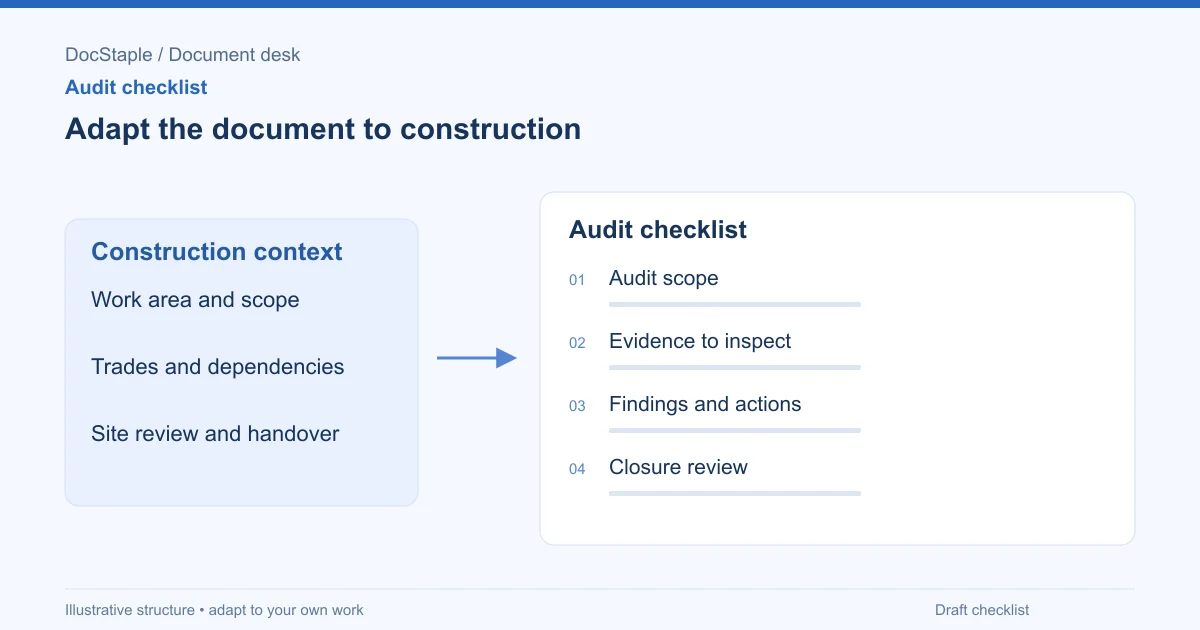
A construction audit checklist has to survive real site conditions. The reviewer may be checking drawings, permits, subcontractor records, work areas, photos, inspection test plans and closeout documents while trades are still moving. The checklist must be clear enough to use in the field and disciplined enough to support findings later.
Use this scenario: a site manager is preparing a commercial fit-out closeout audit before handover. The project includes partitions, electrical rough-in, fire stopping, finishes and tenant equipment coordination. The owner wants a site completion pack. The checklist needs to verify that work was reviewed against approved drawings and site requirements, subcontractor documents are complete, permit or inspection items are closed, and remaining defects have owners.
Define site audit scope and criteria
Construction audits go wrong when the checklist says "site quality" and then tries to cover everything. Start with a defined area, phase, system or closeout package.
Draft language:
Audit objective: confirm whether the commercial fit-out closeout package supports handover of Level 4 tenant areas. Scope includes approved drawings, inspection records, fire-stopping evidence, electrical test documentation, defect list, subcontractor closeout records and site completion pack. Excluded: base building plant outside the tenant demise and warranty items not yet due.
Criteria may include:
- Approved drawings and specifications
- Contract requirements
- Inspection and test plan
- Permit or authority requirements
- Site safety procedure
- Manufacturer instructions
- Subcontractor scope
- Closeout requirements
OSHA's construction standards use the concept of a competent person in multiple standards, and OSHA's competent person page highlights construction-related requirements in 29 CFR 1926 (OSHA competent person standards). Do not use a general audit checklist to replace duties that must be performed by a competent person or other qualified reviewer under applicable law.
Review criteria:
- The audited area, phase or system is named.
- Approved criteria are available on site.
- Exclusions are clear.
- The reviewer has the right competence and authority for the checklist purpose.
- The checklist does not imply regulatory certification unless authorized.
Specify evidence to inspect
Construction evidence is mixed: physical observations, photos, inspection records, drawings, permits, material certificates, subcontractor forms and closeout documents. The checklist should state what evidence proves each item.
Draft checklist item:
Criterion: Fire-stopping penetrations in Level 4 riser cupboards are installed and documented according to approved details. Evidence to inspect: approved fire-stopping detail, inspection record, photo log, location list and subcontractor signoff. Sample: all riser cupboards in Level 4 tenant area.
Another item:
Criterion: Electrical test documentation is complete for circuits included in the tenant handover. Evidence to inspect: test sheets, distribution board schedule, defect list and closeout signoff.
Avoid asking only "complete?" The reviewer needs a place to record which records were inspected and what was observed.
EPA quality guidance describes audits and assessments as systematic activities that compare work with planning documents and document findings and response actions (EPA quality management tools for projects). On a construction project, the planning documents are often drawings, specifications, permits, inspection plans and subcontractor requirements.
Account for subcontractors and site realities
Construction checklists need to handle the fact that evidence comes from multiple parties. A site manager may rely on subcontractor records, but the checklist should still identify what must be reviewed.
Subcontractor evidence may include:
- Inspection requests
- Test certificates
- Material data sheets
- Redline drawings
- Photo records
- Defect closeout confirmations
- Training or induction records where relevant
- Warranty documents
Draft language:
Checklist item: Confirm that each trade subcontractor with closeout responsibility has submitted required records for its scope. Evidence: closeout register, subcontractor transmittals, missing-document log and site manager review notes.
Site conditions change. If an area is inaccessible, unsafe or incomplete, record that limitation. Do not mark an item conforming because the reviewer could not get there.
Draft limitation note:
Limitation: Room 4.12 was not inspected because access was restricted for tenant equipment installation. Item remains not inspected. Follow-up inspection required before handover of that room.
The same mindset used in good incident review helps construction audits: if a defect exists, ask whether the issue is isolated, caused by missing information, trade sequencing, access constraints or unclear acceptance criteria.
Record findings with location and evidence
Construction findings should be locatable. A finding that says "fire stopping incomplete" is not enough. The checklist should capture area, drawing reference, photo reference, requirement, observed condition and required action.
Draft finding:
Finding F-04: Level 4 riser cupboard RC-2 contains two cable penetrations without visible fire-stopping label or photo record. Criterion: approved fire-stopping detail FS-03 and closeout requirement section 6. Evidence: site observation at 10:40, photo P-118, missing entry in fire-stopping register. Effect: handover evidence for RC-2 is incomplete. Required action: subcontractor to inspect, correct if required and provide updated photo and register entry.
Finding categories may include:
- Conforming
- Nonconforming
- Defect
- Observation
- Improvement opportunity
- Not applicable
- Not inspected
Do not overstate the finding. If the audit shows missing evidence, say missing evidence. If it shows defective work, say defective work and cite the observation. If the reviewer cannot determine which, say what further inspection is required.
Assign corrective actions and verification
A construction audit checklist should drive work to closure. Actions need owners, due dates and proof. "Subcontractor to resolve" is not enough unless it names which subcontractor, what resolution means and how it will be checked.
Draft action:
Action A-04: Electrical subcontractor to provide test sheet for DB-L4-03 circuits serving meeting rooms 4.05 to 4.08, or identify circuits not in its scope. Due: [date]. Verification evidence: uploaded test sheet cross-referenced to board schedule, reviewed by site manager. Closure reviewer: project engineer.
Verification evidence may include:
- Reinspection record
- Photo with location and date
- Updated drawing
- Permit or inspection signoff
- Test certificate
- Completed defect item
- Subcontractor transmittal
- Owner acceptance record
EPA Region 1 guidance asks projects to identify who is responsible for corrective actions and how they will be tracked to completion (EPA Region 1 QAPP guidance). In construction, tracking is especially important because handover pressure can make open items disappear from view.
Close the audit before handover
The closure section should decide whether the area, system or package is ready for handover, ready with exceptions, or not ready. It should not hide open defects in a final paragraph.
Closure criteria:
- Scope and exclusions are confirmed.
- Not-inspected items are listed.
- Findings are assigned and dated.
- Blocking defects are separated from non-blocking punch items.
- Required permits, inspection records or signoffs are present.
- Verification evidence is attached.
- The authorized reviewer approves closure.
- The final checklist is stored with the site completion pack.
Draft approval language:
Closure review: The site manager confirms that Level 4 tenant area closeout was audited against the stated scope. Findings F-01, F-02 and F-05 are closed with evidence attached. Findings F-03 and F-04 remain open and block handover of rooms 4.10 to 4.12. The project manager may approve partial handover only after the owner acknowledges the listed exclusions in writing.
For a structured starting document, the construction audit checklist template includes editable Word sections for objective, scope, criteria, evidence, findings, actions, verification and approval. Adapt it to the project documents, site procedures, trade scopes and applicable jurisdiction.
A good construction audit checklist does not try to inspect the whole project with one vague form. It defines the area, checks the right evidence, records findings precisely and keeps actions visible until closure.
Last updated: September 26, 2026
Frequently Asked Questions
Related Articles
Audit Checklist Best Practices
Best practices for audit checklists, including scope, evidence, findings, actions, closure review, failure modes and sample wording.
Audit Checklist Checklist: Review Your Audit Form Before You Use It
A practical audit checklist checklist with decision gates for scope, evidence, findings, actions and closure review.
Audit Checklist Examples: Scope, Evidence, Findings and Closure
Audit checklist examples for consulting work, covering audit scope, evidence to inspect, findings and actions, closure review and practical draft wording.
Business Continuity Plan Best Practices for Consulting Teams
Business continuity plan best practices for consulting teams, including critical services, recovery priorities, communications, exercises and review criteria.
Business Continuity Plan Checklist for Consulting Teams
A practical business continuity plan checklist for consulting work, covering critical services, recovery priorities, communications, exercises and review criteria.
Business Continuity Plan Examples: Consulting Scenarios and Recovery Priorities
Business continuity plan examples for consulting teams, with critical services, recovery priorities, communications, exercises and review criteria.