How to Write a Consulting Audit Checklist
A consulting-specific workflow for adapting an audit checklist, with engagement scope, evidence, findings, closure review, sample wording and approval checks.
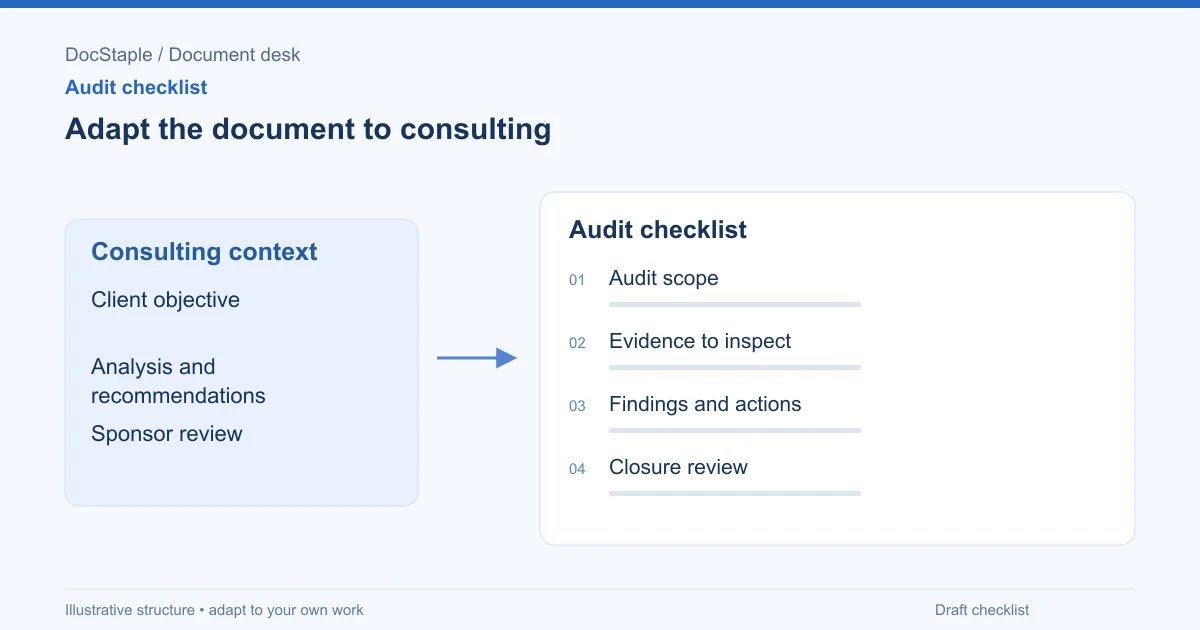
A consulting audit checklist should test whether a client engagement was delivered against approved scope, supported by evidence and closed with clear actions. It should not become a generic quality questionnaire. Consulting work involves judgment, advice, client decisions, confidential material and changing scope; the checklist needs to inspect the records that make those things reviewable.
Use this scenario: a consulting firm is completing a strategy review for a regional distributor. The final recommendations report is due next week. Before issue, a quality lead wants to audit the engagement file: statement of work, interview notes, data extracts, analysis workbook, decision log, draft report, risk register and client approvals. The goal is to catch unsupported recommendations, scope drift and unresolved handoff actions before the client receives the final pack.
Set audit scope around the engagement
Start by naming the engagement and the decision the audit supports. A consulting audit checklist is most useful when it answers a specific question: is this deliverable ready to issue, is this file complete enough for handoff, or did the team follow the required delivery process?
Draft language:
Audit objective: confirm whether the Northstar strategy review engagement file supports issue of the final recommendations report and whether unresolved delivery risks have assigned actions. Scope includes the signed statement of work, approved changes, interview records, analysis workbook, decision log, draft recommendations report and handoff action list from 1 August to 20 September 2026. Excluded: billing, individual performance management and unrelated account planning.
Include criteria:
- Signed statement of work
- Approved change requests
- Consulting quality procedure
- Client confidentiality requirements
- Deliverable review standard
- Handoff requirements
The EPA describes technical audits as systematic and objective examinations that determine whether activities and related results comply with planning documents, are implemented effectively and are suitable to achieve goals (EPA quality management tools for projects). For consulting, your "planning documents" are often the SOW, quality procedure and client approval record.
Review criteria:
- Scope is tied to a real client engagement.
- Criteria are named, current and accessible.
- Exclusions are explicit.
- The reviewer is independent enough for the purpose.
- The audit will not be used to imply assurance beyond its scope.
Choose evidence that supports consulting work
Consulting audits often fail when they inspect polished deliverables but ignore the trail behind them. A beautiful recommendation deck can still contain unsupported claims or unapproved scope additions.
Evidence to inspect may include:
- Statement of work and change approvals
- Interview guide and interview notes
- Attendance records for workshops
- Client-provided data extracts
- Analysis workbook and version history
- Decision log
- Risk and issue log
- Draft review comments
- Final report approval
- Confidentiality and access records
Draft checklist item:
Criterion: Recommendations in the final report are supported by recorded evidence or clearly labeled assumptions. Evidence to inspect: final recommendations report, analysis workbook, interview notes, decision log and assumptions register. Sample: five recommendations, including at least one financial, one operational and one customer-facing recommendation.
This item does not ask the reviewer to decide whether the advice is commercially perfect. It asks whether the advice is traceable to evidence or identified assumptions.
EPA quality program materials describe QA project plans as documents that identify quality activities needed to satisfy performance and acceptance criteria (EPA quality program FAQs). The same thinking helps consulting teams: define what evidence would satisfy each review criterion before opening the files.
Inspect scope drift and client approvals
Scope drift is one of the main consulting audit risks. Teams add useful analysis, answer extra questions and revise recommendations as they learn. Some changes are harmless; others affect fee, timeline, confidentiality, liability or client expectations.
Checklist questions:
- Does each workstream in the final report appear in the SOW or an approved change?
- Are client-requested additions recorded in the decision log?
- Were deadlines or deliverables changed with written approval?
- Are excluded topics still excluded from the final report?
- Are assumptions labeled where the client did not provide data?
Draft finding:
Finding F-01: The SOW includes customer segmentation and margin analysis. The final report also includes a pricing sensitivity appendix. No written approval for the appendix was found in the decision log or email record. Effect: the report may include advice outside approved scope. Required action: obtain client sponsor approval or remove the appendix before issue.
That finding is specific, evidence-based and actionable. It avoids blaming the team for trying to help and focuses on the approval gap.
Record confidentiality and handoff controls
Consulting audits should inspect confidentiality controls because engagement files often contain client data, interview comments and draft advice. The checklist should verify that sensitive material was stored and shared according to the agreement and internal policy.
Checklist items:
- Are client files stored in the approved workspace?
- Are interview notes restricted to the project team?
- Were subcontractor access rights approved?
- Were client-provided data extracts versioned?
- Are draft reports clearly marked as draft?
- Is the final handoff package free of internal notes or comments that should not be issued?
Draft language:
Checklist item: Confirm that the data analyst subcontractor had access only to approved data extracts and not to interview notes containing named employee comments. Evidence: access list, subcontractor approval record and restricted-folder membership export.
If personal data is involved, privacy review may be needed. In the UK, ICO guidance explains that controller-processor contracts under UK GDPR need required data protection terms (ICO controller and processor contracts). State the jurisdiction and avoid treating an audit checklist as a privacy-law answer.
Classify findings and actions
A consulting audit checklist should separate nonconformities from improvement opportunities. Missing client approval for a deliverable is not the same as inconsistent file naming.
Finding categories:
- Conforming
- Nonconforming
- Observation
- Improvement opportunity
- Not applicable
- Not inspected
Draft action:
Action A-03: Engagement lead to remove internal comments from the final report and re-run partner review before client issue. Owner: [name]. Due: [date]. Verification evidence: clean final report PDF and editable master stored in final deliverables folder. Closure reviewer: quality lead.
Every action should include verification evidence. If the action is "update the decision log," the evidence is the updated decision log entry, not a verbal statement that the log was updated.
Review criteria:
- Each finding cites criteria and evidence.
- Effect is stated without exaggeration.
- Each required action has an owner and due date.
- Verification evidence is objective.
- Open client-impacting findings block issue unless an authorized person accepts the risk.
Close with approval and limitations
The closure section should decide what happens next: issue, revise, escalate or hold. It should also preserve audit limitations. If the reviewer sampled five recommendations, the checklist should not imply that every statement in the report was fully re-performed.
Draft closure language:
Closure review: The quality lead reviewed the engagement file against the stated scope. Findings F-01 and F-02 block final issue until resolved. Findings F-03 and F-04 are improvement opportunities and may close after handoff. Limitation: the audit sampled five recommendations and did not independently validate all source data. Approval to issue may be granted only by the engagement partner after blocking findings are closed.
Operational approval check:
- Audit scope was followed.
- Evidence limitations are recorded.
- Blocking findings are clear.
- Non-blocking improvements are separated.
- Actions have owners, dates and verification evidence.
- Client-impacting changes are approved by the engagement partner.
- The final checklist is stored with the engagement file.
For a structured Word draft, the consulting audit checklist template includes editable sections for objective, scope, criteria, evidence, sampling, findings, actions, verification and approval. Adapt it to the engagement's SOW, client requirements and firm procedures.
A good consulting audit checklist respects the nature of advisory work. It does not pretend judgment can be reduced to ticks, but it does require the advice, approvals and handoff actions to be traceable.
Last updated: September 26, 2026
Frequently Asked Questions
Related Articles
Audit Checklist Best Practices
Best practices for audit checklists, including scope, evidence, findings, actions, closure review, failure modes and sample wording.
Audit Checklist Checklist: Review Your Audit Form Before You Use It
A practical audit checklist checklist with decision gates for scope, evidence, findings, actions and closure review.
Audit Checklist Examples: Scope, Evidence, Findings and Closure
Audit checklist examples for consulting work, covering audit scope, evidence to inspect, findings and actions, closure review and practical draft wording.
Business Continuity Plan Best Practices for Consulting Teams
Business continuity plan best practices for consulting teams, including critical services, recovery priorities, communications, exercises and review criteria.
Business Continuity Plan Checklist for Consulting Teams
A practical business continuity plan checklist for consulting work, covering critical services, recovery priorities, communications, exercises and review criteria.
Business Continuity Plan Examples: Consulting Scenarios and Recovery Priorities
Business continuity plan examples for consulting teams, with critical services, recovery priorities, communications, exercises and review criteria.