How to Write a Consulting Business Continuity Plan
A consulting-focused workflow for writing a business continuity plan, with critical services, recovery priorities, communications, exercise prompts and approval checks.
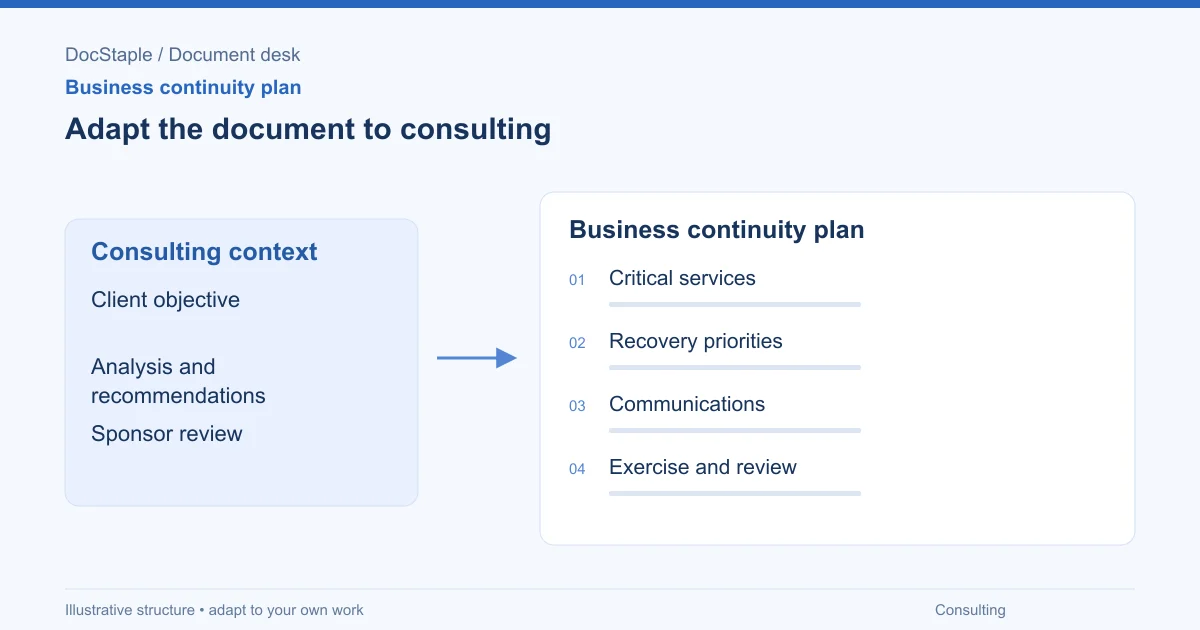
A consulting business continuity plan explains how the firm will keep essential client work moving when normal people, systems, offices or suppliers are unavailable. It should not read like a generic emergency poster. A useful plan identifies the services that matter most, the order in which they must recover, who speaks to clients, what workarounds are allowed and how the plan will be exercised.
This guide uses a practical scenario. A boutique consulting firm is halfway through a six-week strategy review for a distributor. The team is due to run executive interviews, complete margin analysis and present recommendations. On Monday morning, the firm's document platform is unavailable, the engagement lead is sick, and the client wants to know whether Friday's board pre-read will still arrive. The continuity plan should help the team make that decision without improvising from scratch.
Define the scenario and activation trigger
Start with the kind of disruption the plan covers. A consulting plan does not need to describe every possible event in detail, but it does need activation triggers. Otherwise people hesitate because they are not sure whether the plan is "serious enough" to use.
For this scenario, activation might occur when any of these conditions affect active client delivery:
- The document platform or analysis repository is unavailable for more than a defined period.
- The engagement lead or only subject-matter expert is unavailable.
- Confidential client material may be inaccessible or exposed.
- A client milestone is at risk.
- Travel, office access or supplier disruption prevents planned work.
Draft language:
This plan is activated when a disruption is likely to prevent the strategy review team from completing an agreed client milestone within the current delivery window, or when normal systems are unavailable and client confidential material must be protected through approved workaround arrangements. Activation may be approved by the managing partner, engagement lead or operations lead.
Ready.gov says business preparedness planning should include communications planning, IT support and recovery, and continuity plans, and that training, testing and exercises are essential parts of preparedness (Ready.gov business preparedness). Use that broad frame: continuity is about keeping the business and client commitments functioning, not only restoring software.
Identify critical services
Consulting firms often describe everything as urgent. The plan has to be stricter. Identify the services that must continue at a minimum acceptable level and the services that can pause.
For the strategy review, critical services may be:
- Client communication and decision updates
- Secure access to approved client files
- Scheduled executive interviews
- Analysis needed for the recommendations report
- Board pre-read production
- Internal review and approval of client-facing advice
Non-critical or deferrable work may include marketing drafts, internal training, non-deadline research and low-priority administrative clean-up.
For each critical service, record the minimum acceptable operation. Do not write "restore full service" as the first target. Instead, define the smallest useful version:
- Client sponsor receives a status update by the agreed communication owner.
- Team can access the latest approved version of the discovery notes.
- Interviews can proceed using approved questions and secure note storage.
- Analysis can continue from the last verified data extract.
- The board pre-read can be issued after partner review, even if formatting is simplified.
Draft language:
Critical service: board pre-read preparation for the Northstar strategy review. Minimum acceptable operation: produce a reviewed PDF and editable master using the latest approved analysis extract, with unresolved assumptions clearly marked. Normal design formatting may be deferred if the client sponsor approves the revised format.
That level of detail gives the team permission to protect the outcome without pretending normal operations are available.
Set recovery priorities
Recovery priorities should come from client impact, confidentiality, contractual commitments and operational dependencies. They should not simply mirror whoever shouts first.
In the scenario, the recovery order might be:
- Protect confidential client material and confirm access restrictions.
- Establish decision authority because the engagement lead is unavailable.
- Restore access to the latest approved work products or approved backups.
- Tell the client sponsor what will continue, change or pause.
- Recover the board pre-read workflow.
- Reconcile workaround records back into the normal document system.
NIST's contingency planning guidance for federal information systems is IT-focused, but its planning logic is useful: organizations should identify preventive controls, develop recovery strategies, and maintain plans through testing, training and exercises (NIST SP 800-34 Rev. 1). For consulting, translate "system" into the real delivery chain: people, information, review authority, client communication and files.
Draft language:
Recovery priority 1 is protection of client confidential material. No workaround may move client files into unapproved personal storage. Recovery priority 2 is restoration of decision authority: if the engagement lead is unavailable for more than four working hours during an active milestone, the named deputy assumes delivery decisions until the engagement lead returns or the managing partner appoints another owner.
Avoid recovery targets that look precise but have no basis. A recovery time should be approved by the business owner and tested against actual resources. If no one has verified that the team can recover a file repository in two hours, do not write that as a promise.
Plan communications
Continuity plans fail quietly when no one knows who may speak. Consulting firms need internal, client and supplier communication rules because inaccurate messages can damage trust or create contractual risk.
Define communication roles:
- Activation owner: decides the plan is in use.
- Client communication owner: sends approved updates to the client sponsor.
- Technical owner: reports system status and workarounds.
- Delivery deputy: coordinates consultants and subcontractors.
- Approval reviewer: checks any revised milestone or advice before release.
Include message standards. The first client update should usually say what is known, what is being done, whether the next milestone is affected, and when the next update will arrive. Do not hide uncertainty, but do not speculate.
Draft language:
Client update draft: "We are currently working under our continuity process because our document platform is unavailable. The latest approved analysis extract is available through our approved backup location, and work on the board pre-read is continuing under [deputy lead]. We are checking whether Friday's delivery time is affected and will send a confirmed update by 15:00 today. No client files will be moved to unapproved storage."
Communications should include subcontractors. If a subcontractor handles analysis, interview notes or design, the plan should say whether they may continue, what systems they may use and who approves any workaround.
Document workarounds and evidence
A workaround is not a shortcut around controls. It is a pre-approved method for continuing essential work when normal arrangements fail. For consulting, workarounds often involve temporary file access, alternate reviewers, remote interviews, replacement analysts and simplified deliverables.
Write workarounds as decision gates:
- What condition allows this workaround?
- Who approves it?
- What information may be used?
- Where will work be stored?
- What evidence must be kept?
- How will the team return to normal?
Draft language:
Workaround: If the document platform is unavailable, the operations lead may release the latest approved analysis extract from the encrypted backup store to the named delivery deputy. The deputy may share it only with listed project team members through the approved secure transfer method. All changes must be recorded in the continuity change log and reconciled to the main document platform within one working day after restoration.
That is more useful than "use backup files" because it preserves confidentiality and version control. In consulting, a bad workaround can become a second incident.
Exercise and review the plan
A continuity plan that has never been exercised is mostly a theory. Exercises do not need to be elaborate. A tabletop exercise can ask the team to walk through a document outage, sudden lead absence or client milestone conflict. The goal is to find gaps before a real disruption.
NIST's guide to test, training and exercise programs says such events help personnel prepare for adverse situations and improve the ability to prepare for, respond to, manage and recover from disasters affecting the mission (NIST SP 800-84). Ready.gov also treats training, testing and exercises as essential preparedness components.
Review criteria:
- Critical services are current and tied to real client work.
- Recovery priorities are approved by leadership, not invented by the drafter.
- Contact lists and deputies are current.
- Workarounds name approved systems and access rules.
- Client communication templates avoid promises the team cannot meet.
- Subcontractor roles and limits are clear.
- Exercise notes produce assigned improvements.
- The plan owner records approval, review date and next exercise date.
Approval language:
Approval check: The plan owner confirms that critical services and recovery priorities reflect current consulting operations. The operations lead confirms that approved workarounds can be executed with available systems. The engagement partner confirms that client communication language is suitable for active engagements. The plan is approved for use after open exercise findings are either resolved or accepted with a named risk owner.
The consulting business continuity plan template provides editable Word sections for critical activities, activation and communication, workarounds, recovery, exercises and approval. Treat it as a starting draft for your own client commitments and review obligations, not as proof that your plan will work.
The best consulting continuity plan is practical under stress. It tells the team what to protect first, who decides, how to keep client work moving, and how to prove later that the workaround was controlled.
Last updated: September 26, 2026
Frequently Asked Questions
Related Articles
Audit Checklist Best Practices
Best practices for audit checklists, including scope, evidence, findings, actions, closure review, failure modes and sample wording.
Audit Checklist Checklist: Review Your Audit Form Before You Use It
A practical audit checklist checklist with decision gates for scope, evidence, findings, actions and closure review.
Audit Checklist Examples: Scope, Evidence, Findings and Closure
Audit checklist examples for consulting work, covering audit scope, evidence to inspect, findings and actions, closure review and practical draft wording.
Business Continuity Plan Best Practices for Consulting Teams
Business continuity plan best practices for consulting teams, including critical services, recovery priorities, communications, exercises and review criteria.
Business Continuity Plan Checklist for Consulting Teams
A practical business continuity plan checklist for consulting work, covering critical services, recovery priorities, communications, exercises and review criteria.
Business Continuity Plan Examples: Consulting Scenarios and Recovery Priorities
Business continuity plan examples for consulting teams, with critical services, recovery priorities, communications, exercises and review criteria.