How to Write a Consulting Capability Statement That Buyers Can Verify
How to adapt a capability statement for consulting, with a strategy-review scenario, core competencies, relevant experience, differentiators and credentials.
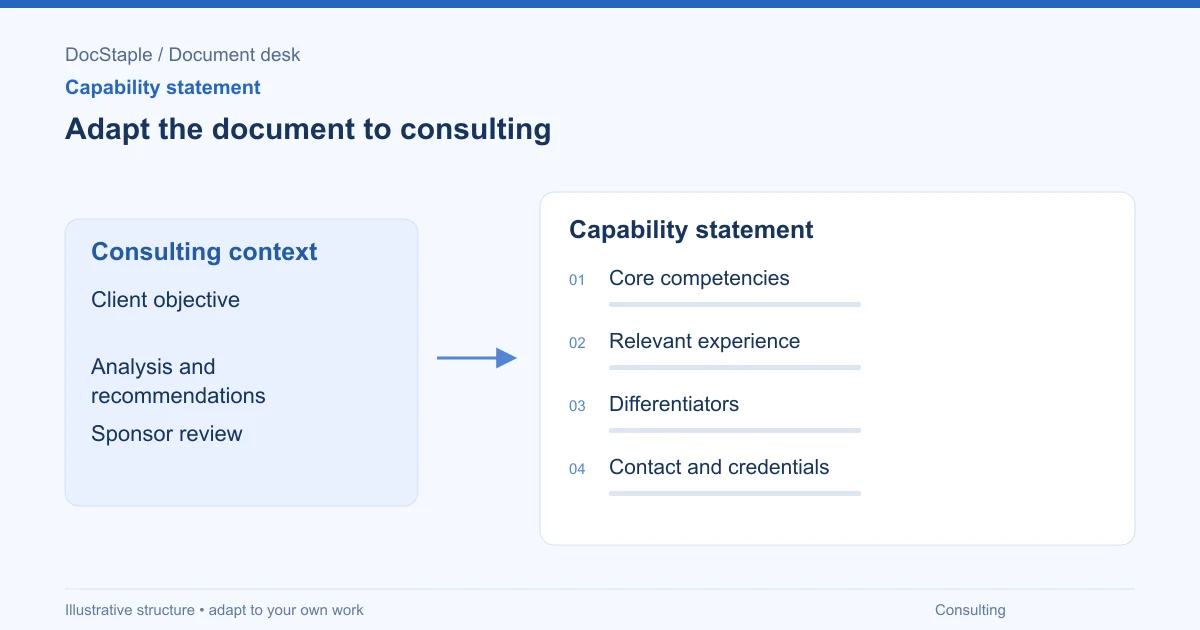
A consulting capability statement should help a buyer decide whether your firm is worth a deeper conversation. It is not a mini brochure stuffed with adjectives. It is a compact evidence document: what you do, where you have done it, what makes your delivery credible and how the buyer can verify or contact you.
This article uses a realistic scenario: a consulting firm wants to send a capability statement to public-sector and nonprofit buyers for operating strategy reviews. The firm delivers discovery interviews, current-state analysis, recommendations reports and sponsor briefings. The goal is to make the statement specific without inventing authority or exposing confidential client details.
Choose The Buyer And Service Lane
Start by deciding which buyer and service line the statement supports. A general "management consulting" statement is easy to ignore because it asks the reader to translate your offer.
Draft language
[Firm name] supports public agencies and nonprofit leadership teams with operating strategy reviews. Our work includes stakeholder interviews, current-state process mapping, evidence-based recommendations and sponsor briefings for implementation decisions.
Approval check: ask whether a procurement specialist could match this opening to a real need. If the answer is "maybe anything strategic," narrow it.
The US Department of Health and Human Services says a capability statement should include core capabilities, major services, certifications, clients, codes and contact information (HHS capability statement guidance). Use that as a content inventory, then adapt the emphasis to the consulting buyer you want.
For consulting, the service lane also controls which evidence belongs on the page. A strategy-review statement should not spend half its space on training workshops unless those workshops are part of the offer. A buyer should not have to infer whether you are selling diagnosis, implementation, coaching or staff augmentation.
Write Core Competencies As Buyer-Recognizable Services
Core competencies should be service promises the firm can actually deliver. Do not use a list of values in place of services.
Worked example: weak versus useful
Weak: We provide strategic transformation, operational excellence and world-class advisory solutions.
Stronger: Core competencies include operating strategy reviews, stakeholder interview programs, current-state process mapping, options analysis, recommendations reports and executive decision briefings.
Decision analysis: the stronger version names work products and methods. A buyer can connect those terms to a scope of work. The weak version may sound polished, but it does not tell the reader what the consultant can be asked to do next.
If you serve government buyers, include relevant codes or registration identifiers only when they are current and match the official record. Do not pad the statement with unrelated categories because a longer list can make the firm look unfocused.
Another useful test is whether each competency can become a line item in a proposal. "Stakeholder interviews" can be scoped, scheduled and priced. "Business transformation" cannot, at least not without more detail. Capability language should make the later proposal easier to write.
Show Relevant Experience Without Overclaiming
Relevant experience is stronger when it names the type of client, scope, period and verified result. If client names are confidential, use an approved generic description.
Worked example: confidential client
Relevant experience: For a regional nonprofit, [Firm name] completed an operating strategy review covering intake, service delivery handoffs and leadership reporting. Deliverables included a current-state map, recommendations report and board briefing. Client name withheld under confidentiality terms.
Decision analysis: this protects the client while still showing the nature of the work. The reader sees sector, scope and deliverables. What is missing is an unsupported claim that the project "transformed operations."
Worked example: approved client name
Relevant experience: [Client name, used with permission], strategy review, [period]. Scope included [number] stakeholder interviews, process map validation and a recommendations report delivered to [role] on [date]. Outcome statement approved by client: [approved wording].
Decision analysis: this version gives more proof because the client name and outcome have permission. The key is the phrase "approved by client." It reminds the drafter not to invent a result after the project.
The Federal Trade Commission tells businesses that advertising must be truthful, not deceptive, and supported by evidence (FTC Advertising FAQ's for Small Business). A capability statement is marketing material, so keep claims within what project records and client permissions can support.
When evidence is thin, choose honest precision over impressive fog. "Delivered three strategy-review reports for nonprofit leadership teams" is more credible than "trusted by organizations everywhere." If a buyer asks for past performance, unsupported adjectives will not help the contracting or evaluation team defend a selection.
Make Differentiators Verifiable
Consulting differentiators often collapse into slogans. Replace "unique methodology" with practices a buyer can check.
Draft language
Differentiators: each engagement is led by a named principal; recommendations cite the evidence used to support them; the firm provides an editable decision log with the final report; and sponsor briefings separate approved decisions from open assumptions.
Approval check: circle every differentiator and ask, "Could another firm say this without changing anything?" If yes, make it more concrete or remove it.
For example, "senior team involvement" becomes stronger as "the named engagement lead attends all sponsor interviews and the final briefing." "Data-driven" becomes stronger as "each recommendation links to interview themes, source documents or agreed assumptions."
Do not borrow a partner’s credential unless the statement explains the partner’s role. If a cybersecurity partner holds a certification, say that the partner provides that component. Do not imply the consulting firm itself holds the credential.
For a consulting firm, a differentiator may be a delivery control rather than a credential. Examples include principal-led interviews, evidence-linked recommendations, fixed sponsor briefing formats or a decision log handed over with every report. Those details show how the buyer will experience the work.
Add Credentials, Contact Details And Next Step
The contact section should make action easy and verification possible.
Annotated sample language
Legal name: [Registered legal name]
Service area: [Regions served]
Relevant identifiers: [Unique Entity ID, NAICS or other buyer-required identifiers, if applicable]
Contact: [Name], [role], [email], [phone]
Next step: request a scoped strategy-review proposal for [buyer need].
Why it works: it avoids a vague "contact us" ending and tells the buyer what to request. If you include US federal procurement identifiers, copy them from the official record and keep them current.
The US Department of Commerce describes a capability statement as a concise one-page overview that highlights core capabilities and performance elements that differentiate the business (Commerce OSDBU guidance). That does not mean every consulting statement must be exactly one page in every context, but it does mean the reader should find the essentials fast.
Review The Statement Before Sending
Review the statement against the buyer’s likely questions: What do you do? Have you done similar work? What evidence can I trust? How do I contact you? What should happen next?
Check every claim against a record. Verify client permissions. Remove vague adjectives. Confirm identifiers, legal name, contact details and dates. Ask someone outside the proposal team to read the first half of the page; if they cannot describe the service lane, rewrite the top.
If the statement will be used for a specific opportunity, run one final fit check against that buyer’s language. A general operating-strategy statement might need a front-page emphasis on intake redesign for one buyer and board reporting for another. Do not rewrite the facts; reorder the verified facts so the most relevant proof appears first.
Keep an approved master and an opportunity-specific copy. The master protects the verified evidence set; the copy lets you tailor emphasis without quietly changing claims. Label both versions so an old draft does not get sent after credentials or contacts change.
The consulting capability statement template gives you editable Word sections for organization and capabilities, relevant experience, differentiators, credentials and review notes. Use it as a drafting frame, then replace the examples with verified consulting evidence.
Last updated: September 26, 2026
Frequently Asked Questions
Related Articles
Capability Statement Best Practices for Consulting Firms
Capability statement best practices for consulting firms, with fixes for vague competencies, weak past performance, generic differentiators and stale credentials.
Capability Statement Checklist for Buyer-Ready Consulting Drafts
A capability statement checklist for consulting firms, with review gates for core competencies, relevant experience, differentiators, credentials and contact details.
Capability Statement Examples: Four Sections Written Weak and Then Strong
Capability statement examples for a fictional consulting firm: core competencies, relevant experience, differentiators, and contact and credentials, each shown as weak and stronger draft wording with a review checklist.
Engagement Letter Best Practices
Best practices for engagement letters, including scope control, responsibility wording, limitation language and approval records.
Engagement Letter Checklist
Use this engagement letter checklist to review purpose, parties, responsibilities, limitations, approval and signature readiness.
Engagement Letter Examples: Purpose, Scope Limits and Signatures
Engagement letter examples for consulting work, with annotated wording for parties, responsibilities, scope limitations, approval and signatures.