How to Write a Construction Confidentiality Agreement
A construction-focused workflow for adapting a confidentiality agreement, with site drawings, bids, subcontractors, permits, exceptions, sample wording and approval checks.
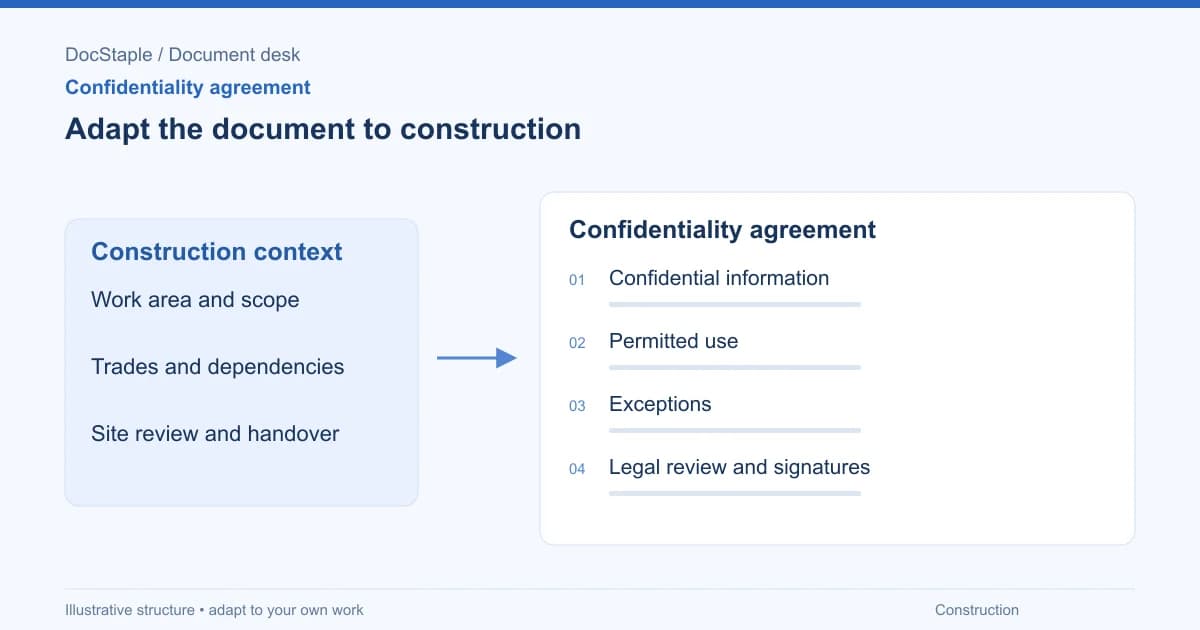
A construction confidentiality agreement has to work on a busy project, not just in a contract folder. Drawings move between designers, general contractors, subcontractors, inspectors, owners and tenants. Pricing may be sensitive. Site access details can raise security concerns. Permit records, safety observations and closeout documents may need to be shared with authorized people while kept away from everyone else.
Use this scenario: a general contractor is preparing a commercial fit-out for a tenant in a multi-tenant building. The owner shares security layouts, access routes, phasing plans, tenant equipment locations and budget information. Several trade subcontractors need selected drawings and schedule information. The contractor must protect sensitive information without stopping coordination, inspections, permit work or handover.
Define the construction purpose
The purpose clause should connect confidentiality to the actual project. In construction, the purpose often includes tendering, pricing, coordination, site work, inspection, closeout and warranty support. If the purpose is only "evaluate the project," it may not cover later delivery. If it is "any construction-related activity," it may be too broad.
Draft language:
Purpose means evaluating, pricing, coordinating and performing the commercial fit-out project at [site], including bid preparation, subcontractor coordination, site execution, inspection closeout, permit-related support and delivery of the site completion pack.
That wording recognizes the construction lifecycle. It also gives a basis for limiting use outside the project.
Operational review:
- Does the purpose match the contract, bid package or work order?
- Does it cover tendering and performance if both are needed?
- Does it include closeout and warranty if records remain in use?
- Does it exclude use on other bids, projects or marketing unless approved?
- Does it account for inspections, permit support and owner reporting?
For safety-sensitive or regulated work, do not let confidentiality language interfere with required reporting. In the United States, OSHA requires certain severe work-related incidents to be reported, including a work-related fatality within 8 hours and inpatient hospitalization, amputation or loss of an eye within 24 hours (OSHA reporting procedures under 29 CFR 1904.39). State the jurisdiction for any reporting claim and route safety reporting questions to the responsible safety/legal reviewer.
Identify confidential construction information
Construction projects involve many records, and not all of them are equally sensitive. The definition should list the project-specific materials that need protection.
Possible examples:
- Security drawings and access control layouts
- Bid pricing, alternates and value-engineering notes
- Tenant equipment locations or operational constraints
- Phasing plans for occupied areas
- Proprietary means and methods
- Unreleased design revisions
- Permit support documents not yet public
- Inspection reports and closeout records
- Photos showing restricted areas
Draft language:
Confidential Information includes non-public information disclosed for the Purpose, including security layouts, access routes, tenant operational information, bid pricing, phasing plans, unreleased drawings, value-engineering notes, inspection records, permit support materials and information derived from those records.
Be careful with documents that may become public through permitting or statutory processes. The agreement should not pretend that a record remains confidential after it becomes public through lawful publication. That is what exceptions are for.
For trade secret issues in the United States, federal law looks in part at whether the owner took reasonable measures to keep information secret and whether the information derives economic value from not being generally known (18 U.S.C. § 1839). In construction, reasonable measures may include limiting drawing distribution, marking sensitive sheets, controlling access to project portals and requiring subcontractor confidentiality terms.
Set permitted use for site and subcontractor realities
Construction delivery requires sharing. A confidentiality agreement that ignores subcontractors will fail immediately. The permitted use section should state which project participants may receive information and for what purpose.
Draft language:
Recipient may use Confidential Information solely for the Purpose. Recipient may disclose Confidential Information only to employees, approved subcontractors, design professionals, inspectors, advisers and authorities having jurisdiction who need the information for the Purpose and who receive only the portion reasonably necessary for their role, except where broader disclosure is required by law or permit process.
That draft recognizes that not every trade needs every drawing. A flooring subcontractor may need phasing and finish plans, but not security details for restricted rooms. A low-voltage subcontractor may need access control drawings but not bid alternates for unrelated trades.
Add handling language:
Recipient will distribute sensitive drawings through the approved project platform or another approved method, will not post restricted drawings in public site areas, and will mark or segregate security-related documents where reasonably practicable.
Review criteria:
- Authorized recipients include required trades and professionals.
- Subcontractor confidentiality flow-down is addressed.
- Distribution is limited by role where practical.
- Project platform, drawing logs and revision controls align with the clause.
- Site posting rules do not expose restricted information.
- Required inspection, permit and authority disclosures are not blocked.
The goal is not secrecy at the expense of coordination. It is controlled sharing.
Write exceptions and required disclosure clauses
Construction confidentiality agreements need exceptions because some information is already known, independently developed, issued publicly, submitted to authorities or required for safety and legal purposes.
Draft language:
Confidential Information does not include information that the recipient can show is or becomes public other than through breach, was lawfully known before disclosure, is lawfully received from a third party without a duty of confidence, is independently developed without use of Confidential Information, or is disclosed through a permit, inspection or other lawful public process.
Required disclosure language:
Recipient may disclose Confidential Information to the extent required by law, court order, safety obligation, regulator, inspector or authority having jurisdiction. Where legally permitted and practical, Recipient will give the disclosing party prompt notice and cooperate with reasonable protective steps.
US whistleblower and reporting rules may also matter, depending on the parties and information. The SEC states that Rule 21F-17(a) prohibits impeding direct communications with SEC staff about possible securities law violations, including through confidentiality agreements (SEC whistleblower protections). A construction confidentiality agreement should not be used to silence legally protected reports.
Draft protected-reporting language:
Nothing in this agreement prohibits a person from reporting a possible violation of law, unsafe condition or other matter to a government agency or from making another disclosure protected by law.
Have counsel adapt that wording. Construction projects often involve local law, public procurement rules, safety duties and project-specific confidentiality obligations.
Plan return, retention and closeout
At the end of a construction project, records do not simply disappear. Closeout packs, as-built drawings, warranties, inspection records, permits, claims files and safety records may need to be retained. The confidentiality agreement should describe return and deletion without conflicting with those duties.
Draft language:
At completion of the Purpose or upon written request, Recipient will return or securely delete Confidential Information in its possession, except for copies retained for legal, insurance, warranty, safety, permit, professional record, dispute or routine backup purposes. Retained copies remain subject to the confidentiality obligations in this agreement.
For the fit-out scenario, closeout review should ask:
- Which drawings become part of the site completion pack?
- Which records must be provided to the owner, tenant, authorities or facility manager?
- Which subcontractors must return or delete restricted information?
- Which photos or inspection records show sensitive areas?
- Which records must be kept for warranty or claim defense?
- Where is the final approved record stored?
Draft closeout language:
The site manager will complete a confidentiality closeout log identifying restricted drawings distributed, subcontractors with access, records returned or retained, and any sensitive materials included in the site completion pack.
Complete legal review and signatures
The final agreement should be reviewed before bid release or before sensitive materials are shared. Waiting until after drawings have circulated reduces the value of the agreement.
Approval criteria:
- Purpose matches the project phase and contract documents.
- Confidential information examples reflect drawings, pricing, site and tenant realities.
- Subcontractor and adviser access is defined.
- Permit, inspection, safety and legal disclosures are carved out.
- Protected reporting is not restricted.
- Return and retention language matches closeout and warranty needs.
- The agreement aligns with subcontract terms and project platform rules.
- Signers are authorized.
- The signed version is stored with the project file.
Signature language:
Signed for [Owner/Client]: [name, title, date]. Signed for [Contractor/Subcontractor]: [name, title, date]. Project: [name/site]. Version signed: [file name/version]. Legal and project review completed by: [name/date].
The construction confidentiality agreement template provides editable Word sections for parties and purpose, permitted use, exceptions, duration, return, review and execution. Use it as a structured starting draft, then adapt it to the contract, project records, site rules and jurisdiction.
A good construction confidentiality agreement does not stop the work. It keeps sensitive information moving only to the people who need it, through controlled channels, while preserving safety, legal and permit realities.
Last updated: September 26, 2026
Frequently Asked Questions
Related Articles
Audit Checklist Best Practices
Best practices for audit checklists, including scope, evidence, findings, actions, closure review, failure modes and sample wording.
Audit Checklist Checklist: Review Your Audit Form Before You Use It
A practical audit checklist checklist with decision gates for scope, evidence, findings, actions and closure review.
Audit Checklist Examples: Scope, Evidence, Findings and Closure
Audit checklist examples for consulting work, covering audit scope, evidence to inspect, findings and actions, closure review and practical draft wording.
Business Continuity Plan Best Practices for Consulting Teams
Business continuity plan best practices for consulting teams, including critical services, recovery priorities, communications, exercises and review criteria.
Business Continuity Plan Checklist for Consulting Teams
A practical business continuity plan checklist for consulting work, covering critical services, recovery priorities, communications, exercises and review criteria.
Business Continuity Plan Examples: Consulting Scenarios and Recovery Priorities
Business continuity plan examples for consulting teams, with critical services, recovery priorities, communications, exercises and review criteria.