How to Write a Consulting Confidentiality Agreement
A consulting-specific workflow for adapting a confidentiality agreement, with a realistic scenario, sample wording, review criteria and approval checks.
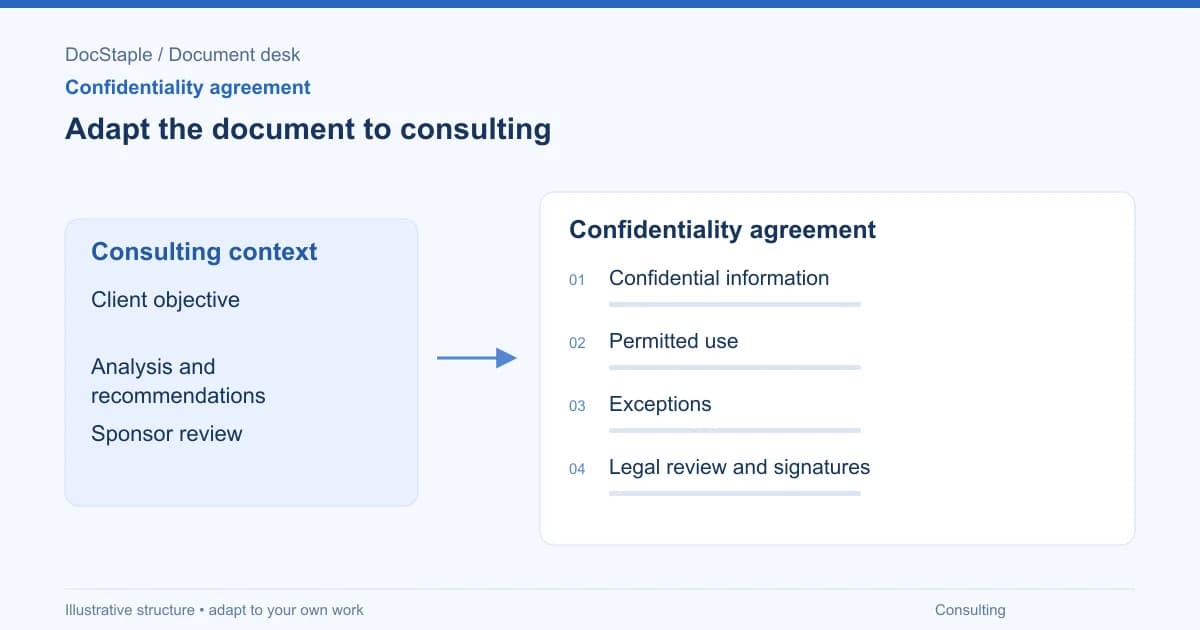
A consulting confidentiality agreement should protect the client without making delivery impossible. Consultants need to review documents, interview staff, test assumptions, prepare recommendations and sometimes involve subcontractors or advisers. A useful agreement states what information is protected, what the consultant may use it for, who may see it, what exceptions apply and who must approve the final signed version.
Use this scenario throughout: a consulting firm is engaged for a strategy review of a regional distributor. The client will share customer lists, draft pricing, sales margin data, warehouse performance notes and candid interview comments from managers. The consulting firm will use a data analyst subcontractor for one workstream and will prepare a recommendations report. The client wants tight confidentiality controls, but the consultant needs enough access to perform the work.
Tie the agreement to the consulting purpose
Begin by describing the purpose. This matters because permitted use, authorized recipients and return obligations should all connect to the work being performed. If the purpose is too broad, the client may lose control. If it is too narrow, the consultant may need repeated amendments for ordinary delivery tasks.
Draft language:
Purpose means evaluating and performing the strategy review described in the statement of work dated [date], including discovery interviews, analysis of client-provided data, preparation of findings and delivery of the recommendations report.
That purpose is specific enough to exclude unrelated use, such as training another client team or building a public benchmark report, but broad enough to cover the normal project sequence.
Operational check:
- Does the purpose match the signed or draft statement of work?
- Does it cover interviews, analysis, workshops and final deliverables?
- Does it exclude marketing, benchmarking and unrelated client work unless expressly approved?
- Does it identify whether subcontractors are part of the permitted delivery model?
When personal data is involved, confidentiality may overlap with privacy law. In the UK, the ICO explains that controller-processor contracts must include required data protection terms under UK GDPR, while commercial terms remain for the parties if the contract complies with the law (ICO controller and processor contracts). State the jurisdiction and route privacy questions to a qualified reviewer.
Define confidential information for consulting work
Consulting projects produce more than client documents. Interview notes, draft findings, raw extracts, workshop outputs and the consultant's work papers may all reveal sensitive client information. The definition should cover the forms and examples that matter in the engagement.
Draft language:
Confidential Information includes non-public information disclosed by or on behalf of Client in connection with the Purpose, in any form, including customer and supplier information, pricing, sales and margin data, operating metrics, organization charts, interview notes, workshop outputs, draft recommendations and information derived from those materials.
Consider whether the consultant's own methods or pre-existing tools need separate treatment. A confidentiality agreement should not accidentally transfer ownership of the consultant's general know-how, templates or methodologies. That issue often belongs in the services agreement, but the confidentiality draft should avoid wording that creates confusion.
For trade secret questions, a consulting agreement can support confidentiality controls, but only if the team also follows practical measures such as access limits, approved storage and subcontractor restrictions.
Review criteria:
- Examples match the actual discovery materials.
- Derived notes and draft recommendations are covered where appropriate.
- Public information and consultant pre-existing know-how are not confused.
- The agreement explains whether oral disclosures must be confirmed in writing.
- The team can identify protected materials in the project workspace.
Set permitted use and access rules
The permitted use clause should say the consultant may use confidential information only for the purpose. Then it should state who may receive it. In consulting, this is where subcontractors, advisers and internal specialists must be handled carefully.
Draft language:
Consultant may use Confidential Information solely for the Purpose. Consultant may disclose Confidential Information only to its employees, professional advisers and the subcontractor listed in Schedule A who need access for the Purpose and are bound by written confidentiality obligations no less protective than this agreement.
If the client must approve each subcontractor, say so. If the consultant can use normal advisers, such as lawyers or insurers, state that separately. If offshore or cross-border access is relevant, route that to privacy and legal review rather than burying it in a general confidentiality clause.
Add practical handling rules:
Consultant will store Confidential Information only in the approved engagement workspace or other location approved in writing by Client. Consultant will not use Confidential Information in marketing materials, training data, public case studies or work for another client without Client's prior written approval.
Avoid promises the consulting team cannot keep. If the firm uses routine backups, say how retained backup copies are treated. If interview notes must be kept for professional records, do not promise total deletion without a retention exception.
Include exceptions and protected disclosures
Exceptions make the agreement workable. They also prevent the agreement from being used in ways the law may not allow.
Draft language:
Confidential Information does not include information that Consultant can show is or becomes public other than through breach of this agreement, was lawfully known before disclosure, is lawfully received from a third party without a duty of confidence, or is independently developed without use of Confidential Information.
Required disclosure language:
Consultant may disclose Confidential Information to the extent required by law, court order or regulator, provided that Consultant gives Client prompt notice where legally permitted and cooperates with reasonable protective steps.
For US agreements, protected reporting deserves explicit attention. The SEC says Rule 21F-17(a) prohibits actions that impede direct communication with SEC staff about possible securities law violations, including enforcing or threatening to enforce confidentiality agreements for those communications (SEC whistleblower protections). The DTSA also provides immunity for certain confidential disclosures to government officials or attorneys to report or investigate suspected violations and includes notice consequences for agreements with employees, contractors and consultants (18 U.S.C. § 1833).
Draft protected-reporting language:
Nothing in this agreement prohibits a person from reporting a possible violation of law to a government agency or making a disclosure protected by law, and no prior approval or notice is required for such protected reporting.
Ask counsel to adapt that clause to the governing law and parties.
Plan return, deletion and handoff
Consulting engagements often end with a handoff: final report, appendix, data extract, presentation and project archive. The confidentiality agreement should explain what happens to source materials and work papers after the purpose ends.
Draft language:
Within [number] days after completion of the Purpose or written request, Consultant will return or securely delete Confidential Information, except that Consultant may retain copies required by law, professional obligation, insurance requirement, dispute record or routine backup process. Retained copies remain subject to this agreement.
For consulting, review these realities before approving the clause:
- Are interview notes part of the deliverable or internal work papers?
- Must the consultant keep evidence supporting advice?
- Does the client want raw data returned, deleted or archived?
- Can the project workspace export a deletion or access record?
- Are subcontractors required to certify return or deletion?
Draft handoff language:
The project closeout record will list final deliverables, returned materials, deleted workspaces, retained records and any subcontractor confirmation. The engagement lead will approve closeout before the agreement is marked complete.
This keeps confidentiality from becoming a vague promise after the final invoice.
Use legal review and signatures
Before signature, perform an approval check that covers both law and operations. The reviewer should not only ask, "Is the clause acceptable?" but also, "Can the consulting team follow this during delivery?"
Approval checklist:
- Purpose matches the statement of work.
- Confidential information examples match discovery materials.
- Subcontractor access is approved and documented.
- Personal data questions are routed to privacy review.
- Permitted use excludes benchmarking, marketing and unrelated advice.
- Exceptions and protected reporting language are present.
- Return, deletion and retention language is realistic.
- Governing law, remedies and duration have legal review.
- Signature authority is confirmed.
- The signed version is stored with the engagement file.
Signature language:
Signed for Client: [name, title, date]. Signed for Consultant: [name, title, date]. Version signed: [file name/version]. Approval record: legal review [name/date], engagement approval [name/date].
The consulting confidentiality agreement template gives you an editable Word starting point with sections for parties and purpose, permitted use and disclosure, exceptions, duration, return, review and execution. Complete it with your actual facts, then have the final draft reviewed for the engagement and jurisdiction.
A strong consulting confidentiality agreement protects the client while letting the consultant do the promised work. The key is not more legal language. It is a clear connection between scope, information, access, exceptions and closeout.
Last updated: September 26, 2026
Frequently Asked Questions
Related Articles
Audit Checklist Best Practices
Best practices for audit checklists, including scope, evidence, findings, actions, closure review, failure modes and sample wording.
Audit Checklist Checklist: Review Your Audit Form Before You Use It
A practical audit checklist checklist with decision gates for scope, evidence, findings, actions and closure review.
Audit Checklist Examples: Scope, Evidence, Findings and Closure
Audit checklist examples for consulting work, covering audit scope, evidence to inspect, findings and actions, closure review and practical draft wording.
Business Continuity Plan Best Practices for Consulting Teams
Business continuity plan best practices for consulting teams, including critical services, recovery priorities, communications, exercises and review criteria.
Business Continuity Plan Checklist for Consulting Teams
A practical business continuity plan checklist for consulting work, covering critical services, recovery priorities, communications, exercises and review criteria.
Business Continuity Plan Examples: Consulting Scenarios and Recovery Priorities
Business continuity plan examples for consulting teams, with critical services, recovery priorities, communications, exercises and review criteria.