How to Write a Construction Employee Handbook
A construction-specific guide to adapting an employee handbook for site work, conduct, reporting, leave placeholders, local review and approval.
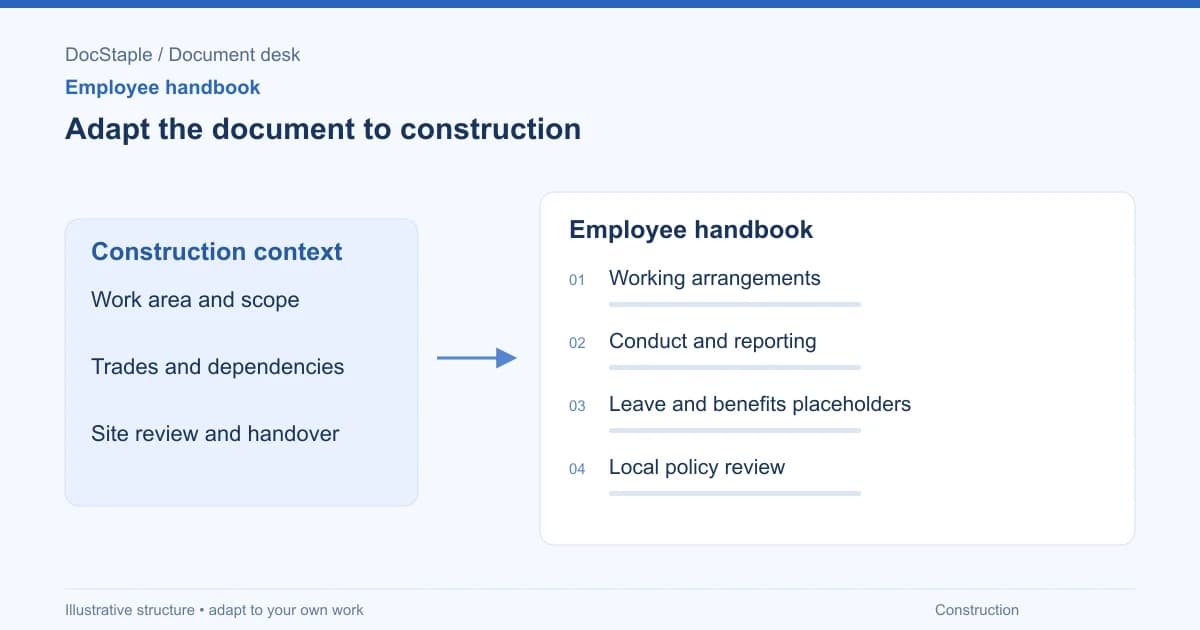
A construction employee handbook has to work across offices, yards and active job sites. It should explain employment practices clearly without pretending that every site runs the same way. Construction employees may move between projects, work under general contractor rules, attend site inductions, use company equipment, report hazards and interact with subcontractors or client representatives. The handbook should connect those realities to the employer's policies.
This guide uses a realistic scenario: a construction contractor is rolling out a handbook for employees assigned to commercial fit-out projects. The workforce includes supervisors, project administrators and field employees. Some work at client sites, some travel between projects, and all need clear reporting routes. U.S. federal sources are cited where relevant, but local employment review is essential.
Define working arrangements for site reality
Start with where and how people work. Construction handbooks should avoid office-only assumptions. Include site assignment, reporting location, shift or schedule communication, timekeeping, travel between sites, weather or access changes, PPE or equipment issue, and who can change the work location.
Draft language:
Employees may be assigned to company offices, yards, workshops or project sites. Work location, start time and site access requirements may vary by project and role. Employees must follow the current assignment instructions, timekeeping process, site induction requirements and supervisor directions. If site instructions conflict with company policy or legal requirements, employees should pause and contact their supervisor or the designated escalation contact.
Construction adaptation: keep client or general contractor rules visible without making the handbook a copy of every project manual. The handbook can say employees must follow applicable site rules, while the project-specific induction provides the current details.
Review criteria:
- Work locations and schedule changes are realistic.
- Timekeeping and travel practices match payroll rules and actual operations.
- Site induction and access are addressed.
- The handbook routes conflicts to a named role.
- It avoids promises that cannot work across projects.
Cover conduct and reporting routes
Construction teams need conduct rules that work in field conditions: respectful workplace expectations, violence prevention, substance policy where applicable, conflicts of interest, social media, client interaction, tool and equipment care, and reporting concerns.
For U.S. employers, the EEOC says employers can help prevent harassment by establishing an effective complaint or grievance process, training managers and employees, and taking immediate and appropriate action when an employee complains (EEOC harassment). A construction handbook should give employees more than one reporting route, especially when the concern involves their direct supervisor or job-site chain of command.
Draft language:
Employees may report workplace conduct concerns to their supervisor, any manager, Human Resources, the designated reporting contact, or another contact listed in the current reporting procedure. Employees are not required to report a concern only to the person involved in the concern. The company prohibits retaliation for good-faith reporting or participation in an investigation.
Construction adaptation: add site-specific reporting for hazards and near misses. OSHA's recommended practices for construction safety programs emphasize that programs work when everyone is involved and comfortable reporting injuries, incidents and hazards (OSHA recommended practices for construction).
Draft language:
Employees should report hazards, incidents, injuries, near misses, damaged equipment and unsafe conditions promptly through the site reporting process or to a supervisor. Urgent danger should be addressed under the applicable emergency procedure.
Review criteria: reporting routes should be usable during field work, after hours and when the direct supervisor is unavailable.
Use leave and benefits placeholders carefully
Leave and benefits sections can become inaccurate quickly. Construction employers may have different employee groups, union or project arrangements, state paid sick leave rules, travel policies, benefit eligibility periods and return-to-work procedures. Use placeholders until HR and legal reviewers confirm the correct language.
For covered U.S. employers, the Department of Labor says the FMLA general notice must be included in employee handbooks or other written guidance about benefits if the employer has such materials (DOL FMLA FAQ). That is a federal point; state and local leave rules may add more.
Draft placeholder:
[Insert reviewed leave policy for the applicable employee group and location. Confirm federal, state and local leave requirements, project scheduling practices, notice procedures, benefits continuation, return-to-work documentation and any collectively bargained terms before publication.]
Benefits placeholder:
[Insert benefits summary or direct employees to the reviewed benefits materials. Confirm eligibility, waiting periods and plan-document language before publication.]
Review criteria:
- Leave wording is reviewed for each work location.
- Benefits references match official plan documents.
- Return-to-work rules are consistent with applicable law.
- Project scheduling needs do not override protected leave rights.
- Supervisors know where to route leave questions.
Address safety, confidentiality and site information
The handbook should explain the employee's role in safety and information handling, then point to controlled procedures for the details. Do not paste every safety program into the handbook unless that is how the employer controls and updates those instructions.
Draft language:
Employees must follow applicable company safety rules, site-specific requirements, training instructions and supervisor directions. Employees must use assigned equipment only as authorized and report damaged equipment, missing guards, unsafe access, exposure concerns and other hazards through the approved reporting route.
OSHA's construction page notes that construction workers may face serious hazards such as falls, unguarded machinery, struck-by equipment, electrocutions, silica dust and asbestos (OSHA construction industry). The handbook should not attempt to train every hazard. It should tell employees where controlled training and procedures live.
Information handling also matters. Construction employees may see drawings, access codes, client schedules, pricing, personal information or security-sensitive site details.
Draft language:
Employees must protect company, client and project information, including drawings, schedules, access details, pricing, personnel information and photographs. Project information may be stored or shared only through approved systems and for approved work purposes.
Review criteria: safety and confidentiality sections should be clear enough for orientation and connected to the detailed procedures used on site.
Local review and approval check
Construction handbooks require local review because obligations can vary by state, locality, project, workforce group and employer size. Review at least:
- Wage and hour classification.
- Overtime and timekeeping.
- Travel and expense reimbursement.
- Leave and accommodation.
- Drug and alcohol testing where applicable.
- Safety reporting and anti-retaliation language.
- Required notices.
- Union or project labor agreement interactions where applicable.
- Equipment, PPE and vehicle rules.
- Acknowledgment wording.
Draft acknowledgment:
I acknowledge receipt of the construction employee handbook dated 26 September 2026. I understand that project-specific rules, site inductions and controlled safety procedures may also apply to my work. I am responsible for asking questions when instructions conflict or are unclear. This acknowledgment does not waive rights that cannot be waived under applicable law.
Approval check:
- HR confirms employment policy accuracy.
- Operations confirms site practices are realistic.
- Safety reviewer confirms handbook language aligns with controlled safety procedures.
- Legal or qualified local reviewer checks jurisdiction-specific wording.
- Authorized employer representative approves release.
- Distribution and acknowledgment records are retained.
The construction employee handbook template provides an editable Word structure for employment context, working arrangements, conduct, safety, confidentiality, reporting, development, acknowledgment and approval. Use it as a framework, then replace example text with project and jurisdiction-specific wording before distribution.
Last updated: September 26, 2026
Frequently Asked Questions
Related Articles
Audit Checklist Best Practices
Best practices for audit checklists, including scope, evidence, findings, actions, closure review, failure modes and sample wording.
Audit Checklist Checklist: Review Your Audit Form Before You Use It
A practical audit checklist checklist with decision gates for scope, evidence, findings, actions and closure review.
Audit Checklist Examples: Scope, Evidence, Findings and Closure
Audit checklist examples for consulting work, covering audit scope, evidence to inspect, findings and actions, closure review and practical draft wording.
Business Continuity Plan Best Practices for Consulting Teams
Business continuity plan best practices for consulting teams, including critical services, recovery priorities, communications, exercises and review criteria.
Business Continuity Plan Checklist for Consulting Teams
A practical business continuity plan checklist for consulting work, covering critical services, recovery priorities, communications, exercises and review criteria.
Business Continuity Plan Examples: Consulting Scenarios and Recovery Priorities
Business continuity plan examples for consulting teams, with critical services, recovery priorities, communications, exercises and review criteria.