How to Write a Consulting Employee Handbook: Working Arrangements, Conduct and Review
How to write a consulting employee handbook with working arrangements, conduct and reporting, leave and benefits placeholders, local policy review, draft wording and approval checks.
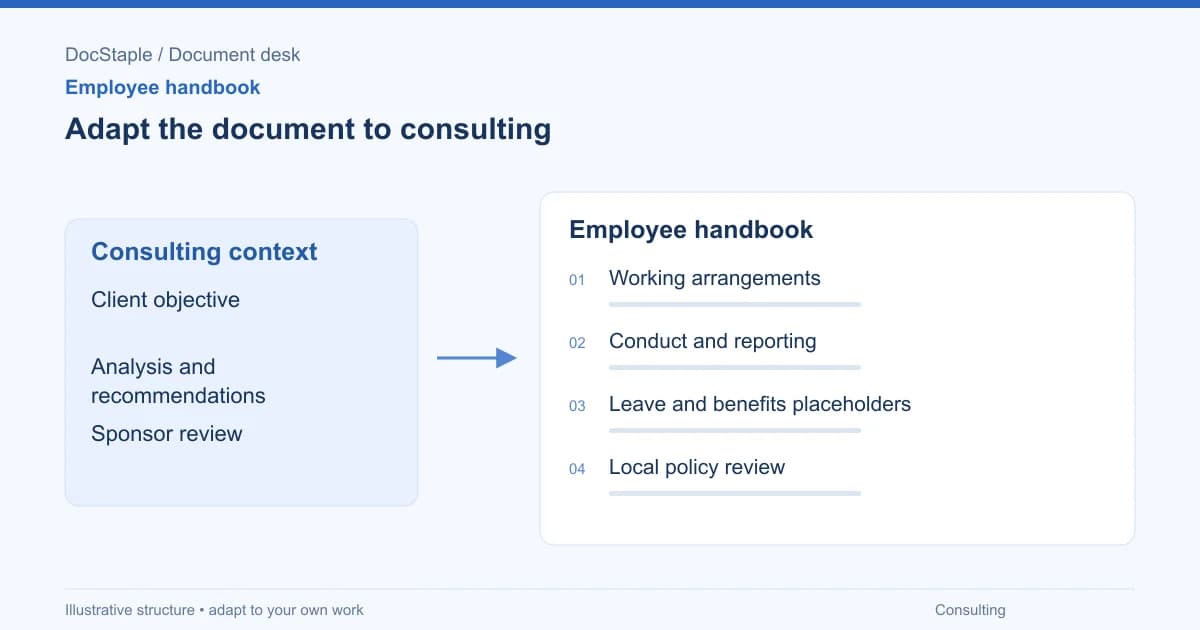
A consulting employee handbook has to do more than list office rules. Consultants move between home offices, client sites, travel days, workshops and internal analysis work. They handle confidential client information and often work under intense deadlines. The handbook needs to explain how employment policies apply in that delivery reality without trying to replace local law, contracts or detailed procedures.
This guide uses a fictional scenario: a 60-person consulting firm is rolling out a refreshed handbook for consultants, managers and operations staff in the United States and the United Kingdom. The firm wants one readable handbook, plus local review for employment-specific sections. The core challenge is consistency: employees need the same conduct and reporting expectations, while leave, benefits and statutory rights must be checked locally.
Jurisdiction matters. In the United States, the Department of Labor explains employer obligations under the Family and Medical Leave Act and notes that some states provide additional rights and protections DOL FMLA toolkit. In the UK, Acas provides a Code of Practice for disciplinary and grievance procedures Acas code. A handbook draft should route these areas to qualified local review instead of pretending one paragraph covers every location.
Start with employment context and handbook limits
The opening should explain who the handbook covers, how it relates to local policies and who can approve changes. Avoid making accidental contractual promises.
Weak wording:
This handbook contains all terms and conditions of employment and applies equally in every country.
That is risky and likely untrue.
Stronger draft language:
Purpose. This handbook summarizes workplace expectations, reporting routes and selected employment practices for [employee groups]. It should be read with the employee's contract, applicable local policies and any client-site rules communicated for an assignment.
Local application. Employment rights, leave, benefits, wage and working-time rules vary by jurisdiction. Where this handbook conflicts with a locally applicable policy, employment contract or legal requirement, the issue must be escalated to [HR role] before action is taken.
Approval. Only [authorized employer representative] may approve changes to this handbook.
That wording does not solve every legal issue, but it makes clear that the handbook is not the only source of employment obligations.
Describe consulting working arrangements
Consultants need practical rules for hybrid work, client site attendance, travel, time recording and availability. The handbook should avoid vague ideals like "be flexible" and instead describe how decisions are made.
Cover these points:
- normal working location categories, such as home, office, client site and travel
- how assignments and client-site expectations are communicated
- who approves changes to schedule or location
- how time, expenses and travel are recorded
- what employees should do when client demands conflict with firm policy
- expectations for protecting confidential material in public places
Draft language:
Consultants may work from the assigned location for the engagement, which may include a company office, approved remote workplace, client site or travel location. The engagement manager confirms client-site attendance expectations before work begins. If a client request would require work outside approved hours, travel arrangements or information security rules, the consultant must escalate to the engagement manager before agreeing.
For consulting, this section should be concrete. A new consultant should know whether a client can directly demand weekend work, where to record travel time, and what to do if a workshop room is not private enough for confidential discussion.
Set conduct and reporting routes
Conduct wording should be readable and operational. It should not bury reporting routes under values language. Employees need to know where to report harassment, discrimination, safety concerns, confidentiality incidents and conflicts of interest.
In the United States, the EEOC says anti-harassment policies should give employees various options for reporting harassment, including filing a complaint EEOC harassment guidance. The EEOC also says employees should report harassment to management early to prevent escalation EEOC harassment overview. Do not copy U.S. wording into non-U.S. handbooks without review, but the practical drafting lesson is useful: provide more than one reporting route.
Draft language:
Employees may report concerns to their people manager, any member of the leadership team, [HR contact] or [ethics/reporting channel]. A concern about a manager does not need to be reported to that manager first. Reports should include what happened, when, where, who was involved and any immediate risk, if known.
The company prohibits retaliation against an employee for raising a concern in good faith or participating in a review. Employees who believe retaliation has occurred should report it through any of the routes above.
Also include client-site conduct. Consultants represent the firm, but they are still employees with reporting rights. The handbook should say that client pressure does not override the firm's conduct, safety, confidentiality or anti-harassment procedures.
Use placeholders for leave and benefits
Leave and benefits are where generic handbooks often go wrong. A placeholder is better than inaccurate entitlement wording. For each location, record the policy owner, source document and review date.
Use a table like this:
| Topic | Handbook wording | Local review needed |
|---|---|---|
| Annual leave or vacation | Refer to local leave policy and HR system | Yes |
| Sick leave | State reporting route, not medical detail | Yes |
| Family leave | Refer to jurisdiction-specific policy | Yes |
| Benefits | Refer to current benefits summary | Yes |
| Public holidays | Refer to employee location and contract | Yes |
Short draft:
Leave and benefits are administered under the policies that apply to the employee's work location, contract and eligibility. Employees should request leave through [system] and contact [HR role] if they are unsure which policy applies. This handbook does not summarize every statutory or contractual entitlement.
In the United States, covered employers must consider FMLA obligations for eligible employees, and DOL's employer guide walks through administration from eligibility to reinstatement DOL employer guide. That kind of jurisdiction-specific detail belongs in reviewed policy material, not improvised handbook prose.
Review confidentiality and client handoff realities
Consulting handbooks need a practical confidentiality section because employees regularly receive client documents, interview notes, recordings and strategy material.
Include:
- approved storage locations
- rules for client-approved tools
- restrictions on forwarding material to personal accounts
- meeting privacy expectations
- reporting route for accidental disclosure
- return or deletion steps at project close
Draft language:
Client information must be stored only in approved project locations. Employees must not copy client material into personal storage, unapproved AI tools or informal channels. If material is sent to the wrong recipient or stored in the wrong location, the employee must notify [information security contact] and the engagement manager promptly and must not attempt unapproved deletion or concealment.
For UK personal data, the ICO says organizations must assess likely risk to people's rights and freedoms after a personal data breach and report notifiable breaches without undue delay and within the stated legal timeframe ICO breach guide. Other jurisdictions have different rules, so the handbook should point employees to the firm's incident process.
Approval check before distribution
Run these checks before sending the handbook to employees:
- Coverage: Are employee groups, locations and local supplements identified?
- Working arrangements: Does the handbook explain remote, office, client-site and travel expectations?
- Conduct: Are reporting routes clear and available outside the direct management chain?
- Leave and benefits: Are placeholders linked to reviewed local policies rather than invented summaries?
- Confidentiality: Does the wording match actual client and information security procedures?
- Local review: Have HR and qualified employment reviewers checked each jurisdiction?
- Acknowledgment: Does the receipt record confirm access to the handbook without asking employees to waive rights?
- Version control: Is there an effective date, owner and update process?
If you need a structured starting point, the consulting employee handbook template is an editable Word file with sections for employment context, working arrangements, safety and confidentiality reporting, development, review and approval. It must be adapted and locally reviewed before use.
Last updated: September 26, 2026
Frequently Asked Questions
Related Articles
Audit Checklist Best Practices
Best practices for audit checklists, including scope, evidence, findings, actions, closure review, failure modes and sample wording.
Audit Checklist Checklist: Review Your Audit Form Before You Use It
A practical audit checklist checklist with decision gates for scope, evidence, findings, actions and closure review.
Audit Checklist Examples: Scope, Evidence, Findings and Closure
Audit checklist examples for consulting work, covering audit scope, evidence to inspect, findings and actions, closure review and practical draft wording.
Business Continuity Plan Best Practices for Consulting Teams
Business continuity plan best practices for consulting teams, including critical services, recovery priorities, communications, exercises and review criteria.
Business Continuity Plan Checklist for Consulting Teams
A practical business continuity plan checklist for consulting work, covering critical services, recovery priorities, communications, exercises and review criteria.
Business Continuity Plan Examples: Consulting Scenarios and Recovery Priorities
Business continuity plan examples for consulting teams, with critical services, recovery priorities, communications, exercises and review criteria.