How to Write a Construction Engagement Letter
Adapt an engagement letter for construction work with site-specific scope, responsibilities, exclusions, change approval and handover examples.
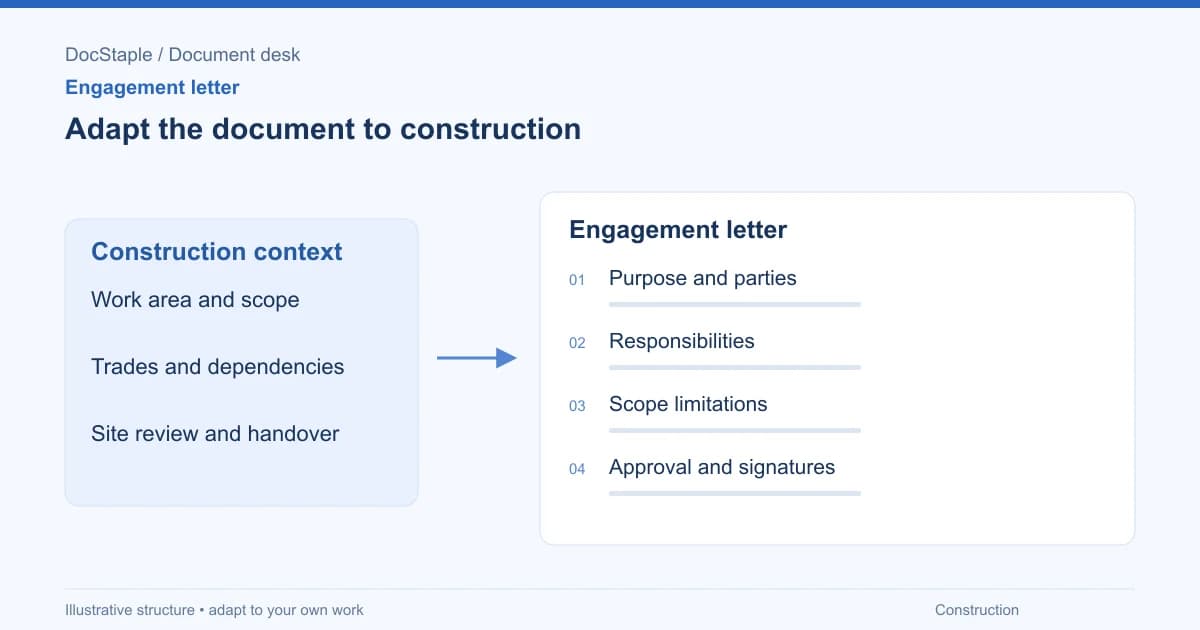
A construction engagement letter must do more than confirm enthusiasm for a project. It needs to tie the work to a site, drawing set, handover expectation and approval path. Construction scope can change quickly, and a vague letter can turn a small fit-out into an argument about design changes, access delays or incomplete closeout records.
The scenario here is a commercial fit-out for a medical office suite in Austin, Texas. A general contractor is engaging a specialist millwork subcontractor to fabricate and install reception cabinetry, exam-room storage and a staff kitchenette. This article is not legal advice, and Texas construction contracts may involve state-specific lien, payment, insurance and licensing issues. Use qualified review for legal requirements.
Start with the project, site and parties
Construction letters should identify the project more precisely than ordinary consulting letters. Include the legal parties, site address, project name, authorized contacts and the document set that frames the work.
Draft language:
This engagement letter records the understanding between Hillcrest Build Group LLC and Mesa Millwork Co. for millwork fabrication and installation at the North Loop Medical Office Fit-Out, 2140 North Loop Boulevard, Austin, Texas. The work supports completion of the reception, exam-room and staff kitchenette areas shown in drawing set A-301 to A-306, revision 4, dated [date].
Annotation: the site is named, the trade is clear and the drawings are identified. If later drawings revise the kitchenette layout, the team can see whether the engagement letter was based on the old or new set.
Add authority:
Hillcrest's site manager may coordinate daily access and sequencing. Only Hillcrest's project manager may approve scope, price or schedule changes under this engagement.
That difference matters. Site coordination is not the same as commercial approval.
If the owner, architect or tenant can influence field decisions, name their role too. Otherwise a subcontractor may receive direction from someone present on site but outside the approval chain.
Define construction responsibilities by role
Construction responsibilities should be separated by party because site work depends on access, predecessor work, measurements and coordination.
Sample responsibility section:
Mesa will field-verify dimensions, prepare shop drawings, fabricate approved millwork, deliver materials to the site and install the millwork listed in Schedule 1. Hillcrest will provide site access, approved drawings, required work areas, coordination with other trades and written responses to submitted questions.
Now add a dependency:
Installation dates assume wall framing, blocking, electrical rough-in and floor protection are complete in the affected rooms before Mesa mobilizes.
Worked example: Mesa arrives and blocking is missing behind reception panels. If the letter only says "install reception cabinetry," the delay may become a blame exercise. If the letter says installation assumes blocking is complete, the project manager can decide whether to reschedule, approve extra work or issue direction.
Decision analysis: should field verification be included? For millwork, yes. Dimensions often decide whether the work fits. But field verification should not silently transfer design responsibility.
Possible wording:
Field verification confirms site dimensions for fabrication. It does not include design responsibility for code compliance, wall construction or concealed conditions unless separately approved.
That keeps practical measurement separate from professional design obligations.
Tie scope to drawings, deliverables and exclusions
The scope section should name the work product: shop drawings, fabricated units, installation and handover records. It should also state exclusions in plain construction language. When possible, put the item list in a schedule rather than a paragraph. Construction readers compare drawings, rooms and trades quickly; a table is easier to verify than a dense sentence.
Included work:
Scope includes shop drawings for listed millwork, fabrication of reception desk panels, exam-room base cabinets, upper storage units and staff kitchenette casework, delivery, installation, punch-list correction for Mesa's work and closeout records listed in Schedule 2.
Exclusions:
Scope excludes demolition, wall framing, blocking, electrical work, plumbing work, countertops supplied by others, permit applications, design revisions and after-hours work unless approved by written change.
The FAR construction site visit provision expects offerors for covered federal construction solicitations to inspect the site where work will be performed (FAR 52.236-27). Your private project may not be a federal contract, but the practical lesson is similar: site conditions and project documents should be addressed before pricing and mobilization.
Worked scope correction:
Weak: "Mesa will install all millwork as needed."
Better: "Mesa will install the millwork items listed in Schedule 1 and shown on drawings A-301 to A-306, revision 4. Items not listed in Schedule 1 are excluded unless added by written change approval."
The second version gives both sides a schedule to review.
Add a quantity check beside the item list. For example, "exam-room base cabinets: rooms 102, 103, 104 and 105" is stronger than "exam-room cabinets." If room 106 is added later, the approval path is obvious.
Record safety, access and site limitations carefully
Construction letters should not casually promise conditions the subcontractor cannot control. Address access, hours, storage, safety orientation, site rules and coordination with other trades.
Sample language:
Hillcrest will provide Mesa personnel with required site orientation, normal-hours access, designated material staging space and current site safety rules before mobilization. Mesa will comply with site rules applicable to its work and will stop work and notify Hillcrest if it encounters a condition that appears unsafe or materially different from the supplied project information.
Do not use this as a substitute for a safety plan or legal compliance review. It is a coordination clause that points to project-specific rules.
Decision example: the project asks Mesa to install after normal hours because exam equipment delivery moved forward. If after-hours work is excluded, the project manager can request a change that covers supervision, access, labor premium and schedule effect.
Possible approval note:
Approved change C-02: Mesa will perform installation in rooms 104-108 after 6 p.m. on [dates]. Hillcrest will provide site access and supervision. Fee effect: [amount]. Schedule effect: [effect].
That is short, but it captures the decision.
Control design changes and closeout
Construction engagement letters should include a change path. In US federal contracting, FAR Part 43 addresses contract modifications for construction and architect-engineer contracts, including change orders and supplemental agreements (FAR Part 43). Private construction projects use their own contracts, but the principle is vital: changed work needs documented authority.
Sample change rule:
Design changes, added rooms, revised finishes, resequencing that requires remobilization, after-hours work and work outside Schedule 1 require written approval by Hillcrest's project manager before Mesa proceeds.
Closeout should also be named:
Mesa will provide a site completion pack containing approved shop drawings, finish list, product care notes and punch-list status for Mesa's work.
Worked closeout example: if a client later says the handover is incomplete because it expected warranty certificates for appliances supplied by another trade, the scope can answer. Mesa's pack covers its millwork records, not every project closeout item.
Second decision example: the architect issues a revised finish schedule after fabrication starts. The engagement letter should not force the site team to decide verbally whether Mesa absorbs refabrication. The change record should identify deleted work, added work, material already ordered and whether the completion date moves.
Approval check before issue:
- Are the drawing revisions named?
- Are site address and rooms specific?
- Are exclusions construction-specific?
- Does the letter distinguish site coordination from commercial approval?
- Are closeout records listed?
- Are comments and placeholders removed?
Microsoft explains that tracked changes remain in a Word document until accepted or rejected, even if markup is hidden (Microsoft Support: Track changes in Word). Use the Review tab before issuing a construction engagement letter, especially when pricing comments or negotiation notes were exchanged.
For a reusable structure, the construction engagement letter template includes editable sections for project purpose, site responsibilities, scope limits, information and timetable, and approval. Adapt it to the actual contract documents, site constraints and jurisdiction-specific review needs.
Last updated: September 26, 2026
Frequently Asked Questions
Related Articles
Capability Statement Best Practices for Consulting Firms
Capability statement best practices for consulting firms, with fixes for vague competencies, weak past performance, generic differentiators and stale credentials.
Capability Statement Checklist for Buyer-Ready Consulting Drafts
A capability statement checklist for consulting firms, with review gates for core competencies, relevant experience, differentiators, credentials and contact details.
Capability Statement Examples: Four Sections Written Weak and Then Strong
Capability statement examples for a fictional consulting firm: core competencies, relevant experience, differentiators, and contact and credentials, each shown as weak and stronger draft wording with a review checklist.
Engagement Letter Best Practices
Best practices for engagement letters, including scope control, responsibility wording, limitation language and approval records.
Engagement Letter Checklist
Use this engagement letter checklist to review purpose, parties, responsibilities, limitations, approval and signature readiness.
Engagement Letter Examples: Purpose, Scope Limits and Signatures
Engagement letter examples for consulting work, with annotated wording for parties, responsibilities, scope limitations, approval and signatures.